H-34 Choctaw
American piston-engined military utility helicopter of the 1950s, used for anti-submarine warfare, troop transport and rescue, and in combat in Algeria, Vietnam and the Six-Day War. Key figures: top speed 196 km/h, range 306 km, service ceiling 3,658 m, max takeoff weight 6,033 kg, built 2,340.
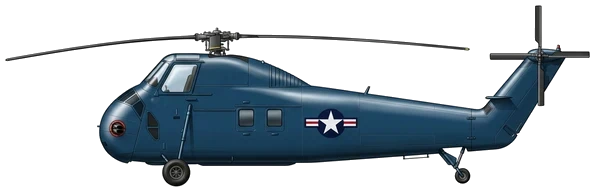
| Crew | 2 |
| Length | 14.4 m (47.2 ft) |
| Wingspan | 17.1 m (56.0 ft) |
| Height | 4.4 m (14.3 ft) |
| Wing area | 228.8 m² (2462.8 sqft) |
| Empty weight | 3,468 kg (7,646 lbs) |
| Max. takeoff weight | 6,033 kg (13,300 lbs) |
| Powerplant | 1 × radial piston engine Wright R-1820-84 Cyclone 1,137 kW each |
| Maximum speed | 196 km/h (122 mph) |
| Operational range | 306 km (190 mi) |
| Service ceiling | 3,658 m (12,001 ft) |
| Climb rate | 7.6 m/s (24.9 ft/s) |
- 19-shot 2.75 in (70 mm) rocket pods (TK-1 gunship kit, with M60C machine guns)
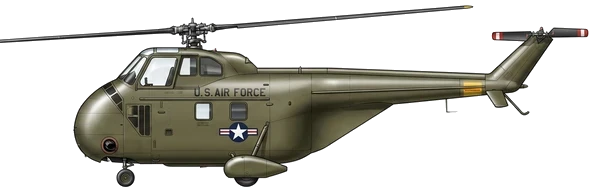
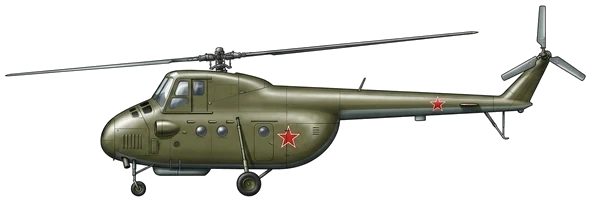
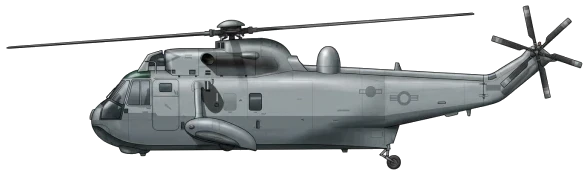
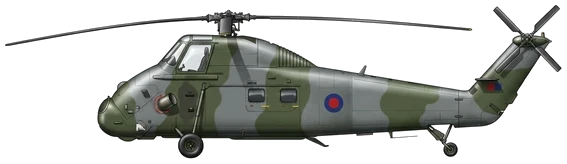
Description
The Sikorsky H-34 Choctaw (company designation S-58) is an American piston-engined utility helicopter. It was originally designed for US Navy anti-submarine warfare and entered service in 1954. The armed forces of 25 countries operated it, and it saw combat in Algeria, Vietnam, the Dominican Republic, Nicaragua and the Six-Day War. It was the last piston-engined helicopter in US Marine Corps service. Including licence production, 2,340 were built between 1953 and 1970.
Development
Sikorsky developed the S-58 as a lengthened, more powerful version of the S-55 (H-19 Chickasaw). The US Navy placed a contract in 1952, and the aircraft first flew on 8 March 1954. The Navy designated it HSS-1 Seabat in the ASW role and HUS-1 Seahorse in the utility role. The Army ordered it in 1955 as the H-34 Choctaw, and the Marine Corps followed in 1957. In 1962 these designations became SH-34, UH-34 and CH-34.
In France, Sud-Aviation assembled US-supplied kits and built a further 166 under licence. In the UK, Westland developed the turboshaft-powered Wessex from 1958. Sikorsky ended production in 1968 after building 1,821.
Design
The S-58 kept the S-55's nose-mounted radial engine, with the drive shaft passing through a cockpit set above the cargo compartment, but adopted tail-dragger landing gear. Military versions use a 1,525 hp Wright R-1820-84 Cyclone, giving a maximum speed of 122 mph (196 km/h) and a range of 190 mi (310 km). Transport versions carry 12 to 16 troops or eight stretchers.
The civil S-58T conversion was certified in April 1971. It uses two Pratt & Whitney Canada PT6T-3 Twin-Pac turboshafts, which raise full-power altitude from 700 ft to 6,000 ft and allow continued flight after an engine failure.
Armament
USMC H-34s were among the first helicopter gunships trialled in Vietnam. They were fitted with the Temporary Kit-1 (TK-1), consisting of two M60C machine guns and two 19-shot 2.75 in rocket pods. These "Stingers" were quickly phased out, but the TK-1 formed the basis of a follow-on armament kit for USMC UH-1Es.
Operational History
In the Algerian War, French Air Force helicopters, including the H-34, flew over 190,000 hours and evacuated more than 20,000 combatants. Their combined use of armed and transport helicopters produced early airmobile tactics.
The US Army did not deploy its H-34s to Vietnam, but Marine Corps crews requested the type by name for its reliability. The RVNAF 219th Squadron used H-34s to insert MACV-SOG teams into Laos.
Israeli S-58s carried troops and evacuated wounded at the Battle of Karameh on 21 March 1968. In 1961 an H-34 had to release the flooded Mercury capsule Liberty Bell 7, which sank. The last USMC flight took place on 3 September 1973. Civil S-58Ts later flew scheduled passenger services in New York.
Variants
- HSS-1 Seabat (SH-34G): US Navy anti-submarine production model, with 215 built.
- HSS-1N Seabat (SH-34J): Night and bad-weather ASW version with improved avionics and autopilot, with 167 built.
- HUS-1 Seahorse (UH-34D): US Marine Corps utility transport, with 462 built.
- H-34A (CH-34A): US Army version powered by the R-1820-84, with 359 built.
- S-58T: Civil conversion with twin PT6T-3 Twin-Pac turboshafts and a nose cowling with twin rectangular intakes.
Frequently Asked Questions
What type of aircraft is the H-34 Choctaw?
What is the maximum speed of the H-34 Choctaw?
What is the range of the H-34 Choctaw?
When did the H-34 Choctaw first fly?
How many H-34 Choctaw have been built?
Which countries operate the H-34 Choctaw?
What is the service ceiling of the H-34 Choctaw?
- SEP 302026 Created Page created: H-34 Choctaw