HH-52 Seaguard
American amphibious search and rescue helicopter, developed in the late 1950s and widely operated by the United States Coast Guard for air-sea rescue missions until the late 1980s. Key figures: top speed 176 km/h, range 763 km, service ceiling 3,400 m, max takeoff weight 3,765 kg, built 175.
| Crew | 3 |
| Length | 13.6 m (44.5 ft) |
| Wingspan | 16 m (52.5 ft) |
| Height | 4.9 m (16.0 ft) |
| Wing area | 204.9 m² (2205.5 sqft) |
| Empty weight | 2,306 kg (5,084 lbs) |
| Max. takeoff weight | 3,765 kg (8,300 lbs) |
| Powerplant | 1 × General Electric T58-GE-8 540 kW each |
| Maximum speed | 176 km/h (109 mph) |
| Operational range | 763 km (474 mi) |
| Service ceiling | 3,400 m (11,155 ft) |
| Climb rate | 5.5 m/s (18.0 ft/s) |

Description
The Sikorsky HH-52 Seaguard, designated S-62 by the manufacturer, is an amphibious helicopter designed and produced by Sikorsky Aircraft. It was the first amphibious rotorcraft produced by Sikorsky, as well as the first turbine-powered and first amphibious helicopter operated by the United States Coast Guard (USCG). Developed as an independent commercial venture in the late 1950s, the design integrated the dynamic components of the Sikorsky S-55 with a new boat-hull fuselage. The prototype conducted its maiden flight in May 1958. Following a company-funded evaluation program at the Naval Air Test Center in Patuxent River, Maryland, the USCG issued an initial production contract on 21 June 1962. Deliveries of the 99 production aircraft began on 9 January 1963 and concluded on 17 January 1969.
Design
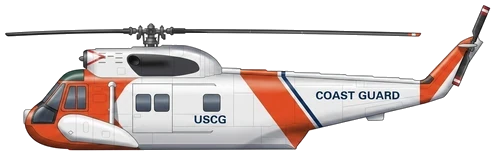
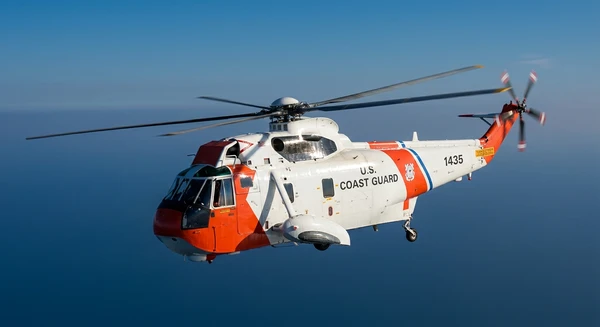
The HH-52 features a watertight, boat-shaped hull fuselage that permits landings on water and snow. Stability on water is provided by two outrigger floats containing retractable landing gear, and the aircraft can deploy an anchor to maintain its position on the water. The helicopter is powered by a single General Electric T58-GE-8B turboshaft engine, derated to 730 shp (540 kW) for the HH-52A. It accommodates a crew of three and can carry up to 12 passengers, six litters, or a 3,127-pound (1,418 kg) payload.
Operational History
The USCG operated the HH-52 primarily for search and rescue (SAR) missions, deploying them from land bases, cutters, and icebreakers. The amphibious design allowed direct water landings to perform rescues without requiring additional flotation gear. During its 26-year service life, the HH-52 fleet rescued over 15,000 people, including 1,200 during the aftermath of Hurricane Betsey in 1965, and assisted during the foundering of the tanker Burmah Agate in 1979. The type was also used for Antarctic logistical support. The HH-52 was retired from USCG service on 12 September 1989, replaced by the Eurocopter HH-65 Dolphin.
Civilian operators utilized the S-62 for passenger service, offshore oil rig transport, and remote logistics. Foreign government and military operators included the Icelandic Coast Guard, the Royal Thai Police, the Philippine Air Force, and Japanese military and coast guard services.
Variants
- S-62: The prototype helicopter, which first flew on 14 May 1958.
- S-62A: The initial production amphibious transport version, powered by a General Electric CT58-110-1 engine and configured for up to 11 passengers.
- S-62B: A single S-62 airframe modified with the main rotor system of the Sikorsky S-58.
- S-62J: The variant produced under license in Japan by Mitsubishi.
- HH-52A Seaguard: The search and rescue variant produced for the United States Coast Guard, with 99 units constructed.
Frequently Asked Questions
What type of aircraft is the HH-52 Seaguard?
What is the maximum speed of the HH-52 Seaguard?
What is the range of the HH-52 Seaguard?
When did the HH-52 Seaguard first fly?
How many HH-52 Seaguard have been built?
Which countries operate the HH-52 Seaguard?
What is the service ceiling of the HH-52 Seaguard?
- JUL 12026 Created Page created: HH-52 Seaguard