H-19 Chickasaw
American multi-purpose piston-engined utility helicopter, developed in the mid-20th century, extensively used for transport, rescue, and medical evacuation by various global military and civil operators. Key figures: top speed 163 km/h, range 720 km, service ceiling 3,200 m, max takeoff weight 3,402 kg, built 1,728.
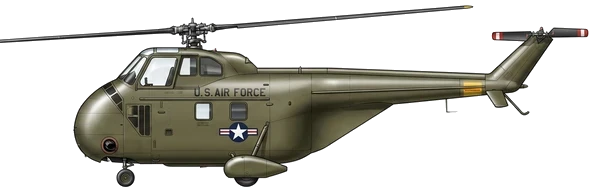
| Crew | 2 |
| Length | 12.9 m (42.2 ft) |
| Wingspan | 16 m (52.5 ft) |
| Height | 4.1 m (13.3 ft) |
| Wing area | 204.9 m² (2205.5 sqft) |
| Empty weight | 2,175 kg (4,795 lbs) |
| Max. takeoff weight | 3,402 kg (7,500 lbs) |
| Powerplant | 1 × Pratt & Whitney R-1340-57 9-cylinder air-cooled radial piston engine 450 kW each |
| Maximum speed | 163 km/h (101 mph) |
| Operational range | 720 km (447 mi) |
| Service ceiling | 3,200 m (10,499 ft) |
Description
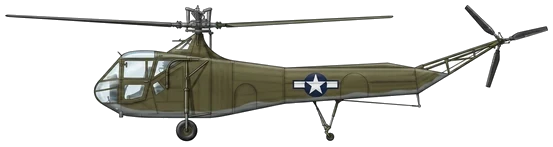
The Sikorsky H-19 Chickasaw, designated S-55 by the manufacturer, was developed as a private venture without government sponsorship. Designed under Edward F. Katzenberger, the first YH-19 prototype flew on 10 November 1949. The United States Air Force accepted the first delivery in April 1950, followed by the United States Navy in August 1950 and the Marine Corps in 1951. Sikorsky produced 1,281 units in the United States, while licensees including Westland Aircraft in the United Kingdom, SNCASE in France, and Mitsubishi in Japan manufactured an additional 447 aircraft.
Design
The H-19 utilized a nose-mounted radial engine located below the cockpit and forward of the main cabin. This configuration placed the payload area near the aircraft's center of gravity, maintaining longitudinal stability under various loads without the internal ballast required by earlier Sikorsky designs. The engine was accessible through dual clamshell doors and could be replaced in two hours. The aircraft featured a single fully articulated main rotor with offset flapping hinges and hydraulic servos to reduce control forces. Early models used the 600 hp Pratt & Whitney R-1340-57 engine, while later versions such as the H-19B and HO4S-3 utilized the 700 hp Wright R-1300-3. Equipment included a starboard-mounted hoist with capacities ranging from 400 to 600 pounds. Starting in 1956, production models featured a tailboom inclined three degrees downward for increased rotor clearance during landings.
Armament
While primarily a transport, the French Air Force experimented with armed H-19s in 1956. Test configurations included a 20mm cannon, two rocket launchers, and various machine guns, though these loads proved excessive for the aircraft's power-to-weight ratio.
Operational History
During the Korean War, the H-19 served as the U.S. Army's first transport helicopter, performing medical evacuation and cargo support. Marine squadron HMR-161 conducted large-scale lifts, including 1.6 million pounds of cargo during Operation Haylift II in 1953. USAF H-19s performed air-sea rescue, including the April 1953 recovery of F-86 ace Joseph C. McConnell. France deployed the type in Indochina and Algeria for troop transport and casualty evacuation. Pakistan utilized S-55s for search and rescue during the 1965 Indo-Pakistani War. In 1953, Sabena used the S-55 to launch the first commercial helicopter service in Europe. The U.S. military retired its final H-19 variants in February 1969.
Variants
- H-19B: USAF version powered by a 700 hp Wright R-1300-3 engine.
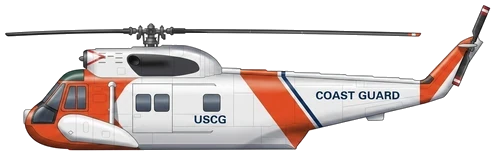
- HO4S-3: Re-engined U.S. Navy and Coast Guard air-sea rescue version using the R-1300-3 powerplant.
- HRS-1: U.S. Marine Corps troop transport configured to carry eight personnel and powered by an R-1340-57 engine.
- S-55T: Civil conversion featuring a 650 hp Garrett TPE-331 turboshaft engine.
- S-55/Mi-24: Orlando Helicopter Airways conversion for the U.S. Army using a five-bladed rotor to simulate the Soviet Mil Mi-24.
Frequently Asked Questions
What type of aircraft is the H-19 Chickasaw?
What is the maximum speed of the H-19 Chickasaw?
What is the range of the H-19 Chickasaw?
When did the H-19 Chickasaw first fly?
How many H-19 Chickasaw have been built?
Which countries operate the H-19 Chickasaw?
What is the service ceiling of the H-19 Chickasaw?
- MAY 102026 Created Page created: H-19 Chickasaw