Hürkus
Turkish trainer aircraft, renowned for 21st-century design, and operational in armed forces pilot training and light attack missions. Key figures: top speed 574 km/h, range 1,478 km, service ceiling 10,577 m, built 18. In service with 3 air forces as of 2026 — Turkey (15), Chad (3), Niger (2).
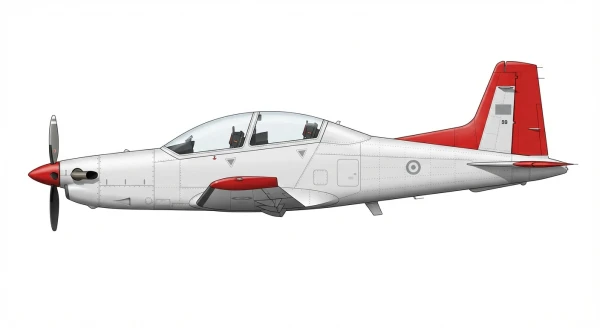
| Length | 11.2 m (36.6 ft) |
| Wingspan | 10.0 m (32.7 ft) |
| Height | 3.7 m (12.1 ft) |
| Empty weight | 2,976 kg (6,561 lbs) |
| Powerplant | 1 × turboprop Pratt & Whitney Canada PT6A-68T 1,193 kW each |
| Ejection seat | Martin-Baker Mk T-16N |
| Maximum speed | 574 km/h (357 mph) |
| Operational range | 1,478 km (918 mi) |
| Service ceiling | 10,577 m (34,701 ft) |
| Climb rate | 22.0 m/s (72.2 ft/s) |
| Takeoff distance | 489 m (1,604 ft) |


- Anti-Tank Rocketsan UMTAS
- Training Douglas BDU-33
- Low-Drag Mk 81
- Low-Drag Mk 82
- Training Mk 106
- Guided TUbitak SAGE HGK-3
- Guided TUbitak SAGE KGK-82
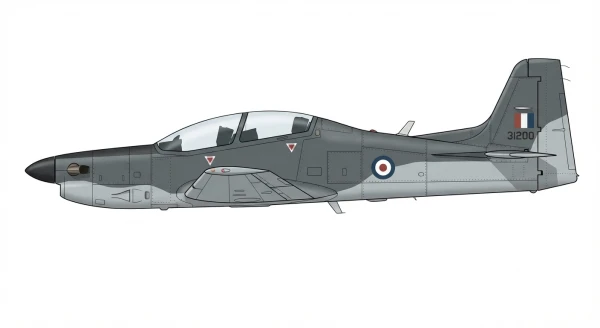
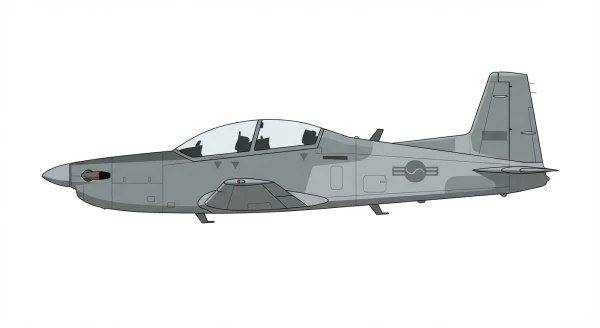
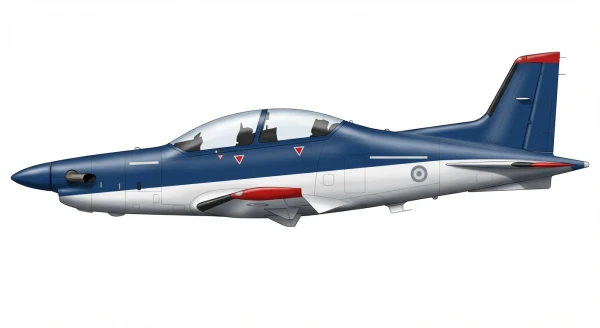
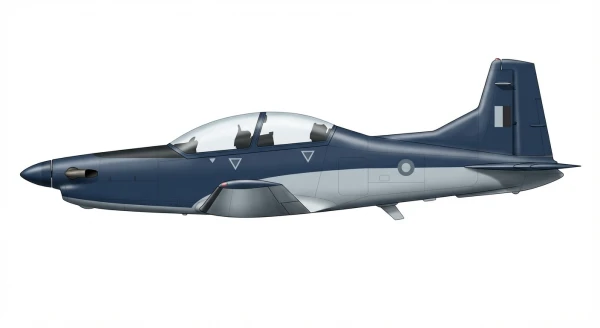
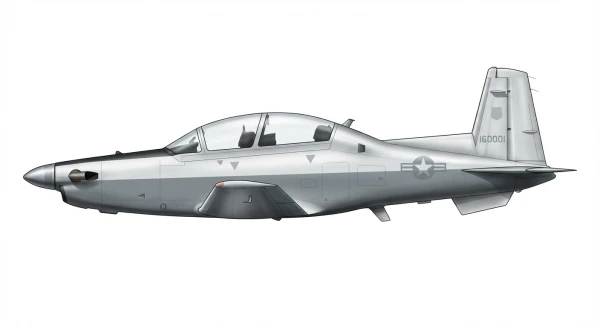

Description
The TAI Hürkuş ("Free Bird") is a tandem two-seat, low-wing, single-engine turboprop trainer and light attack aircraft produced by Turkish Aerospace Industries for the Turkish Armed Forces. It is named after Vecihi Hürkuş, a World War I and Turkish Independence War pilot and the first Turkish aircraft manufacturer. The type first flew in 2013 and is in service with Niger and Chad, with further deliveries contracted to Libya.
Development
The programme began with an agreement signed between the Turkish Undersecretariat for Defense Industries (SSB) and TAI in March 2006, under which TAI would design, manufacture and certify the aircraft to European Aviation Safety Agency CS-23 standards. By June 2012 the programme had consumed one million man-hours with 140 engineers; about a quarter of the Turkish engineers involved were women, as were two of the three project heads. The first prototype had been forecast to fly in late 2009 with deliveries from 2011, but the aircraft was rolled out at TAI's Kazan facility on 27 June 2012 and first flew on 29 August 2013, a 33-minute sortie from Ankara Akıncı Air Base. In 2016 the Hürkuş-A received a CS-23 Validation Type Certificate from EASA and a Type Certificate from the Turkish DGCA. In February 2017 the Turkish MoD released images of the Hürkuş-C prototype carrying Roketsan UMTAS missiles, Cirit rockets, an EO/IR pod and external tanks; on 7 April 2017 a Hürkuş-C fired an L-UMTAS against a ground target. Fifteen Hürkuş-1B and 1C aircraft were delivered to the Turkish Armed Forces and later redirected for export. The lighter Hürkuş-2 completed its first flight at 6,500 ft and 140 kt, lasting 20 minutes; 15 are due in 2025, 20 in 2026 and 20 in 2027.
Design
The Hürkuş is powered by a single Pratt & Whitney Canada PT6A-68T turboprop of 1,200 kW (1,600 shp) driving a five-blade Hartzell HC-B5MA-3 propeller. Maximum speed is 574 km/h, range 1,478 km at 15,000 ft, endurance 4.25 hours, service ceiling 10,577 m and g limits +7/-3.5. Equipment includes cabin pressurisation at 4.16 psid, Martin-Baker Mk T-16 N zero-zero ejection seats, an onboard oxygen generation system, a vapour-cycle environmental control system supplied by Microtecnica of Turin, an anti-g system, high shock-absorbing landing gear and HOTAS controls. The rear cockpit has a 50-degree down-view angle. Avionics comprise an air data computer, attitude and heading reference system, GPS, Mode S transponder, radar altimeter and emergency locator transmitter. Design service life is 35 years.
Armament
Maximum weapons load is 1,500 kg (3,300 lb). Options include 12.7 mm gun pods and 20 mm cannon pods, Roketsan Cirit laser-guided and 2.75-inch unguided rockets, Roketsan UMTAS anti-tank missiles, Mk-81 with LGK-81 guidance, Mk-82, TÜBİTAK SAGE HGK-3 and KGK-82 kits, TOGAN and BOZOK munitions, MAM smart micro munitions, and BDU-33 and Mk-106 training ordnance.
Variants
- Hürkuş-1A: Basic version certified to EASA CS-23 requirements and intended for the civil market.
- Hürkuş-1B: Military version with integrated avionics including HUD, MFDs and mission computer, with a cockpit layout similar to the F-16.
- Hürkuş-1C: Armed close air support variant with a 1,500 kg weapons load, FLIR sensor and unprepared-runway capability; unmanned and Coast Guard maritime patrol derivatives were also proposed.
- Hürkuş-2: Officially the New Generation Hürkuş-B, 450–500 kg lighter through increased composite use, with redesigned nose, spinner, intake, nose gear, canopy, winglets and tail, plus indigenous cooling, hydraulic, radio and IFF systems.
Frequently Asked Questions
What type of aircraft is the Hürkus?
What is the maximum speed of the Hürkus?
What is the range of the Hürkus?
When did the Hürkus first fly?
How many Hürkus have been built?
Which countries operate the Hürkus?
What is the service ceiling of the Hürkus?
- AUG 302026 Updated Description updated
- APR 82026 Updated Empty weight added
- APR 72026 Updated Sources and cross-references refreshed
- FEB 72026 Updated Range added