I-22 Iryda
Polish twin-engine jet trainer built by PZL Mielec as the TS-11 Iskra's successor, flown by the Polish Air Force from 1992 to 1996 before the programme was abandoned. Key figures: top speed 940 km/h, range 1,200 km, service ceiling 13,700 m, max takeoff weight 7,500 kg, built 17.
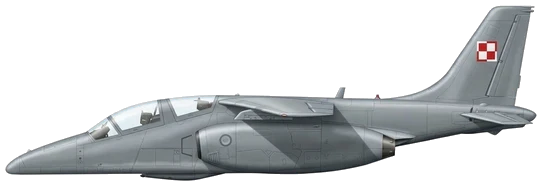
| Crew | 2 (student, instructor) |
| Length | 13.2 m (43.4 ft) |
| Wingspan | 9.6 m (31.5 ft) |
| Height | 4.3 m (14.1 ft) |
| Wing area | 19.9 m² (214.4 sqft) |
| Empty weight | 4,600 kg (10,141 lbs) |
| Max. takeoff weight | 7,500 kg (16,535 lbs) |
| Powerplant | 2 × turbojets PZL K-15 1,499 kgf each |
| Maximum speed | 940 km/h (584 mph) |
| Operational range | 1,200 km (746 mi) |
| Service ceiling | 13,700 m (44,948 ft) |
| Climb rate | 40.6 m/s (133.2 ft/s) |
- Air-to-Air Short-Range R-60
- Unguided Bomb FAB-250
- Unguided Bomb FAB-500
- Rocket Pod S-5 57 mm
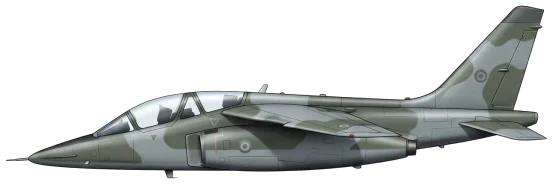
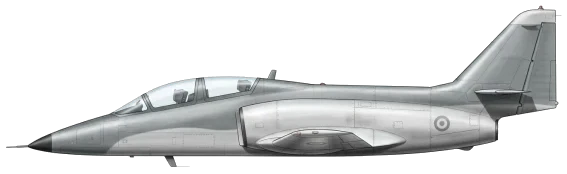
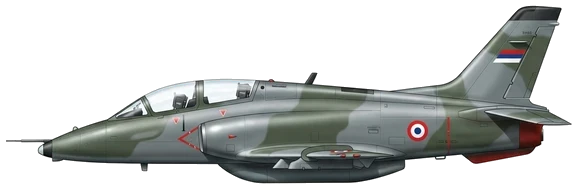
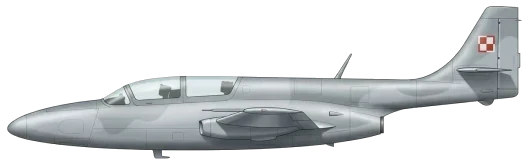
Description
The PZL I-22 Iryda, also designated PZL M93 and PZL M96, is a twin-engine, two-seat military jet trainer developed and produced by PZL Mielec in Poland as a successor to the TS-11 Iskra. It first flew on 3 March 1985, and the Polish Air Force operated it between 1992 and 1996. The programme is known for its protracted development, disputes over cost and performance, a fatal accident in 1996, and its cancellation in 1998.
Development
The Warsaw Institute of Aeronautics (Instytut Lotnictwa) began the programme in 1976 to replace the Polish Air Force's TS-11 Iskra fleet. PZL Mielec, then WSK-Mielec, designed the aircraft. The intended PZL K-15 turbojet was not ready, so early aircraft flew with two underpowered PZL-5 turbojets as an interim powerplant. Five PZL-5-powered aircraft were handed over before the first two K-15-powered M-93Ks were delivered in May 1995.
On 1 December 1995 the government announced it would buy no further aircraft on cost grounds. Prime Minister Józef Oleksy reportedly overruled this decision, and in January 1996 funding was redirected to the programme. A fatal crash on 24 January 1996, reportedly caused by a trim-related issue, led to the fleet being grounded and orders frozen in February. In March 1996 the Institute abandoned the D-18A engine intended for combat versions. The programme resumed in April 1996 with an order for six new-build aircraft and upgrades to existing aircraft by 1998, and the upgraded aircraft first flew in June 1997.
In the second half of 1997 PZL Mielec sued the Defence Ministry over the contract, and the prototype was grounded during the legal action. Procurement was formally cancelled in 1998. PZL Mielec resumed flights on 22 July 2002 under the name Iskra 2, but no orders followed.
Design
The M-93K is powered by two PZL K-15 turbojets of 14.7 kN thrust each, which almost doubled payload capacity compared with the PZL-5. Rolls-Royce at one stage worked with PZL to certify the Viper engine for export aircraft. The crew sit on Martin-Baker Mk.10 ejection seats. The M-93K is 13.22 m long, with a 9.6 m wingspan and a maximum takeoff weight of 7,500 kg. It reaches 940 km/h (Mach 0.82) at 5,000 m and has a range of 1,200 km and a service ceiling of 13,700 m.
The upgrade PZL Mielec proposed in 1996 comprised leading-edge root extensions, trailing-edge flaps and a SAGEM-sourced avionics suite. A colonel of the Dęblin pilot-training school criticised the aircraft's longitudinally "heavy" controls, high approach speed and avionics.
Armament
The M-93K carries one 23 mm GSh-23L cannon with 200 rounds. Four underwing hardpoints carry up to 2,000 kg, including 57 mm S-5 rockets, R-60 air-to-air missiles, and FAB-250 and FAB-500 bombs.
Operational History
The Polish Air Force operated eight Irydas from 1992 to 1996. At the time it sought around 40 jet trainers, and it planned to receive five M-93Ks by the end of 1995, with six to eight more discussed. Flight International reported that air force officials at one point claimed the Iryda had the highest serviceability rate in the inventory. After government support was withdrawn in the late 1990s, the delivered aircraft were stored. No export orders were received.
Variants
- PZL-5-powered aircraft: Prototypes and early aircraft fitted with interim PZL-5 turbojets.
- M-93K: Production standard with PZL K-15 engines, first delivered in May 1995.
- Upgraded M-93K: Fitted with aerodynamic improvements and an upgraded avionics package, and first flown in June 1997.
- Maritime reconnaissance/strike version: A proposed variant intended to replace the Polish Navy's MiG-21bis fighters.
- Iskra 2: The 2002 relaunch with Thales avionics and underwing hardpoints for weapons, fuel tanks and equipment.
Frequently Asked Questions
What type of aircraft is the I-22 Iryda?
What is the maximum speed of the I-22 Iryda?
What is the range of the I-22 Iryda?
When did the I-22 Iryda first fly?
How many I-22 Iryda have been built?
Which countries operate the I-22 Iryda?
What is the service ceiling of the I-22 Iryda?
- OCT 12026 Created Page created: I-22 Iryda