C-101 Aviojet
Spanish jet trainer and light attack aircraft, deployed in the late 20th century, notably utilized by the Chilean and Spanish Air Forces. Key figures: top speed 770 km/h, range 519 km, service ceiling 12,500 m, max takeoff weight 6,300 kg, unit price $8M, built 166.
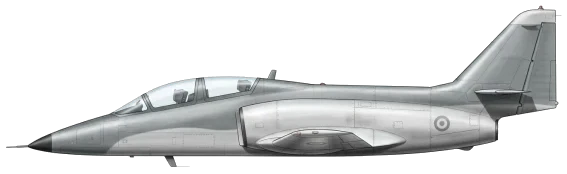
| Crew | 2 |
| Length | 12.5 m (41.0 ft) |
| Wingspan | 10.6 m (34.8 ft) |
| Height | 4.3 m (13.9 ft) |
| Wing area | 20 m² (215.3 sqft) |
| Empty weight | 2,800 kg (6,173 lbs) |
| Max. takeoff weight | 6,300 kg (13,889 lbs) |
| Powerplant | 1 × turbofan Honeywell TFE731-2 1,588 kgf each |
| Ejection seat | Martin-Baker Mk 10 |
| Maximum speed | 770 km/h (478 mph) |
| Operational range | 519 km (322 mi) |
| Service ceiling | 12,500 m (41,011 ft) |
| Climb rate | 32.5 m/s (106.6 ft/s) |
| Takeoff distance | 560 m (1,837 ft) |
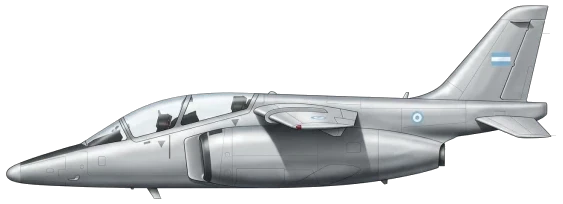
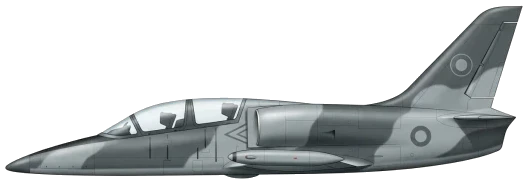
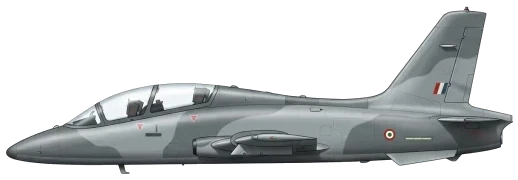
Description
The CASA C-101 Aviojet is a single-engine jet advanced trainer and light attack aircraft designed and built by Construcciones Aeronáuticas SA (CASA) of Spain. Developed to replace the Spanish Air Force's Hispano HA-200/HA-220 Saeta, it first flew in June 1977 and entered service on 17 March 1980. It served as the Spanish Air Force's primary jet trainer and as the mount of the Patrulla Águila aerobatic team for four decades, and was exported to Chile, Honduras and Jordan.
Development
The Spanish Air Force issued its trainer requirement in 1975, calling for a limited attack capability alongside the training role and self-deployment range from the mainland to the Canary Islands. CASA, which had absorbed Hispano in 1972, received a development contract in October 1975 covering two static airframes and four flying prototypes at a cost of 1,297 million pesetas ($22 million). Foreign technical assistance was contracted: MBB of Germany designed the rear fuselage and tail, while Northrop handled the wings and engine inlets. The first prototype flew on 27 June 1977, though the test programme covering vibration, flutter and spin trials began only on 17 April 1978; the aircraft appeared at Farnborough in July 1978. The Spanish Air Force ordered 88 aircraft as the C-101EB-01, designated E.25 Mirlo in service. Chilean airframes were assembled locally by ENAER.
Design
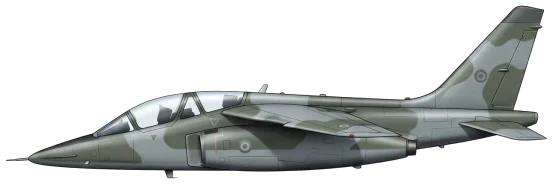
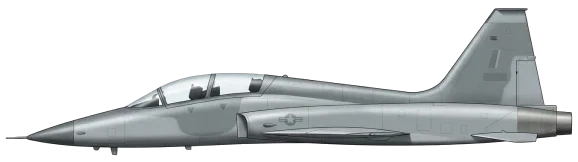
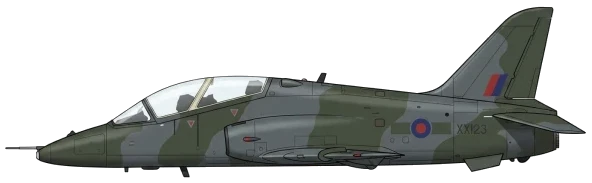
The C-101 is a low-wing monoplane with unswept wings, aerodynamically simpler than contemporaries such as the BAE Hawk and Alpha Jet. The two crew sit in tandem under a spacious canopy, with the rear instructor's seat staggered upward for forward visibility. Construction is modular to ease manufacture and maintenance, and the fuselage retains volume for additional systems supporting ground attack, armed escort, photographic reconnaissance and ECM roles. The powerplant is a Honeywell TFE731-5-1J turbofan of 19.13 kN, rising to 20.91 kN at Military Power Reserve, a commercial engine adapted for military use. Successive variants introduced uprated engines and increased fuel capacity. Spanish aircraft were upgraded between 1990 and 1992, mainly in navigation and armament systems.
Armament
A weapons bay beneath the rear cockpit accommodates a 30 mm DEFA cannon or two 12.7 mm M3 machine gun pods, and can alternatively carry reconnaissance payloads. Six underwing pylons carry up to 2,220 kg of stores, including 125 kg and 250 kg bombs, rocket launchers, Rafael Shafrir air-to-air missiles and, on the C-101DD, the AGM-65 Maverick. The initial EB-01 trainer had only limited weapons capability, expanded on later production aircraft.
Operational History
Spanish service began in March 1980; regular training operations ended in 2022 and the type was retired in June 2025 after a final display at the Aire25 festival at San Javier, having flown 285,000 training hours. Honduras purchased four C-101BB-02s and Chile 12 BB-02s (T-36 Halcón) plus 23 C-101CC-02s (A-36 Halcón), all retired in 2022. Jordan operated 16 C-101CC-04s, withdrawn in 2018, with at least one sold to Chile for ground instruction. Replacement of the Spanish fleet was decided in 2020 with the Pilatus PC-21 and the Airbus Future Jet Trainer; after the AFJT's cancellation, Spain moved to order up to 30 TAI Hürjets.
Variants
- C-101EB-01: Dedicated trainer for the Spanish Air Force, 88 built, designated E.25 Mirlo.
- C-101BB-02: Trainer/attack variant with uprated engine, exported to Honduras (4) and Chile (12, as T-36 Halcón).
- C-101CC-02: Dedicated attack version first flown in 1983 with further engine upgrade and increased fuel, 23 for Chile as A-36 Halcón.
- C-101CC-04: Export attack variant, 16 delivered to the Royal Jordanian Air Force.
- C-101DD: Demonstrated in 1985 with HUD, HOTAS cockpit, AN/ALR-66 radar warning receiver and chaff/flare dispensers; no orders received.
Frequently Asked Questions
What type of aircraft is the C-101 Aviojet?
What is the maximum speed of the C-101 Aviojet?
What is the range of the C-101 Aviojet?
When did the C-101 Aviojet first fly?
How many C-101 Aviojet have been built?
Which countries operate the C-101 Aviojet?
How much does a C-101 Aviojet cost?
What is the service ceiling of the C-101 Aviojet?
- AUG 302026 Updated Description updated
- AUG 52026 Updated Powerplant updated in a site-wide editorial pass
- JUL 232026 Updated Sources and cross-references refreshed
- APR 72026 Updated Sources and cross-references refreshed
- JAN 122026 Updated Range updated in a site-wide editorial pass