Tu-144 Charger
Soviet commercial supersonic airliner, operated from 1975 to 1983, used for passenger transport, cargo delivery, and supersonic research programs. Key figures: top speed 2,500 km/h, range 6,500 km, service ceiling 20,000 m, max takeoff weight 207,000 kg, built 16.
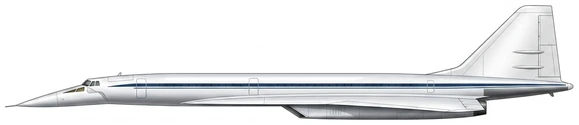
| Crew | 3 |
| Length | 65.7 m (215.6 ft) |
| Wingspan | 28.8 m (94.5 ft) |
| Height | 12.6 m (41.2 ft) |
| Wing area | 506.4 m² (5450.3 sqft) |
| Empty weight | 99,200 kg (218,698 lbs) |
| Max. takeoff weight | 207,000 kg (456,356 lbs) |
| Powerplant | 4 × turbojets Kolesov RD-36-51 240 kN each |
| Maximum speed | 2500 km/h (Mach 2.4) |
| Operational range | 6,500 km (4,039 mi) |
| Service ceiling | 20,000 m (65,617 ft) |
| Climb rate | 50.0 m/s (164.0 ft/s) |
Description
The Tupolev Tu-144 (NATO reporting name: Charger) was a Soviet supersonic commercial passenger airliner designed by the Tupolev Design Bureau and manufactured by the Voronezh Aircraft Production Association. It was the world's first commercial supersonic transport aircraft, entering service with Aeroflot in December 1975 for mail and cargo operations and November 1977 for passenger service. It is known for being the first commercial transport aircraft to fly supersonic and to exceed Mach 2.
Development
Soviet air ministry development of the Tu-144 officially began on 26 July 1963 following approval by the Council of Ministers. The prototype conducted its maiden flight from Zhukovsky Airport on 31 December 1968. The aircraft first reached supersonic speed on 5 June 1969 and exceeded Mach 2 on 26 May 1970. Aerodynamic testing for the redesigned production wing was supported by the MiG-21I testbed aircraft. A total of 16 airworthy aircraft were produced, consisting of one prototype, one pre-production aircraft, nine Tu-144S production models, and five Tu-144D models.
Design
Production Tu-144s featured a double delta wing with spanwise and chordwise camber, alongside retractable nose canards designed to increase lift at low speeds. Construction primary materials were aluminium alloys, supplemented by 15% titanium and 23% non-metallic materials by weight. The Tu-144S variant was powered by four Kuznetsov NK-144A turbofans, while the Tu-144D utilized four Kolesov RD-36-51 turbojets. Lacking reverse thrust capabilities, the aircraft used a braking parachute during landing.
Operational History
Aeroflot inaugurated commercial operations with the Tu-144S on 26 December 1975, transporting mail and freight between Moscow and Alma-Ata, before initiating passenger flights on 1 November 1977. Commercial passenger services ended on 1 June 1978 after a Tu-144D crashed during a test flight on 23 May 1978. In total, the type completed 102 commercial flights, including 55 passenger flights, before commercial operations ceased entirely in 1983. Tu-144D aircraft were later used to train pilots for the Soviet Buran space shuttle, and one modified aircraft operated with NASA for supersonic research between June 1996 and April 1999, making the type's final flight on 26 June 1999.
Variants
-
Tu-144: The sole prototype aircraft (izdeliye 044) built for initial flight testing.
-
Tu-144S: Production variant fitted with Kuznetsov NK-144A engines and a redesigned undercarriage.
-
Tu-144D: Long-range production variant equipped with non-afterburning Kolesov RD-36-51 turbojets.
-
Tu-144DA: Projected variant study featuring increased wing area, higher fuel capacity, and upgraded RD-36-61 engines.
-
Tu-144LL: Single converted Tu-144D used as a supersonic flying laboratory equipped with Kuznetsov NK-321 afterburning engines.
Frequently Asked Questions
What type of aircraft is the Tu-144 Charger?
What is the maximum speed of the Tu-144 Charger?
What is the range of the Tu-144 Charger?
When did the Tu-144 Charger first fly?
How many Tu-144 Charger have been built?
Which countries operate the Tu-144 Charger?
What is the service ceiling of the Tu-144 Charger?
- AUG 62026 Created Page created: Tu-144 Charger