J-12
Chinese lightweight supersonic fighter prototype, developed in the late 1960s for short-runway interception operations, but never introduced into active military service. Key figures: top speed 1,472 km/h, range 1,167 km, service ceiling 16,870 m, max takeoff weight 5,295 kg, built 6.
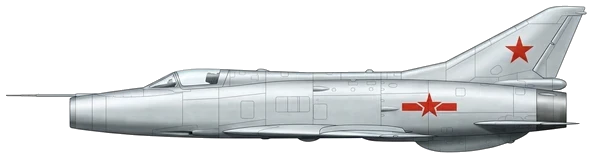
| Crew | 1 |
| Length | 10.6 m (34.9 ft) |
| Wingspan | 7.2 m (23.6 ft) |
| Height | 3.7 m (12.2 ft) |
| Wing area | 16.0 m² (172.0 sqft) |
| Empty weight | 3,172 kg (6,993 lbs) |
| Max. takeoff weight | 5,295 kg (11,673 lbs) |
| Powerplant | 1 × turbojet Wopen WP-6B 2,500 kgf each |
| Maximum speed | 1472 km/h (Mach 1.4) |
| Operational range | 1,167 km (725 mi) |
| Service ceiling | 16,870 m (55,348 ft) |
| Climb rate | 180.0 m/s (590.6 ft/s) |
| Takeoff distance | 450 m (1,476 ft) |
- Air-to-Air PL-2
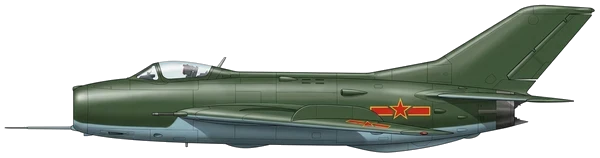
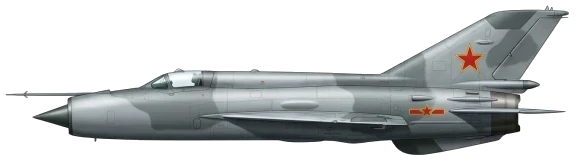
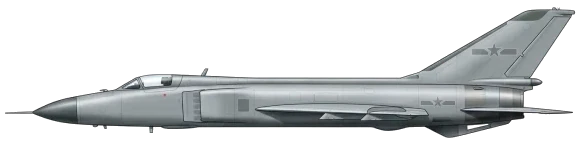
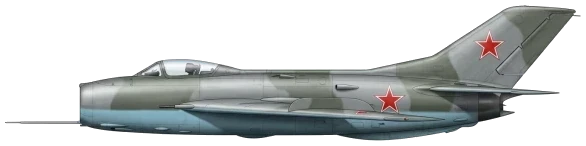
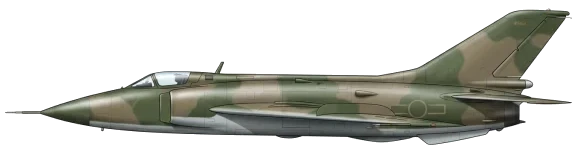
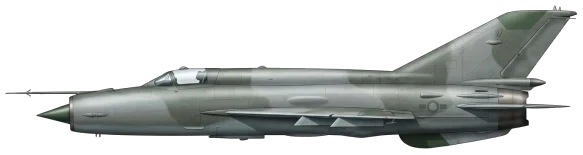
Description
The Nanchang J-12 was a single-seat lightweight supersonic fighter built by the Nanchang Aircraft Manufacturing Company for the People's Republic of China. Intended as an inexpensive short takeoff and landing (STOL) interceptor for the People's Liberation Army Air Force, the aircraft never entered service. Weighing 3,172 kg empty, it is known as one of the lightest jet fighters ever built and was designed around an aerial guerrilla warfare concept before the program was ultimately abandoned.
Development
In 1969, the PLAAF issued a requirement for a lightweight STOL fighter to replace the MiG-19. The program grew from observations during the Vietnam War of fighters conducting ambush sorties from concealed forward strips, leading Chinese leadership to request an aircraft suited for large-scale aerial guerrilla warfare. The Nanchang design bureau, led by chief designer Lu Xiaopeng, froze the configuration in August 1969. The first flight occurred on 26 December 1970, and the aircraft was demonstrated to political leaders in Beijing on 10 September 1973. Testing continued until January 1977, accumulating 135 flights and 61 hours of flight time. Sources disagree on how many airframes were completed: Russian accounts describe a batch of six fighters laid down for troop trials, while Western references give a range of five to eight, plus one static test article. The program was canceled in 1977 after the PLAAF determined the guerrilla fighter concept was untenable against contemporary multirole strike aircraft, and because the Chengdu J-7, derived from the Soviet MiG-21F, offered clearly superior performance.
Design
The J-12 featured a tubular fuselage, swept control surfaces, and low-aspect-ratio swept wings equipped with two-section flaps. Construction utilized titanium alloys, chemically milled panels, and honeycomb multi-layer structures to achieve its low empty weight. The aircraft was powered by a single Wopen WP-6B non-afterburning turbojet producing 2,500 kgf (5,512 lbf) of thrust, which drew air through a fixed nose intake. Auxiliary intakes were located on the upper forward fuselage to supply the engine during takeoff and landing, preventing foreign object damage from unprepared strips. The J-12 lacked radar, relying entirely on an optical sight and a nose-mounted radio rangefinder for target acquisition. The aerodynamic configuration allowed for a takeoff run of 450 meters and a maximum speed of 1,472 km/h at 11,000 meters.
Armament
The primary built-in armament consisted of two large-caliber cannons mounted in the wing roots, specifically one 23 mm and one 30 mm weapon. The aircraft featured three external hardpoints, with one located under each wing and a third on the fuselage centerline. These stations could carry infrared-homing air-to-air missiles, unguided rocket pods, or light bombs.
Operational History
The J-12 never entered military service and secured no export customers. Following the cancellation of the testing program in 1977, the completed prototypes were retired without generating an operational combat record. Surviving airframes are preserved as static displays, including one located outside the Chinese Aviation Museum in Beijing.
Variants
- J-12: The initial version of the light fighter featuring a pitot bifurcated air intake and a non-afterburning WP-6B engine.
- J-12I: An improved version, also known as J-12A, featuring a 4,050 kgf (8,929 lbf) Wopen WP-6Z afterburning turbojet, a lighter area-ruled fuselage, simplified control surfaces, and provisions for two PL-2 air-to-air missiles.
Frequently Asked Questions
What type of aircraft is the J-12?
What is the maximum speed of the J-12?
What is the range of the J-12?
When did the J-12 first fly?
How many J-12 have been built?
What is the service ceiling of the J-12?
- AUG 132026 Created J-12 page created: specs, description and origin for the abandoned Nanchang lightweight fighter prototype