J-6 Farmer
Chinese jet fighter, developed in the mid-20th century, extensively deployed in regional conflicts and air defense roles. Key figures: top speed 1,540 km/h, range 2,200 km, service ceiling 17,900 m, max takeoff weight 8,832 kg, built 4,500.
| Crew | 1 |
| Length | 14.6 m (48.0 ft) |
| Wingspan | 9 m (29.5 ft) |
| Height | 3.9 m (12.7 ft) |
| Wing area | 25.2 m² (270.8 sqft) |
| Empty weight | 5,172 kg (11,402 lbs) |
| Max. takeoff weight | 8,832 kg (19,471 lbs) |
| Powerplant | 2 × Wopen WP-6A 32 kN each |
| Maximum speed | 1540 km/h (Mach 1.5) |
| Operational range | 2,200 km (1,367 mi) |
| Endurance | 1 hours |
| Service ceiling | 17,900 m (58,727 ft) |
| Climb rate | 180.0 m/s (590.6 ft/s) |
- Unguided Bomb Unguided bombs
- Rocket Pod 55 mm rocket pods
- Rocket Pod 57 mm S-5 rockets
- Rocket Pod 68mm SNEB rockets
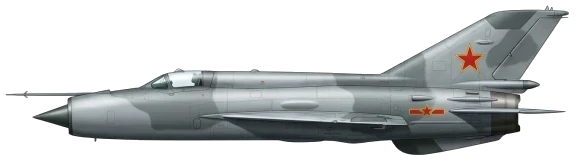
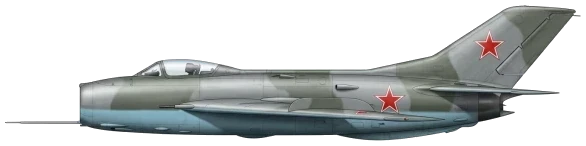
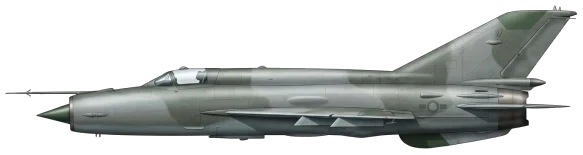
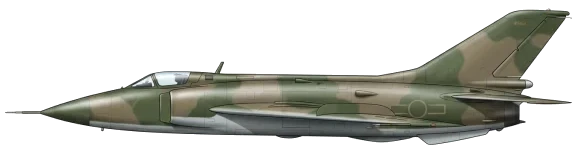
Description
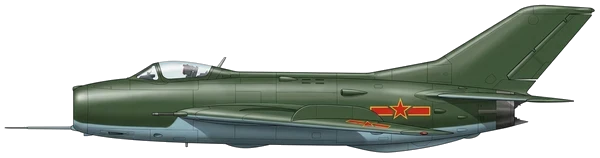
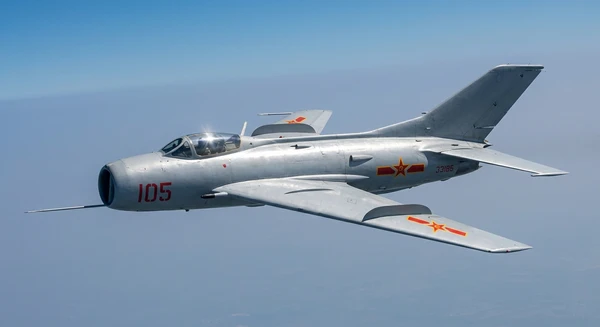
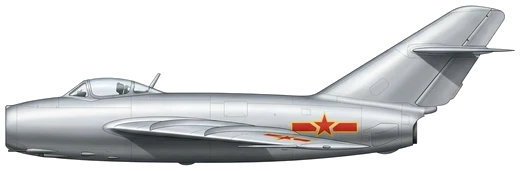
The Shenyang J-6 (export designation F-6, NATO reporting name Farmer) is the Chinese version of the Soviet MiG-19 fighter. Produced by China between 1958 and 1981, the aircraft has an operational lifespan of 100 flight hours before overhaul, though Pakistani maintenance extended this to 130 hours. China converted several J-6 airframes into unmanned aircraft starting in 2013. The J-6 airframe also formed the basis of the Q-5 ground attack aircraft.
Design
The J-6 is powered by two Liming Wopen-6A afterburning turbojet engines, providing a maximum speed of 1,540 km/h (Mach 1.45) and a service ceiling of 17,900 meters. The aircraft has an empty weight of 5,172 to 5,447 kg and a maximum takeoff weight of 8,832 kg with drop tanks and rocket pods. Internal armament consists of three 30 mm NR-30 cannons. Four wing pylons can carry up to 250 kg of ordnance each, with a maximum load of 500 kg. Munitions include unguided bombs, rocket pods, or PL-2 and PL-5 air-to-air missiles. Pakistani F-6s were modified to carry AIM-9 missiles and French 68mm SNEB rockets.
Operational History
In 1965, a Chinese J-6 shot down a US F-104 Starfighter over Hainan Island. During the Vietnam War, the Vietnam People's Air Force used J-6s during Operations Linebacker and Linebacker 2, claiming 13 aerial victories—including seven F-4 Phantoms confirmed by US sources—against five combat losses. Pakistan operated 260 F-6s. In the 1971 Indo-Pakistani War, Pakistani F-6s flew 945 sorties, claiming eight Indian aircraft destroyed—including Su-7s and Hawker Hunters—against three combat losses. Pakistan retired its single-seat F-6s in 2002. During the Iran-Iraq War, both nations deployed J-6s primarily for ground-attack missions; China delivered 100 aircraft to Iran, while Iraq operated Egyptian-transferred units. J-6s also saw action with Albania, Kampuchea, Somalia, Sudan, Tanzania, and Zambia.
Variants
- Shenyang J-6: The standard single-seat day fighter variant, equivalent to the Soviet MiG-19S.
- Shenyang J-6A: An all-weather interceptor variant equipped with a radar and two 30mm cannons.
- J-6B: An interceptor variant armed with two PL-1 beam-riding air-to-air missiles.
- J-6C: A day fighter variant equipped with three 30mm cannons and a braking parachute at the rudder base.
- Shenyang/Tianjin JJ-6: A two-seat trainer variant featuring an 84 cm fuselage stretch and one 30 mm cannon.
Frequently Asked Questions
What type of aircraft is the J-6 Farmer?
What is the maximum speed of the J-6 Farmer?
What is the range of the J-6 Farmer?
When did the J-6 Farmer first fly?
How many J-6 Farmer have been built?
Which countries operate the J-6 Farmer?
What is the service ceiling of the J-6 Farmer?
- AUG 142026 Updated Air force inventory entries linked to this aircraft page
- AUG 132026 Updated First flight and service entry corrected to the accepted J-6 airframe
- AUG 122026 Updated Range corrected to the ferry range with drop tanks
- AUG 52026 Updated Thrust updated
- JUN 302026 Created Page created: J-6 Farmer; then built added; manufacturer updated