M-50 Bounder
Soviet prototype four-jet engine supersonic strategic bomber, developed in the late 1950s, which never entered operational service. Key figures: top speed 1,950 km/h, range 7,400 km, service ceiling 16,500 m, max takeoff weight 200,000 kg, built 1.

| Crew | 2 |
| Length | 57.5 m (188.6 ft) |
| Wingspan | 25.1 m (82.3 ft) |
| Height | 8.3 m (27.1 ft) |
| Wing area | 290.6 m² (3128.0 sqft) |
| Empty weight | 85,000 kg (187,393 lbs) |
| Max. takeoff weight | 200,000 kg (440,924 lbs) |
| Powerplant | 4 × turbojets Dobrynin VD-7F 137 kN each |
| Maximum speed | 1950 km/h (Mach 1.8) |
| Operational range | 7,400 km (4,598 mi) |
| Service ceiling | 16,500 m (54,134 ft) |
- Cruise M-59
- Cruise M-61

Description
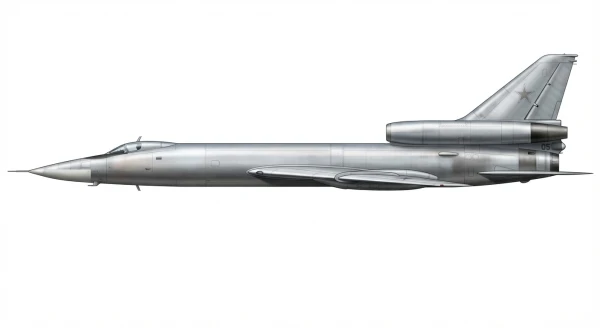
The Myasishchev M-50 (NATO reporting name: Bounder) was a Soviet four-engine supersonic strategic bomber prototype developed by the Myasishchev design bureau. The aircraft never entered service, with its sole flightworthy prototype first flying in October 1959. It is known for its delta-wing configuration and for being mistakenly identified in Western media as a nuclear-powered aircraft.
Development
The M-50 was developed during the late 1950s as a high-speed strategic bomber. The initial prototype made its maiden flight in October 1959, and a second modified airframe was completed shortly thereafter. The program was canceled in the early 1960s when Soviet defense priorities shifted toward intercontinental ballistic missile development and the space program. The single flying prototype completed 19 total flights before being retired to the Monino Museum outside Moscow.
Design
The M-50 utilized shoulder-mounted, truncated delta wings with a surface area of 290.6 m² and a wingspan of 25.10 m. Propulsion was provided by four engines in a mixed configuration: two inner under-wing Dobrynin VD-7F afterburning turbojets generating 137.29 kN thrust wet, and two outer wingtip-mounted Dobrynin VD-7 non-afterburning turbojets producing 110 kN thrust. The crew of two sat in a tandem arrangement within the forward fuselage. The aircraft had a maximum takeoff weight of 200,000 kg, reached a maximum speed of 1,950 km/h, and had a range of 7,400 km.
Armament
The M-50 had a maximum payload capacity of 30,000 kg carried entirely in internal bays. Planned armaments included bombs as well as M-59 and M-61 long-range cruise missiles.
Operational History
The M-50 saw no combat service, operational deployment, or foreign export. Its active history was limited to 19 test flights, culminating in a final flight during the Soviet Aviation Day flypast over the Tushino air show on 9 July 1961. In December 1958, the publication Aviation Week published photographs of the M-50, erroneously reporting that the aircraft was a flight-tested nuclear-powered bomber.
Variants
- M-50A: Initial flightworthy prototype powered by two VD-7 and two VD-7F turbojets, configured with tandem cockpit seating.
- M-52: Modified second airframe equipped with Zubets 16-17 turbofans, a side-by-side cockpit layout, and an additional upper tailplane, which was completed but never flight-tested.
- M-51: Unmanned intercontinental cruise missile variant designed to deliver multiple warheads to targets in the contiguous United States.
Frequently Asked Questions
What type of aircraft is the M-50 Bounder?
What is the maximum speed of the M-50 Bounder?
What is the range of the M-50 Bounder?
When did the M-50 Bounder first fly?
How many M-50 Bounder have been built?
Which countries operate the M-50 Bounder?
What is the service ceiling of the M-50 Bounder?
- AUG 62026 Created Page created: M-50 Bounder