MD-450 Ouragan vs MiG-15 Fagot
MD-450 Ouragan vs MiG-15 Fagot at a glance — top speed 940 vs 1,075 km/h, range 920 vs 2,520 km, max takeoff weight 7,900 vs 6,105 kg, built 567 vs 17,310 units.
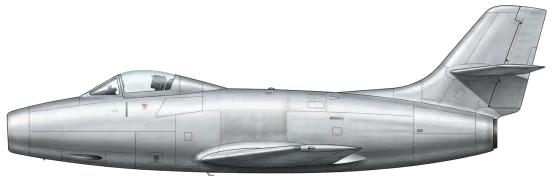
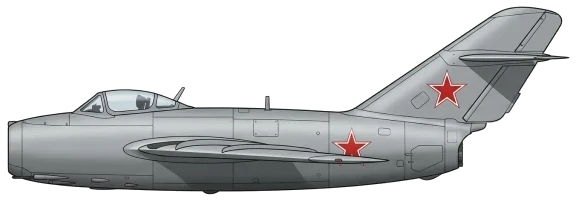
| MD-450 Ouragan | MiG-15 Fagot | |
|---|---|---|
| Origin country | 🇫🇷 France | 🇷🇺 Ex-USSR |
| Category | Combat Aircraft | Combat Aircraft |
| Manufacturer | Dassault | Mikoyan-Gurevich |
| First flight | 28 February 1949 | 19 December 1947 |
| Year introduced | 1952 | 1949 |
| Number produced | 567 units | 17310 units |
| Average unit price | $1 million | $200K |
| Wing area | 23.8 m² | 20.6 m² |
| Wingspan | 13.2 m | 10.1 m |
| Height | 4.1 m | 3.7 m |
| Length | 10.7 m | 10.1 m |
| Maximum speed | 940 km/h | 1075 km/h |
| Operational range | 920 km | 2,520 km |
| Service ceiling | 13,000 m | 15,500 m |
| Max. takeoff weight | 7,900 kg | 6,105 kg |
| Empty weight | 4,142 kg | 3,580 kg |
| Total thrust | 1 x 2,263 kgf | 1 x 2,700 kgf |
Detailed Comparison
The Dassault MD-450 Ouragan and the Mikoyan-Gurevitch MiG-15 Fagot emerged from the immediate post-WWII vacuum, utilizing similar British engine technology to achieve vastly different strategic goals. While the Ouragan served as a foundational step for the French aviation industry's resurgence, the MiG-15 represented a generational leap in Soviet capability, achieving mass production numbers that defined Cold War air power.
Development and Design
Marcel Bloch (Dassault) designed the MD-450 as a private venture to revitalize French manufacturing, prioritizing a rapid rate of climb and a straightforward cylindrical fuselage. The design remained relatively conservative, employing a divided nose intake and thin, tapered wings rather than a fully swept configuration. It relied on a license-produced Rolls-Royce Nene engine.
Conversely, the Soviet MiG-15 leveraged advanced swept-wing aerodynamics to delay drag rise, allowing for transonic speeds. Powered by the Klimov VK-1—a reverse-engineered derivative of the same Nene architecture used in the Ouragan—the MiG featured high-strength aluminum alloy construction. While the Ouragan was designed with a focus on stability for gunnery, the MiG-15 prioritized high-altitude interception capabilities, resulting in a design that was faster but suffered from primitive avionics compared to Western contemporaries.
Specifications and Performances
The MiG-15 exhibits clear kinematic superiority, largely due to its lighter airframe (3,580 kg empty vs. 4,142 kg for the Ouragan) and more powerful engine thrust (2,700 kgf vs. 2,263 kgf). This thrust-to-weight advantage translates into a top speed of 1,075 km/h for the Soviet fighter, surpassing the French aircraft's 940 km/h.
Vertical performance follows suit; the MiG-15 achieves a climb rate of 50.0 m/s and a service ceiling of 15,500 m, significantly outclassing the Ouragan’s 38.0 m/s climb and 13,000 m ceiling. The provided data indicates a stark contrast in operational endurance, with the MiG-15 citing a range of 2,520 km against the Ouragan's severely limited 450 km, restricting the French jet primarily to tactical support roles rather than long-range interception.
Deployment and usage
Operationally, the MiG-15 defined the air war over the Korean Peninsula, forcing UN forces to accelerate the deployment of the F-86 Sabre. Its heavy armament (37 mm and 23 mm cannons) was optimized for destroying strategic bombers but proved lethal against fighters in "MiG Alley."
The Ouragan saw service primarily as a ground-attack platform rather than an air superiority fighter. While it served the Armée de l'Air briefly, it saw combat with the Indian Air Force (as the Toofani) and the Israeli Air Force, notably during the Suez Crisis and Six-Day War. Its stability made it an effective weapons truck for rockets and bombs. El Salvador utilized the type in counter-insurgency roles until the late 1980s, long after the MiG-15 had been relegated to training roles.
Conclusion
The MD-450 Ouragan succeeded as an industrial proof-of-concept, establishing Dassault's technical independence, but its straight-wing design rendered it obsolescent almost immediately upon entry into service. The MiG-15, however, was a strategic shock to Western air power. With over 17,310 units built compared to Dassault's 567, the MiG-15 offered a superior combat envelope and overwhelming numbers, marking it as the definitive interceptor of the early jet age while the Ouragan remained a regional ground-attack asset.