DH.100 Vampire
British single-engined twin-boom jet fighter that entered RAF service in 1946, flew with 31 air forces and served as fighter-bomber, night fighter, carrier fighter and trainer. Key figures: top speed 882 km/h, range 1,963 km, service ceiling 13,045 m, max takeoff weight 5,620 kg, built 4,780.
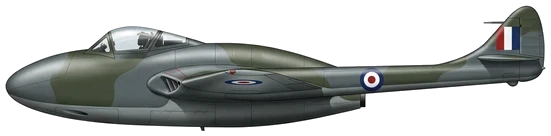
| Crew | 1 |
| Length | 9.4 m (30.7 ft) |
| Wingspan | 11.6 m (38.0 ft) |
| Height | 2.7 m (8.8 ft) |
| Wing area | 24.3 m² (261.6 sqft) |
| Empty weight | 3,304 kg (7,284 lbs) |
| Max. takeoff weight | 5,620 kg (12,390 lbs) |
| Powerplant | 1 × turbojet de Havilland Goblin 3 1,520 kgf each |
| Maximum speed | 882 km/h (548 mph) |
| Operational range | 1,963 km (1,220 mi) |
| Service ceiling | 13,045 m (42,799 ft) |
| Climb rate | 24.4 m/s (80.1 ft/s) |
- Unguided Bomb 500 lb bomb
- Rocket Pod RP-3 3-inch rocket
Description
The de Havilland DH.100 Vampire is a British single-engined, twin-boom jet fighter developed and manufactured by the de Havilland Aircraft Company. It entered Royal Air Force (RAF) service in 1946 as the RAF's second jet fighter after the Gloster Meteor, and the first powered by a single jet engine. Six Vampires were the first jet aircraft to fly across the Atlantic Ocean. The naval Sea Vampire was the Royal Navy's first jet fighter, and two-seat versions served widely as trainers.
Development
De Havilland began design work in 1941 following an informal approach to build a jet fighter together with a suitable engine. The engine emerged as the Halford H.1, later produced as the de Havilland Goblin. The DH.99 design of June 1941 was revised to combined wood-and-metal construction and renumbered DH.100 by November 1941. On 22 April 1942 the ministry authorised two prototypes under Specification E.6/41, and the aircraft was codenamed Spider Crab.
The company's chief test pilot flew the first prototype from Hatfield on 20 September 1943. The flight was delayed because the only flight-ready engine had been sent to the United States for the XP-80. Tail changes corrected directional instability. An order for 120 Mk I aircraft on 13 May 1944 rose to 300, and English Electric at Preston built most of them. In Britain, 3,268 Vampires were built in 15 versions, including 804 trainers, and a further 1,512 were built under licence abroad.
Design
The twin-boom layout kept the jet pipe short and placed the tailplane clear of the exhaust. The fuselage used moulded plywood forward and aluminium aft, drawing on the company's Mosquito experience. The wings were straight and mid-mounted and carried air brakes. Flight controls were manually operated. Goblin thrust grew from 2,100 lbf to 3,500 lbf in the export Mk 35. There was no means of relighting the engine in flight.
Australian Vampires used the Rolls-Royce Nene. Their dorsal auxiliary intakes caused elevator blanking, and three aircraft were lost before the intakes were moved beneath the fuselage. The DH.113 night fighter carried AI Mk X radar. The Sea Vampire had a V-shaped arrester hook, enlarged air brakes and flaps, and a strengthened structure. The FB.6 reached 548 mph and had a range of 1,220 mi.
Armament
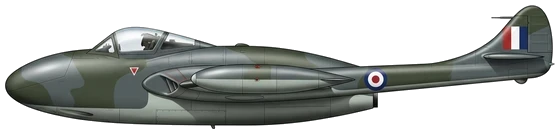
Four 20 mm Hispano Mk V cannon were mounted under the nose, with 150 rounds per gun. From the FB.5, each wing could carry a drop tank or a 500 lb bomb. Eight 3-inch rockets could be fitted on four attachments inboard of the booms.
Operational History
At its peak, 19 RAF squadrons flew the FB.5 in Europe, the Middle East and the Far East. FB.5s attacked insurgents during the Malayan Emergency, and FB.9s deployed briefly against the Mau Mau in Kenya in 1954. On 3 December 1945, a Sea Vampire made the first pure-jet carrier landing and take-off. The RAF retired its last trainers in 1967.
Thirty-one air forces operated the type. Egyptian Vampires flew ground-attack missions at the Mitla Pass during the Suez Crisis. Indian Vampires sank a Portuguese patrol vessel during the 1961 annexation of Goa. In 1965 India lost four Vampires in one action and withdrew the type from front-line service. Rhodesian Vampires flew until the end of the bush war in 1979 and stayed with the Air Force of Zimbabwe until the early 1980s, the last Vampires used on operations anywhere.
Variants
- F.1: Initial single-seat RAF fighter; 228 built, including 70 for Sweden as the J 28A.
- FB.5: Goblin-powered fighter-bomber with clipped wings; 1,123 built.
- NF.10: Two-seat DH.113 night fighter for the RAF; 81 built.
- T.11: Two-seat DH.115 trainer; 526 built by de Havilland and Fairey.
- Sea Vampire F.20: Navalised FB.5; 18 converted by English Electric.
Frequently Asked Questions
What type of aircraft is the DH.100 Vampire?
What is the maximum speed of the DH.100 Vampire?
What is the range of the DH.100 Vampire?
When did the DH.100 Vampire first fly?
How many DH.100 Vampire have been built?
Which countries operate the DH.100 Vampire?
What is the service ceiling of the DH.100 Vampire?
- SEP 302026 Created Page created: DH.100 Vampire