Mirage G
French experimental swing-wing fighter, designed during 1960s-1970s, never deployed operationally, evolved into several prototypes. Key figures: top speed 2,390 km/h, range 3,850 km, service ceiling 18,500 m, max takeoff weight 23,800 kg, unit price $25M, built 3.
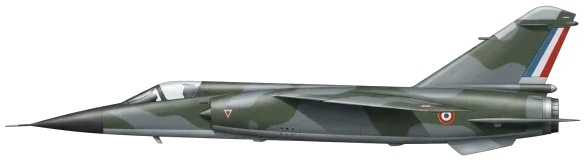
| Crew | 1 |
| Length | 18.8 m (61.7 ft) |
| Wingspan | 15.4 m (50.5 ft) |
| Height | 5.4 m (17.6 ft) |
| Wing area | 37 m² (398.3 sqft) |
| Empty weight | 14,740 kg (32,496 lbs) |
| Max. takeoff weight | 23,800 kg (52,470 lbs) |
| Powerplant | 2 × turbojets SNECMA Atar 9K50 7,148 kgf each |
| Ejection seat | Martin-Baker Mk 4 |
| Maximum speed | 2390 km/h (Mach 2.3) |
| Operational range | 3,850 km (2,392 mi) |
| Service ceiling | 18,500 m (60,696 ft) |
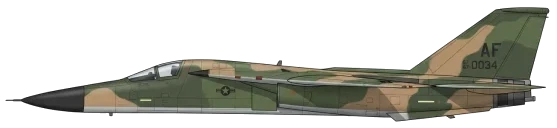
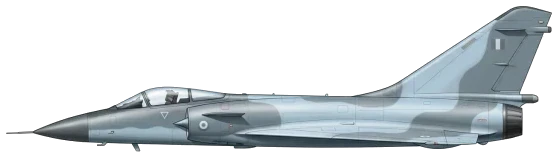
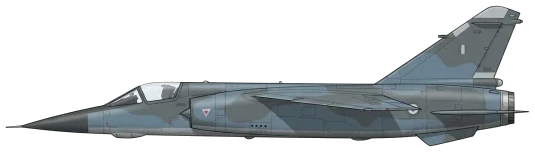
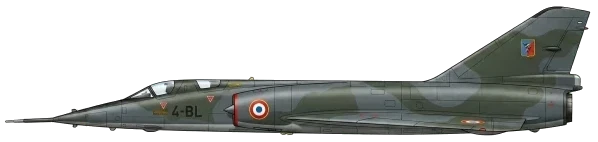
Description
In 1963, studies began within the French defence ministry concerning variable-sweep wing aircraft for both land and aircraft carrier applications. This initiative was influenced by the American TFX program. Avions Marcel Dassault initiated studies for a Mirage variant, including the Mirage F4G. In 1964, Dassault proposed the MD800 for a carrier-based naval version and the smaller, single-engined Mirage IIIF2G. In 1965, Dassault partnered with the British Aircraft Corporation (BAC) to develop an Anglo-French Variable Geometry (AFVG) aircraft, a collaboration which dissolved in 1967. The IIIF2G initiative led to the Mirage G prototype, configured as a single-seat, single-engined aircraft, which rolled out in 1967. The first flight of the Mirage G occurred on 18 November 1967. The prototype crashed on 13 January 1971 following a total loss of electrical power. By 1968, the twin-engine, two-seat Mirage G4 had been proposed as a nuclear strike fighter. This led to contracts for two prototypes, G4-01 and -02, which were later redesignated as the Mirage G8 interceptor. Mirage G8-01 first flew on 8 May 1971, followed by the second aircraft, G8-02, on 13 July 1972. The Mirage G program was canceled in 1968 due to projected funding limitations in the 1971-1976 French defence budget.
Design
The Dassault Mirage G series incorporated a variable-sweep wing design. On the initial Mirage G prototype, the wing sweep could vary from 22 degrees when fully forward to 70 degrees when fully aft. This aircraft was also equipped with full-span double-slotted trailing edge flaps and two-position leading-edge flaps. The later Mirage G8 variant featured a Thomson-CSF radar system and utilized a low-altitude navigational-attack system derived from components developed for the SEPECAT Jaguar and Dassault Milan.
Armament
The proposed Mirage G4 variant was intended for the nuclear strike mission, indicating a planned capability to carry nuclear ordnance. The subsequent redesignation of the prototypes to the Mirage G8 interceptor role suggests potential integration of air-to-air missile systems, utilizing the installed Thomson-CSF radar for target engagement.
Operational History
The operational history of the Dassault Mirage G series is limited to flight testing phases. The initial single-engine Mirage G prototype conducted flights from 1967 until its loss in a crash in 1971 caused by a total loss of electrical power. The twin-engine Mirage G8 prototypes underwent flight trials, with the first aircraft, G8-01, performing its initial flight in May 1971, and the second, G8-02, flying in July 1972. Despite successful flight test results, no production order was placed for the aircraft. The design influenced the Ling-Temco-Vought V-507 proposal in the United States, contributing technical data on variable-geometry wings during the competition for the US Navy's VFX carrier fighter contract, which was ultimately won by the Grumman F-14 Tomcat.
Variants
Main Variants:
-
F4G: An initial study conducted prior to the construction of the first prototype.
-
MD800: A submission for the DAFNE program in 1964.
-
G: The single-engine initial prototype; one example was flown starting in 1967.
-
G4 and G8: A twin-engine fighter project that began with two G4 nuclear strike fighter prototypes, but they were later redesignated as G8 interceptors during construction, with one flying as a two-seater and the other as a single-seater from 1968.
-
G8A or Super Mirage: A fixed-wing development of the G8 with a 55-degree sweepback; a 1973 contract for a prototype was canceled in 1975.
Frequently Asked Questions
What type of aircraft is the Mirage G?
What is the maximum speed of the Mirage G?
What is the range of the Mirage G?
When did the Mirage G first fly?
How many Mirage G have been built?
Which countries operate the Mirage G?
How much does a Mirage G cost?
What is the service ceiling of the Mirage G?
- AUG 52026 Updated Thrust updated
- JUL 12026 Updated Name updated
- APR 72026 Updated Sources and cross-references refreshed
- FEB 212026 Updated Name updated
- JAN 242026 Updated Thrust updated