F-111 Aardvark
American tactical bomber, active during Cold War and significant use in Vietnam and Gulf Wars, renowned for its variable-sweep wings. Key figures: top speed 2,655 km/h, range 5,940 km, service ceiling 20,117 m, max takeoff weight 45,359 kg, unit price $15M, built 563.
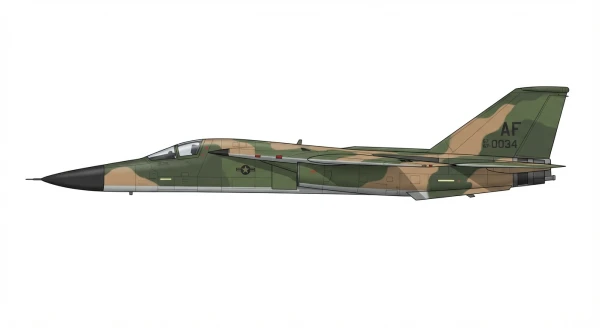
| Crew | 2 (pilot, WSO) |
| Length | 22.4 m (73.5 ft) |
| Wingspan | 19.2 m (63.0 ft) |
| Height | 5 m (16.4 ft) |
| Wing area | 61.1 m² (657.4 sqft) |
| Empty weight | 21,400 kg (47,179 lbs) |
| Max. takeoff weight | 45,359 kg (99,999 lbs) |
| Powerplant | 2 × turbofans Pratt & Whitney TF30-P-100 11,385 kgf each |
| Ejection seat | Escape capsule |
| Maximum speed | 2655 km/h (Mach 2.65) |
| Operational range | 5,940 km (3,691 mi) |
| Service ceiling | 20,117 m (66,001 ft) |
| Climb rate | 131.5 m/s (431.4 ft/s) |
Description
The origin of the Aardvark, so named for its resemblance to the long-nosed animal, dates back to July 1960, in response to a dual specification for a long-range interceptor for the US Navy and a deep-strike aircraft for the USAF.
Development
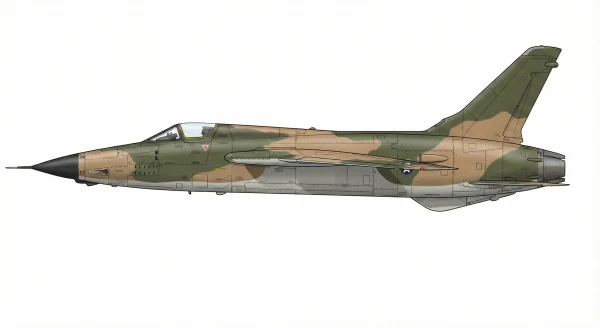
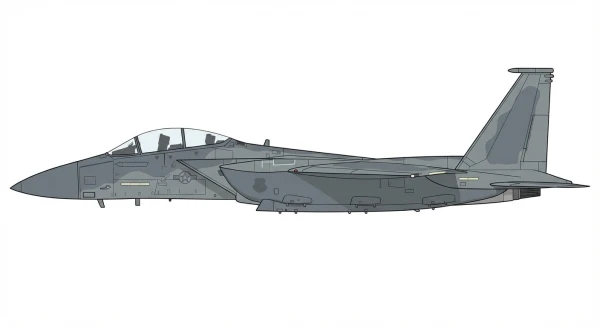
This project is based on the development of a variable-geometry aircraft that would replace the US Air Force's F-105 Thunderchief and the Navy's F-4 Phantom II. At the time, Secretary of Defense Robert McNamara believed that both armed forces' requirements could be met by a single project: the TFX. General Dynamics thus began developing a supersonic multirole aircraft, the F-111, which would become controversial due to its costs, technical difficulties, and its early performance in Vietnam, but it was also highly effective and reliable in its all-weather interdiction role.
Design
The F-111 Aardvark led to numerous developments, such as:
-
The variable-geometry wing, which combines good maneuverability at low speeds, considerable range, excellent payload capacity, good takeoff and landing performance, and remarkable performance at high speeds. However, this type of wing is very complex to implement. The F-111's wing varies from a sweep angle of 16° during low-speed phases to 72.5° in supersonic flight. Generally, the pilot selects 54° of sweep for optimal maneuverability (lift and maneuvering).
-
Terrain Following Radar (TFR), which allows the F-111 Aardvark to fly day and night at all altitudes and in all weather conditions. The TFR enables the aircraft to follow the contours of the terrain it flies over without pilot input.
-
A two-seat ejection cabin: a detonation cable separates the capsule, in which both crew members sit side by side. A rocket engine then propels the cabin away from the aircraft, followed by a parachute to slow the descent.
By meeting the Defense Department's program requirements, General Dynamics secured a contract for the development of 23 prototype aircraft: 18 for the USAF (F-111A) and 5 for the US Navy (F-111B), which made their first flights on December 21, 1964, and May 18, 1965, respectively.
The first F-111A became operational in October 1967. Demonstrating excellent performance, the F-111 Aardvark was immediately deployed in the Vietnam War in March 1968. However, during the initial campaign, 2 out of the 6 aircraft engaged in the conflict were shot down. As a result, all F-111s were withdrawn from Vietnam. It was not until 1972 that the F-111 returned to Vietnam, with 50 aircraft deployed. Despite suffering numerous losses, they were often grounded due to adverse weather conditions.
On the other hand, the carrier-based version experienced a significant increase in weight, which considerably diminished its performance. In August 1968, the F-111B project was definitively abandoned after the construction of two production aircraft.
Armament
The F-111A was equipped with the TF-30 P3 engine, a 20mm cannon (housed internally with 2084 rounds), and had an offensive load of 11 tons distributed across 6 hardpoints and an internal weapons bay.
Variants
In total, 563 F-111 aircraft were delivered starting in 1969, and several different versions were introduced:
-
96 F-111D with improved avionics and equipped with TF-30 P9 engines.
-
94 F-111E, a simplified version of the F-111D, of which most were deployed in Europe. It was capable of carrying nuclear weapons (B-61 type) in addition to its usual array of conventional armaments.
-
106 F-111F fitted with the much more powerful TF-30 P100 engine (11.4 tons of thrust) and equipped with the Pave Tack system for night operations (FLIR: Forward Looking InfraRed) for laser targeting. The F-111F also had an optronic system that directly transmitted images to the cockpit.
-
76 FB-111A, optimized for missions of the Strategic Air Command. They were introduced starting in 1969. These aircraft were longer, had a larger wingspan, a reinforced landing gear, and increased internal fuel capacity. Armed with nuclear weapons (B-61 bombs) or SRAM missiles (Short Range Attack Missile) and additional fuel tanks, they contributed to nuclear deterrence until the 1990s before being partially re-designated as F-111G and assigned to training duties. The capabilities of the F-111 were also utilized in the field of electronic warfare, starting in 1981, with the EF-111 Raven version developed in collaboration with Grumman.
The Aardvark did not achieve much success in terms of exports, as only 24 F-111C aircraft were purchased by Australia in 1963. The Australians had to wait 10 years to receive modified aircraft tailored to their specific anti-ship warfare needs. On the other hand, the United Kingdom canceled an order for 46 aircraft due to severe budgetary constraints.
The F-111 returned to the political forefront in April 1986 during the raid on Tripoli in Libya. F-111F aircraft based in the United Kingdom struck multiple targets despite being prohibited from overflying Europe and Spain. They had to circumnavigate Europe via the Atlantic and join Libya through the Strait of Gibraltar, requiring six aerial refuelings.
Operationally, the F-111 is capable of supersonic flight both at 18,000m (Mach 2.5) and at low altitudes (Mach 1.2), and can carry a heavy offensive load (11 tons) over long distances deep behind enemy lines. The offensive load is primarily carried in an internal weapons bay, which is mainly used for nuclear payloads, a cannon, or the Pave Tack system, with an additional 4 hardpoints on the wings (the inner two are movable to ensure wing sweep pivot, while the outer two are fixed and only used during minimum sweep).
The final Aardvark was delivered in September 1976, and the last F-111F aircraft were retired from service on July 27, 1996.
Frequently Asked Questions
What type of aircraft is the F-111 Aardvark?
What is the maximum speed of the F-111 Aardvark?
What is the range of the F-111 Aardvark?
When did the F-111 Aardvark first fly?
How many F-111 Aardvark have been built?
How much does a F-111 Aardvark cost?
What is the service ceiling of the F-111 Aardvark?
- AUG 52026 Updated Powerplant and thrust updated
- JUL 232026 Updated Sources and cross-references refreshed
- APR 72026 Updated Sources and cross-references refreshed
- APR 52026 Updated Ejection seat added
- JAN 242026 Updated Thrust updated
- JAN 122026 Updated Range updated in a site-wide editorial pass