MQ-1 Predator vs MQ-9 Reaper
MQ-1 Predator vs MQ-9 Reaper at a glance — top speed 217 vs 300 km/h, range 1,250 vs 1,850 km, max takeoff weight 1,020 vs 4,760 kg, built 360 vs 300 units.
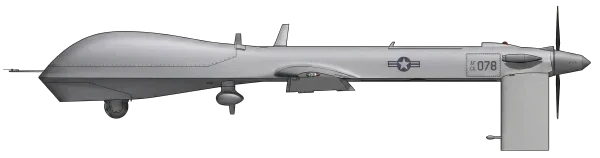
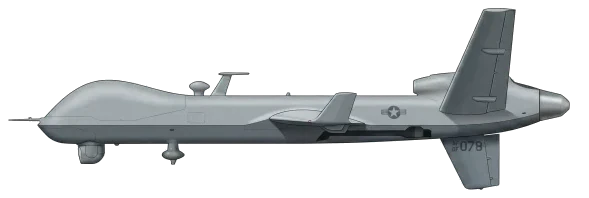
| MQ-1 Predator | MQ-9 Reaper | |
|---|---|---|
| Origin country | 🇺🇸 United States | 🇺🇸 United States |
| Category | Military Drones | Military Drones |
| Manufacturer | General Atomics | General Atomics |
| First flight | 3 July 1994 | 1 February 2001 |
| Year introduced | 1995 | 2007 |
| Number produced | 360 units | 300 units |
| Average unit price | $4 million | $30 million |
| Wingspan | 14.8 m | 20.0 m |
| Length | 8.2 m | 11.0 m |
| Maximum speed | 217 km/h | 300 km/h |
| Operational range | 1,250 km | 1,850 km |
| Service ceiling | 7,620 m | 15,000 m |
| Max. takeoff weight | 1,020 kg | 4,760 kg |
| Empty weight | 512 kg | 2,223 kg |
Detailed Comparison
General Atomics' MQ-1 Predator and MQ-9 Reaper chart the U.S. Air Force’s transition from ad-hoc armed reconnaissance to dedicated unmanned strike operations. The MQ-1, essentially a retrofitted intelligence platform, initiated the modern drone war paradigm, while the MQ-9 was purpose-built to execute the hunter-killer doctrine that the Predator proved viable but lacked the payload to sustain.
Development and Design
The MQ-1 originated in the early 1990s from Abraham Karem’s "Amber" and Gnat 750 designs. Procured initially as an Advanced Concept Technology Demonstration (ACTD) for pure ISR (RQ-1), it utilized a 115-horsepower Rotax piston engine. Weaponization was an afterthought; the airframe was retrofitted with lasers and Hellfire missiles in 2001, necessitating the MQ-1 re-designation. The MQ-9 emerged from General Atomics' recognition of the MQ-1's kinetic limitations. Scaling up the airframe and integrating a 900-horsepower Honeywell TPE331-10GD turboprop transformed the platform. The MQ-9 integrates a multi-spectral targeting system natively paired with a heavy stores management system, shifting the design priority from persistence alone to combined persistence and heavy ordnance delivery.
Specifications and Performances
The physical scaling from the MQ-1 to the MQ-9 dictates their operational utility.
- The MQ-1's 1,020 kg maximum takeoff weight (MTOW) capped its payload at two AGM-114 Hellfire missiles.
- The MQ-9 more than quadruples the MTOW to 4,760 kg, accommodating up to 1,700 kg of external stores.
This allows the Reaper to carry a mixed loadout of four Hellfires and two 500-lb GBU-12 Paveway II or GBU-38 JDAMs, matching the payload capacity of some early manned attack jets. The Reaper operates at altitudes up to 15,000 meters, nearly double the Predator’s 7,620-meter ceiling, distancing it from man-portable air defense systems (MANPADS). Speed increases from the Predator's 217 km/h to the Reaper's 300 km/h, reducing transit times to target areas.
Deployment and usage
The USAF deployed the MQ-1 in the Balkans in 1995 for surveillance, later arming it for targeted strikes in Afghanistan, Pakistan, and Yemen. Its low speed and altitude made it physically vulnerable; an Iraqi MiG-25 shot one down in 2002, and unencrypted video feeds allowed insurgents to monitor its surveillance. The MQ-9 assumed frontline duties in 2007. By 2008, the 174th Attack Wing transitioned entirely from F-16s to MQ-9s, institutionalizing the platform for close air support. Both platforms suffer heavy attrition in contested airspace; Reapers have recorded multiple losses to Houthi surface-to-air missiles in Yemen (2017, 2019, 2022) and Russian interference over the Black Sea (2023), exposing the limits of unstealthy MALE UAVs against integrated air defense systems.
Conclusion
For low-intensity counterinsurgency and permissive airspace ISR, the MQ-1 provided an early $4.0 million solution, though it is obsolete for modern strike profiles and was retired by the USAF in 2018. The $30.0 million MQ-9 holds a definitive edge in hunter-killer missions, maritime patrol, and persistent close air support due to its ordnance capacity and sensor suite. However, neither aircraft survives in contested airspace. The MQ-9's utility is strictly bound to environments where air supremacy is established prior to deployment.


