MQM-107 Streaker
American reusable turbojet-powered target towing drone, introduced in the mid-1980s, used by the United States military for testing and training. Key figures: top speed 925 km/h, service ceiling 12,192 m, max takeoff weight 664 kg, built 2,236.
| Length | 5.5 m (18.0 ft) |
| Wingspan | 3 m (9.8 ft) |
| Height | 1.5 m (4.8 ft) |
| Max. takeoff weight | 664 kg (1,464 lbs) |
| Powerplant | 1 × Microturbo TRI 60 Turbojet |
| Maximum speed | 925 km/h (575 mph) |
| Service ceiling | 12,192 m (40,000 ft) |
Description
The Beechcraft MQM-107 Streaker is a reusable, turbojet-powered target towing drone. Developed to meet the United States Army Aviation and Missile Command's 1972 Variable Speed Training Target requirement, the design was selected as the winner in 1975. The first flight occurred in 1974, and the system was officially introduced in 1984. The U.S. Army received the initial MQM-107A model until 1979. Production of the drone ended in 2003 after 2,236 units were built.
Design
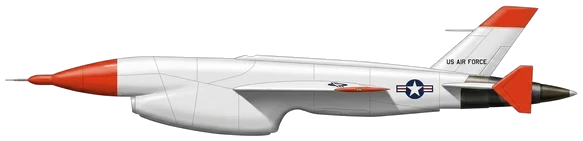
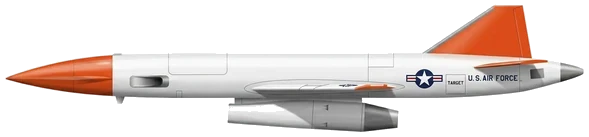
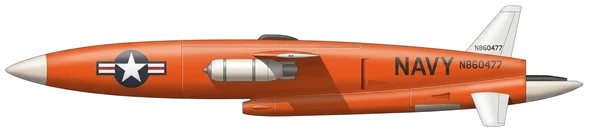
The MQM-107 features a high-subsonic design with slightly swept wings and a centerline-mounted turbojet engine. It is launched from the ground via a rocket booster that accelerates the drone until the jet engine takes over. Recovery is achieved by parachute. For the MQM-107B variant, the aircraft length is 18 ft 1 in (5.5 m), the wingspan is 9 ft 10 in (3.0 m), and the height is 4 ft 10 in (1.47 m). It has a maximum takeoff weight of 1,464 lb (664 kg). Powered by a Microturbo TRI 60 turbojet engine, it has a maximum speed of 575 mph (925 km/h) and a service ceiling of 40,000 ft (12,192 m).
Armament
The drone carries no offensive armament. Its payloads consist of towed targets, including radar or infrared tow targets for missile training, or a square banner with an enhanced radar signature for gunnery training. It can also carry flare or chaff pods.
Operational History
The United States Army and United States Air Force operated the MQM-107 for training and testing. The U.S. Army used the drone to test surface-to-air systems including the FIM-92 Stinger and MIM-104 Patriot, while the U.S. Air Force used it for practice engagements with AIM-9 Sidewinder and AIM-120 AMRAAM missiles. International operators have included Australia, Egypt, Iran, Jordan, North Korea, South Korea, Singapore, Sweden, Taiwan, Turkey, and the United Arab Emirates. In 2012, North Korea acquired several MQM-107D units second-hand from a Middle Eastern country, later revealing an indigenous derivative in 2013. The U.S. military inventory is being phased out in favor of the BQM-167 Skeeter.
Variants
- MQM-107A: The original model, powered by a Teledyne CAE J402-CA-700 turbojet engine and exported under the designation Model 999.
- MQM-107B: This 1982 variant featured a larger fuselage, a higher payload capacity, and a Microturbo TRI 60-2 turbojet engine.
- MQM-107C: This model used the fuselage of the MQM-107B and the J402-CA-700 engine of the A-model to exhaust surplus engine inventory.
- MQM-107D: Introduced in 1987, this variant originally used a J402-CA-702 engine before transitioning to a Microturbo TRI 60-5 engine in 1989.
- MQM-107E: First flown in 1992, this heavily redesigned model featured modified wing and tail surfaces for higher maneuverability and was built by BAE Systems.
Frequently Asked Questions
What type of aircraft is the MQM-107 Streaker?
What is the maximum speed of the MQM-107 Streaker?
When did the MQM-107 Streaker first fly?
How many MQM-107 Streaker have been built?
Which countries operate the MQM-107 Streaker?
What is the service ceiling of the MQM-107 Streaker?
- JUL 62026 Created Page created: MQM-107 Streaker