PC-12 Eagle
Swiss turboprop passenger and cargo aircraft, distinguished by worldwide operational history, notably in charter, regional, and utility roles. Key figures: top speed 528 km/h, range 3,417 km, service ceiling 9,144 m, unit price $6M, built 2,000. In service with 7 air forces as of 2026 — United States (30), Finland (6), Ireland (4) and 4 others.
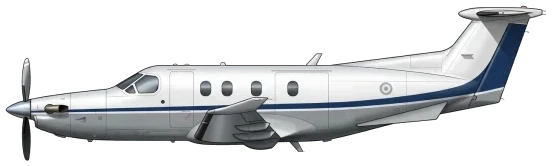
| Wingspan | 16.3 m (53.4 ft) |
| Empty weight | 2,810 kg (6,195 lbs) |
| Maximum speed | 528 km/h (328 mph) |
| Operational range | 3,417 km (2,123 mi) |
| Service ceiling | 9,144 m (30,000 ft) |
| Climb rate | 9.8 m/s (32.2 ft/s) |
-
 United States
30
United States
30
-
 Finland
6
Finland
6
-
 Ireland
4
Ireland
4
-
 Guatemala
2
Guatemala
2
-
 Bulgaria
1
Bulgaria
1
-
 South Africa
1
South Africa
1
-
 Thailand
1
Thailand
1
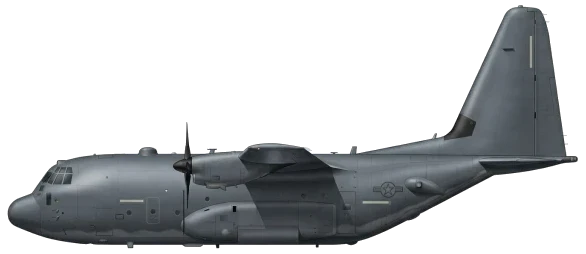
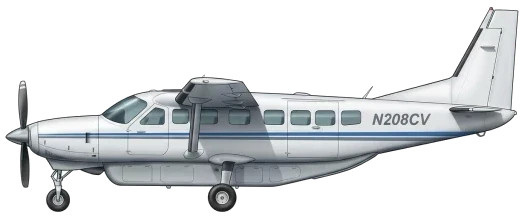
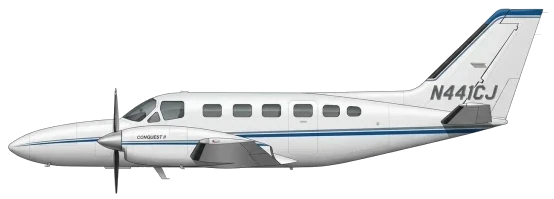
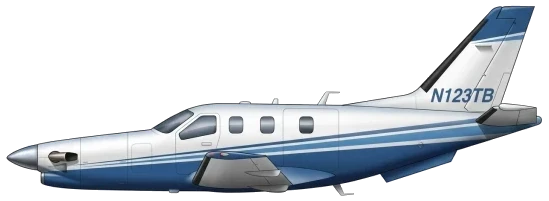
Description
The PC-12 Eagle is the paramilitary special missions derivative of the Pilatus PC-12, a pressurized single-engine turboprop utility aircraft built by Pilatus Aircraft of Stans, Switzerland. Later marketed in the United States as the PC-12M Spectre, it is configured for intelligence, surveillance and reconnaissance, flight inspection, air ambulance and aerial photography work. Its best-known military application is the U-28A Draco, operated by United States Air Force Special Operations Command.
Development
Pilatus announced the PC-12 at the National Business Aviation Association convention in October 1989, having developed the project in secrecy while assembly of the first prototype was already underway. Two prototypes were completed on 1 May 1991 and the first flight took place on 31 May 1991; a wing redesign adding span and winglets delayed certification, which the Swiss Federal Office of Civil Aviation granted on 30 March 1994, followed by FAA approval on 15 July 1994. The PC-12M special missions version is based on the PC-12 NG, announced in 2006 and launched at NBAA 2007, with first delivery in May 2008. Military sales were treated as a low priority during early development, the PC-12 being Pilatus' first aircraft aimed principally at the civil market. The 1,000th PC-12 was delivered in June 2010 and the 2,000th on 12 May 2023, by which point 1,889 were in service and Pilatus held a backlog of 63 units.
Design
The PC-12M is distinguished from standard aircraft by a higher-capacity electrical generation system permitting the installation of additional power-consuming mission equipment. A retractable electro-optical/infrared sensor may be fitted in the tail, with an operator's console in the main cabin containing two display monitors, a digital video recorder, a communications panel and expansion bays for radios and datalinks. An optional utility door accommodates parachute drops of personnel and cargo, supplementing the oversized cargo door fitted as standard. Power comes from a single Pratt & Whitney Canada PT6A-67P of 890 kW (1,200 shp) driving a four-blade Hartzell composite propeller; the NG cruises at 285 kn with a range of 1,845 nmi and a 30,000 ft ceiling. The flight deck uses the Honeywell Primus Apex system with four 10-inch LCD displays, synthetic vision and automatic pressurization control. Dual angle-of-attack sensors near the wingtips provide stall protection, and the aircraft is certified for flight into known icing with pneumatic wing and empennage boots, electrical windshield heating and exhaust-heated engine intakes. Short-field performance permits operation from rough strips, with takeoff over 50 ft in 793 m.
Operational History
The U-28A is flown by the 319th and 34th Special Operations Squadrons at Hurlburt Field, Florida, under the 1st Special Operations Wing, and by the 318th and 310th Special Operations Squadrons at Cannon Air Force Base, New Mexico, under the 27th Special Operations Wing. The 34th SOS was activated on 9 April 2010; the name 'Draco' was formally approved in May 2019. In August 2022 US Special Operations Command selected the AT-802U Sky Warden under the Armed Overwatch programme to assume U-28A combat missions, with the U-28A retained for ISR supporting search and rescue and humanitarian relief. The Finnish Air Force selected the PC-12 NG in 2009 to replace Piper Chieftains and Valmet L-90 Redigos in the liaison role, taking delivery in 2010 and operating six aircraft. Other government operators include the Royal Canadian Mounted Police and the Royal Flying Doctor Service of Australia, launch customer in 1994 with 32 aircraft.
Variants
- PC-12/41: Original production variant certified in 1994 with PT6A-67B engine, 4,100 kg maximum takeoff weight and round-dial cockpit.
- PC-12/45: Certified in 1996 with maximum takeoff weight raised to 4,500 kg; almost all aircraft converted to Series 10 specification.
- PC-12/47: Certified in 2005 with 4,740 kg maximum takeoff weight, revised overhead panel, wingtips and cabin heating.
- PC-12/47E: Certified in 2008 with Honeywell Primus Apex avionics and PT6A-67P engine, marketed as PC-12 NG.
- PC-12M Spectre: Paramilitary special missions platform based on the NG, originally named Eagle, related to the USAF U-28A Draco.
Frequently Asked Questions
What type of aircraft is the PC-12 Eagle?
What is the maximum speed of the PC-12 Eagle?
What is the range of the PC-12 Eagle?
When did the PC-12 Eagle first fly?
How many PC-12 Eagle have been built?
Which countries operate the PC-12 Eagle?
How much does a PC-12 Eagle cost?
What is the service ceiling of the PC-12 Eagle?
- AUG 302026 Updated Description updated
- AUG 52026 Updated Climb rate added
- APR 82026 Updated Empty weight added
- APR 72026 Updated Sources and cross-references refreshed
- FEB 72026 Updated PC-12 Eagle: top speed added; PC-12 Eagle: ceiling added; PC-12 Eagle: range added; PC-12 Eagle: wingspan added