Pe-2 Buck
Soviet twin-engine dive bomber, developed in the late 1930s, extensively deployed during World War II. Key figures: top speed 540 km/h, range 1,315 km, service ceiling 8,800 m, max takeoff weight 8,520 kg, built 11,430.
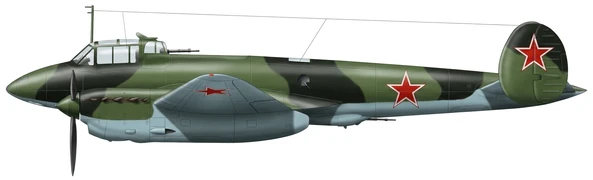
| Crew | 3 |
| Length | 12.7 m (41.5 ft) |
| Wingspan | 17.2 m (56.3 ft) |
| Height | 3.4 m (11.2 ft) |
| Wing area | 40.5 m² (435.9 sqft) |
| Empty weight | 5,950 kg (13,117 lbs) |
| Max. takeoff weight | 8,520 kg (18,783 lbs) |
| Powerplant | 2 × V12 piston engines Klimov M-105RA 820 kW each |
| Maximum speed | 540 km/h (336 mph) |
| Operational range | 1,315 km (817 mi) |
| Service ceiling | 8,800 m (28,871 ft) |
| Climb rate | 13.3 m/s (43.6 ft/s) |
- Unguided Bomb 100 kg bomb
- Unguided Bomb 250 kg bomb
- Unguided Bomb 500 kg bomb
- Rocket Pod RS-82
- Rocket Pod RS-132
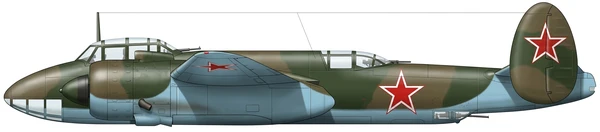
Description
The Petlyakov Pe-2 (NATO reporting name "Buck", nicknamed "Peshka") was a Soviet twin-engine tactical dive bomber built by Petlyakov during World War II. Entering service in June 1941, it also functioned as a heavy fighter, night fighter, and reconnaissance aircraft. With 11,430 units produced, the Pe-2 was the most manufactured Soviet bomber of the war, comprising 75% of the Soviet twin-engine bomber fleet at its peak.
Development
Development began in 1938 at the NKVD sharashka KB-100 under Vladimir Petlyakov as a high-altitude interceptor designated VI-100, which first flew on 22 December 1939. In May 1940, Soviet requirements shifted toward dive bombing, prompting the redesign of the aircraft into the three-seat PB-100 with unpressurized cabins, modified glazing, and dive brakes. Ordered into production as the Pe-2 without a dedicated PB-100 prototype, serial testing began on 15 December 1940 at Zavod 39. Total wartime production reached 11,430 aircraft.
Design
The Pe-2 was an all-metal, low-wing cantilever monoplane featuring a stressed-skin structure and twin vertical stabilizers with an 8-degree tailplane dihedral. Powered by two Klimov M-105 liquid-cooled V-12 engines, the airframe incorporated wing-mounted slatted dive brakes and self-sealing fuel tanks protected by a nitrogen inert gas system. The aerodynamic design required high elevator control forces during takeoff rotation and exhibited harsh landing characteristics due to shock absorber limitations.
Armament
The aircraft carried up to 600 kg internally in a fuselage bomb bay and engine nacelles, supplemented by external underwing racks for a maximum bomb payload of 1,000 kg. Defensive armament originally consisted of 7.62 mm ShKAS machine guns in dorsal, ventral, and fixed forward mountings. Production updates introduced 12.7 mm UBK nose machine guns, 12.7 mm UBT defensive guns in FT mountings and VUB-1 turrets, and underwing hardpoints for up to ten RS-82 or RS-132 unguided rockets.
Operational History
Accepted into service in June 1941, the Pe-2 performed daylight tactical bombing, ground attack, and reconnaissance missions throughout World War II. Despite high initial loss rates among novice crews, tactics evolved to leverage speeds exceeding 640 km/h to evade interceptors. Foreign operators included Finland, which flew seven captured aircraft for strategic reconnaissance, as well as post-war users such as Czechoslovakia, Yugoslavia, Poland, Bulgaria, Hungary, and China.
Variants
- VI-100: High-altitude twin-engine interceptor prototype built with pressurized crew cabins and turbo-supercharged Klimov M-105R engines.
- PB-100: Dive-bomber prototype adapted from the VI-100 in 1940 featuring lower nose glazing, wing dive brakes, and unpressurized cabins.
- Pe-2FT: Main production variant built with a VUB-1 dorsal turret housing a 12.7 mm UBT machine gun, reduced nose glazing, and removed dive brakes.
- Pe-2R: Three-seat dedicated photo reconnaissance variant equipped with larger fuel tanks for extended range.
- Pe-2UTI (UPe-2): Dedicated dual-control trainer variant produced in small numbers.
Frequently Asked Questions
What type of aircraft is the Pe-2 Buck?
What is the maximum speed of the Pe-2 Buck?
What is the range of the Pe-2 Buck?
When did the Pe-2 Buck first fly?
How many Pe-2 Buck have been built?
What is the service ceiling of the Pe-2 Buck?
- AUG 62026 Created Page created: Pe-2 Buck