V-12 Homer
Soviet heavy-lift prototype helicopter, designed in the late 1960s for transporting strategic intercontinental ballistic missiles and heavy military equipment. Key figures: top speed 260 km/h, range 500 km, service ceiling 3,500 m, max takeoff weight 105,000 kg, built 2.
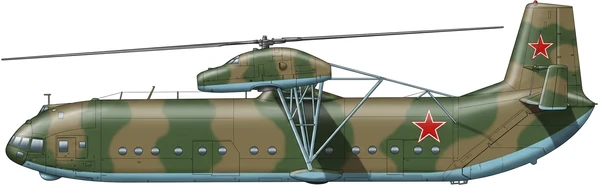
| Crew | 6 (pilot, co-pilot, flight engineer, electrician, navigator, radio operator) |
| Length | 37 m (121.4 ft) |
| Wingspan | 35 m (114.8 ft) |
| Height | 12.5 m (41.0 ft) |
| Wing area | 962 m² (10354.9 sqft) |
| Empty weight | 69,100 kg (152,339 lbs) |
| Max. takeoff weight | 105,000 kg (231,485 lbs) |
| Powerplant | 4 × turboshafts Soloviev D-25VF 4,800 kW each |
| Maximum speed | 260 km/h (162 mph) |
| Operational range | 500 km (311 mi) |
| Service ceiling | 3,500 m (11,483 ft) |

Description
The Mil V-12 (NATO reporting name: Homer), designated project Izdeliye 65, is a prototype heavy transport helicopter built by the Mil OKB in the Soviet Union. Developed during the 1960s to transport intercontinental ballistic missiles and heavy military equipment, the aircraft never entered serial production or military service. It remains the largest helicopter ever constructed.
Development
Mil OKB began design studies for a heavy lift helicopter in 1959, receiving an official directive from the State Committee on Aircraft Technology in 1961 to build a rotorcraft with a 20 to 25 tonne payload capacity. To accommodate cargo dimensions equivalent to the Antonov An-22, designers evaluated single-rotor and tandem configurations before selecting a transverse rotor layout utilizing two Mil Mi-6 transmission systems. Construction of the first prototype began at Panki in 1965. Following an aborted flight attempt in June 1967 caused by control feedback oscillations, the first prototype made its first successful flight on 10 July 1968. A second prototype flew in March 1973, but all development on the project was halted in 1974 after two airframes were completed.
Design
The V-12 uses a transverse rotor layout featuring two 35-meter, five-bladed rotors mounted at the tips of inverse-tapered wings spanning 30 meters. Power is provided by four Soloviev D-25VF turboshaft engines rating 4,800 kW (6,500 shp) each, mounted in paired pods beneath the main gearboxes with interconnecting shafts for rotor synchronization. The fuselage contains a 28.15 m × 4.4 m × 4.4 m cargo cabin equipped with a rear drop-down ramp, clamshell doors, and internal electric hoists. Flight controls feature a three-stage system combining mechanical linkages, intermediate hydraulic boosters, and main gearbox actuators to manage pitch, differential collective roll, and disc-tilting yaw control. Installed avionics include the AP-44 autopilot, experimental VUAP-2 autopilot, and ROZ-1 Lotsiya weather and navigational radar.
Operational History
The first prototype, registered SSSR-21142, conducted its maiden flight from Panki to the test facility in Lyubertsy on 10 July 1968. Between February and August 1969, the V-12 established several payload-to-altitude world records, including lifting 44,205 kg to an altitude of 2,255 meters. The first prototype was displayed publicly at the 29th Paris Air Show in May–June 1971. Despite exceeding design performance specifications, the Soviet Air Force declined state acceptance trials because mobile ICBM deployment concepts had made its primary mission obsolete. The first prototype was retained at the Mil Moscow Helicopter Plant in Panki-Tomilino, while the second prototype was donated to the Central Air Force Museum.
Variants
-
V-12: Internal OKB designation applied to the two prototypes constructed for flight testing.
-
Mi-12: Service designation reserved for the intended production aircraft that was never manufactured.
-
Mi-12M: Proposed variant fitted with two 15,000 kW Soloviev D-30V turboshaft engines driving six-bladed rotors, cancelled at the mock-up stage.
Frequently Asked Questions
What type of aircraft is the V-12 Homer?
What is the maximum speed of the V-12 Homer?
What is the range of the V-12 Homer?
When did the V-12 Homer first fly?
How many V-12 Homer have been built?
What is the service ceiling of the V-12 Homer?
- AUG 62026 Created Page created: V-12 Homer