Tu-2 Bat
Soviet twin-engined high-speed daylight and frontline bomber, introduced during World War II, used extensively for tactical bombing, dive-bombing, and reconnaissance roles. Key figures: top speed 528 km/h, range 2,020 km, service ceiling 9,000 m, max takeoff weight 11,768 kg, built 2,257.
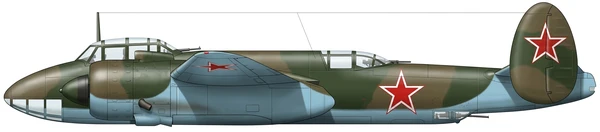
| Crew | 4 |
| Length | 13.8 m (45.3 ft) |
| Wingspan | 18.9 m (61.9 ft) |
| Height | 4.1 m (13.5 ft) |
| Empty weight | 7,601 kg (16,757 lbs) |
| Max. takeoff weight | 11,768 kg (25,944 lbs) |
| Powerplant | 2 × radial piston engines Shvetsov ASh-82 1,380 kW each |
| Maximum speed | 528 km/h (328 mph) |
| Operational range | 2,020 km (1,255 mi) |
| Service ceiling | 9,000 m (29,528 ft) |
| Climb rate | 8.2 m/s (26.9 ft/s) |
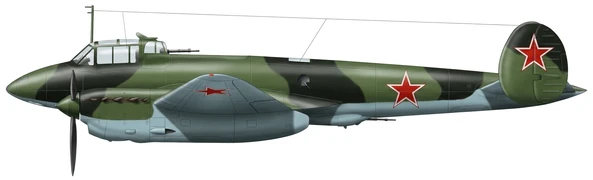
Description
The Tupolev Tu-2 (NATO reporting name "Bat") is a twin-engine Soviet high-speed daylight and frontline bomber aircraft developed by the Tupolev design bureau. Designed to meet a requirement for a high-speed bomber or dive-bomber with fighter-like speed and a large internal payload, the aircraft entered combat service in March 1942. Produced in bomber, torpedo, interceptor, and reconnaissance versions, the aircraft served with the Soviet Air Forces during World War II and remained in operational service until 1950.
Development
The Tu-2 was designed by Andrei Tupolev following his 1937 arrest, based on the earlier ANT-58, ANT-59, and ANT-60 light bomber prototypes. The first prototype flew on 29 January 1941 powered by Mikulin AM-37 engines, and initial mass production began at Omsk Aircraft Factory Number 166 in September 1941. Production was temporarily halted to redesign the airframe for Shvetsov ASh-82 radial engines after AM-37 production was cancelled in favor of the Il-2's AM-38F. Manufacturing restarted in late 1943, reaching a total production run of 2,460 aircraft by 1952, primarily built at Factory Number 23 in Moscow.
Design
The Tu-2 is an all-metal, twin-engine aircraft operated by a four-seat crew in its standard configuration. Power is provided by two Shvetsov ASh-82 14-cylinder air-cooled radial piston engines rated at 1,380 kW (1,850 hp) each, driving three-bladed propellers. The airframe measures 13.8 meters in length with a wingspan of 18.86 meters and a maximum takeoff weight of 11,768 kg. Select specialized variants were configured with radar equipment or internal bomb-bay cameras for photo-reconnaissance.
Armament
Forward fixed armament consists of two 20 mm ShVAK cannons mounted in the wing roots. Defensive armament originally comprised three rear-firing 7.62 mm ShKAS machine guns mounted in the canopy, dorsal, and ventral positions, which were later replaced by 12.7 mm Berezin UB machine guns or Berezin B-20 cannons. Ordnance capacity includes up to 1,500 kg carried internally in a bomb bay and up to 2,270 kg carried on external hardpoints.
Operational History
The Tu-2 entered combat with the 132nd Bomber Aviation Regiment over Velikiye Luki in November 1942, completing 46 sorties during its initial deployment. The regiment flew an additional 47 sorties against airfields and rail junctions supporting operations toward the River Dnepr through April 1943, losing three aircraft in action. Surplus aircraft were exported after World War II to operators including Bulgaria, Hungary, Indonesia, North Korea, Poland, Romania, and China. The Chinese People's Liberation Army Air Force operated Tu-2s during the Chinese Civil War, the Korean War, and ground-attack operations in Qinghai-Tibet from 1958 to 1962 before retiring the type in the late 1970s.
Variants
-
Tu-2: Initial production bomber variant powered by two 1,081 kW Shvetsov ASh-82 engines.
-
Tu-2S: Standard frontline bomber variant powered by two 1,380 kW Shvetsov ASh-82FN radial piston engines.
-
Tu-2T: Torpedo-bomber variant derived from the Tu-2S and fielded by Soviet Naval Aviation units.
-
Tu-2P: Photo-reconnaissance version featuring an extended wingspan, internal bomb-bay cameras, and additional wing fuel tanks.
-
Tu-1: Prototype three-seat night fighter variant equipped with radar and forward-firing autocannons.
Frequently Asked Questions
What type of aircraft is the Tu-2 Bat?
What is the maximum speed of the Tu-2 Bat?
What is the range of the Tu-2 Bat?
When did the Tu-2 Bat first fly?
How many Tu-2 Bat have been built?
What is the service ceiling of the Tu-2 Bat?
- AUG 62026 Created Page created: Tu-2 Bat