Il-10 Beast
Soviet ground attack aircraft developed at the end of World War II and deployed in service through the early Cold War era. Key figures: top speed 551 km/h, range 800 km, service ceiling 5,500 m, max takeoff weight 6,535 kg, built 6,166.
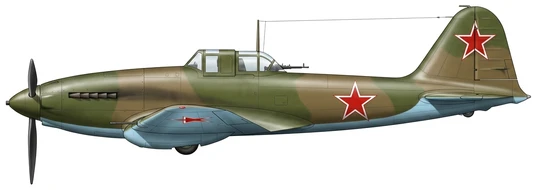
| Crew | 2 |
| Length | 11.1 m (36.3 ft) |
| Wingspan | 13.4 m (44.0 ft) |
| Height | 4.2 m (13.7 ft) |
| Wing area | 30 m² (322.9 sqft) |
| Empty weight | 4,680 kg (10,318 lbs) |
| Max. takeoff weight | 6,535 kg (14,407 lbs) |
| Powerplant | 1 × V12 piston engine Mikulin AM-42 1,320 kW each |
| Maximum speed | 551 km/h (342 mph) |
| Operational range | 800 km (497 mi) |
| Service ceiling | 5,500 m (18,045 ft) |
| Climb rate | 10.0 m/s (32.8 ft/s) |
- Unguided Bomb 50 kg bombs
- Unguided Bomb 100 kg bombs
- Unguided Bomb 250 kg bombs
- Unguided Bomb AO-2,5-2 fragmentation bomb
- Unguided Bomb PTAB-2,5-1,5 anti-tank HEAT bomb
- Rocket Pod RS-82 rocket
- Rocket Pod RS-132 rocket
- Rocket Pod ORO-82 rocket launcher
- Rocket Pod ORO-132 rocket launcher
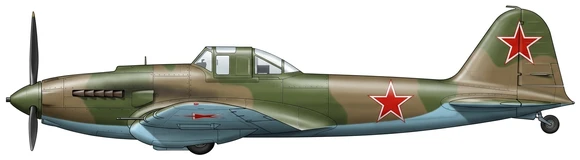
Description
The Ilyushin Il-10 (NATO reporting name: "Beast") is a Soviet two-seat ground attack aircraft developed by the Ilyushin construction bureau. Derived from the Il-2 Sturmovik, it entered Soviet Air Force service in late 1944 and was also license-produced in Czechoslovakia as the Avia B-33. The type served in close assault roles during World War II and the Korean War.
Development
Development began in 1943 with the Il-1 concept, which was redesigned in early 1944 as a ground attack aircraft. The prototype first flew in April 1944, winning an evaluation against the Sukhoi Su-6 and Il-8. Production was authorized on 23 August 1944, with the first production aircraft flying on 27 September 1944. Soviet production ended in 1949 after 4,600 aircraft, but resumed from 1953 to 1954 to build 146 Il-10Ms. Czechoslovakia's Avia built 1,200 B-33 variants between 1951 and 1956, bringing total production to 6,166 airframes.
Design
The Il-10 features a metal monoplane frame built around an armored shell 4 to 8 mm thick that protects the engine underside, cockpit, and crew stations, totaling 994 kg of armor. Power is provided by a liquid-cooled 12-cylinder Mikulin AM-42 inline engine producing 1,320 kW continuous power and driving a 3.6-meter AV-5L-24 propeller. Internal fuel capacity is 730 liters across two fuselage tanks. Structural features include main landing gear that rotates 86 degrees into the wings, internal wing bomb bays, and an AFA-1M camera.
Armament
Early production models mounted two 23 mm VYa-23 cannons and two 7.62 mm ShKAS machine guns in the wings, plus a rear 12.7 mm UBT machine gun. Aircraft built from 1947 carried four 23 mm wing cannons and a 20 mm rear cannon. The aircraft held a normal bomb payload of 400 kg and a maximum load of 600 kg in internal wing bays and on external racks. Payload options included 200 AO-2,5-2 fragmentation bombs, 144 PTAB-2,5-1,5 HEAT bomblets, four RS-82 or RS-132 unguided rockets, and ten AG-2 tail grenades.
Operational History
The Il-10 entered Soviet combat service in April 1945 in Europe and fought Japanese forces in Korea in August 1945. It served as the primary ground attack aircraft for the Soviet Union and Warsaw Pact forces until its frontline retirement in 1956. North Korea operated 93 Il-10 aircraft during the Korean War, suffering heavy losses against USAF fighters. China acquired 254 Il-10s, using them against Taiwanese border islands in 1955 before retiring them in 1972. On 14 April 1951, 13 Soviet Il-10s crashed near Kemlitz during a training flight, killing 26 crew members.
Variants
- Il-10: Initial Soviet production variant of the ground attack aircraft.
- Il-10M: Modernized production variant with an extended airframe and four NR-23 cannons.
- Il-10U: Two-seat operational trainer variant fitted with dual controls.
- Avia B-33: License-built Czechoslovak variant of the standard Il-10.
- Avia BS-33: License-built Czechoslovak two-seat operational trainer variant.
Frequently Asked Questions
What type of aircraft is the Il-10 Beast?
What is the maximum speed of the Il-10 Beast?
What is the range of the Il-10 Beast?
When did the Il-10 Beast first fly?
How many Il-10 Beast have been built?
What is the service ceiling of the Il-10 Beast?
- AUG 62026 Created Page created: Il-10 Beast