Il-2 Sturmovik
Soviet ground-attack aircraft, introduced during World War II, extensively used for close air support on the Eastern Front. Key figures: top speed 410 km/h, range 765 km, service ceiling 4,525 m, max takeoff weight 6,360 kg, built 36,183.
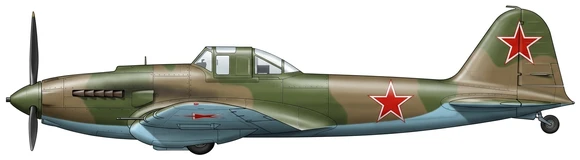
| Crew | 2 |
| Length | 11.7 m (38.2 ft) |
| Wingspan | 14.6 m (47.9 ft) |
| Height | 4.2 m (13.7 ft) |
| Wing area | 38.5 m² (414.4 sqft) |
| Empty weight | 4,425 kg (9,755 lbs) |
| Max. takeoff weight | 6,360 kg (14,021 lbs) |
| Powerplant | 1 × V12 piston engine Mikulin AM-38F 1,280 kW each |
| Maximum speed | 410 km/h (255 mph) |
| Operational range | 765 km (475 mi) |
| Endurance | 3 hours |
| Service ceiling | 4,525 m (14,846 ft) |
| Climb rate | 5.56 m/s (18.2 ft/s) |
- Rocket Pod RS-82
- Rocket Pod RS-132
- Unguided Bomb FAB-50
- Unguided Bomb FAB-100
- Cluster Bomb PTAB-2.5-1.5
Description
The Ilyushin Il-2 is a Soviet ground-attack aircraft produced by Ilyushin during World War II. Entering service in May 1941, the aircraft saw widespread action on the Eastern Front. Known commonly as the Sturmovik and designated Bark by NATO, the type earned nicknames including "Ilyusha" and the "Flying Tank" due to its armored hull design.
Development
Designed by Sergey Ilyushin in 1938, the prototype TsKB-55 first flew on 2 October 1939 under the VVS designation BSh-2. The design was subsequently lightened and re-engined as the single-seat TsKB-57 powered by a low-altitude Mikulin AM-38 engine, completing its first flight on 12 October 1940. It passed state acceptance trials in March 1941 and received the designation Il-2 in April 1941. Production took place across multiple facilities, including State Aviation Factories No. 1, No. 18, and No. 381, yielding a total of 36,183 units.
Design
The Il-2 is a single-engine, low-wing monoplane built with mixed metal and wood construction. The forward fuselage features an integrated armored shell made of riveted AB-1 steel plates between 5 and 12 mm thick, protecting the cockpit, engine, radiators, and fuel tanks as a load-bearing structural component. Power was supplied by Mikulin AM-38 series liquid-cooled V12 engines driving a three-bladed propeller. Later production models introduced 15-degree swept-back outer wing panels to shift the aerodynamic center and offset weight added by the rear gunner station.
Armament
Forward armament comprised two 23 mm VYa-23 cannons (or 20 mm ShVAK cannons on early aircraft) and two 7.62 mm ShKAS machine guns. Two-seat variants incorporated a flexible rear-firing 12.7 mm Berezin UBT machine gun. Payload capacity reached up to 600 kg of ordnance carried in internal wing bays and on underwing hardpoints, including 50 kg or 100 kg FAB bombs, RS-82 or RS-132 rockets, or up to 220 PTAB-2.5-1.5 anti-tank bomblets.
Operational History
The Il-2 entered combat in June 1941 with the 4th Ground Attack Regiment over the Berezina River. It saw continuous deployment on the Eastern Front, where units utilized tactics such as low-level shallow dives and the "circle of death" defensive formation. In addition to ground strike missions against armored forces, the type engaged Luftwaffe transport aircraft and bombers. Postwar operators included Bulgaria, Czechoslovakia, Hungary, Mongolia, Poland, and Yugoslavia.
Variants
-
TsKB-55: Two-seat prototype powered by a Mikulin AM-35 engine that made its first flight on 2 October 1939.
-
Il-2 two-seat: Production variant introduced in late 1942 featuring an added rear gunner position equipped with a 12.7 mm UBT machine gun.
-
Il-2 with NS-37: Anti-tank variant fitted with underwing pods containing 37 mm Nudelman-Suranov NS-37 cannons, used during the Battle of Kursk.
-
Il-2 production 1944: Variant featuring swept-back all-metal outer wing panels designed to restore center of gravity and handling qualities.
-
Il-2U: Dual-control training variant developed for pilot instruction.
Frequently Asked Questions
What type of aircraft is the Il-2 Sturmovik?
What is the maximum speed of the Il-2 Sturmovik?
What is the range of the Il-2 Sturmovik?
When did the Il-2 Sturmovik first fly?
How many Il-2 Sturmovik have been built?
What is the service ceiling of the Il-2 Sturmovik?
- AUG 62026 Created Page created: Il-2 Sturmovik