SAAB 105
Swedish jet trainer, deployed in mid-20th century, extensively utilized for training, light attack and reconnaissance missions in the Scandinavian region. Key figures: top speed 970 km/h, range 2,300 km, service ceiling 13,700 m, max takeoff weight 4,635 kg, built 192.
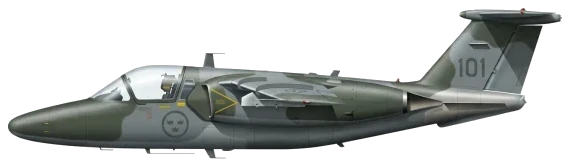
| Length | 10.8 m (35.4 ft) |
| Wingspan | 9.5 m (31.2 ft) |
| Height | 2.7 m (8.9 ft) |
| Wing area | 16.3 m² (175.5 sqft) |
| Empty weight | 2,849 kg (6,281 lbs) |
| Max. takeoff weight | 4,635 kg (10,218 lbs) |
| Powerplant | 2 × turbojets General Electric J85-GE-17B 1,293 kgf each |
| Maximum speed | 970 km/h (603 mph) |
| Operational range | 2,300 km (1,429 mi) |
| Service ceiling | 13,700 m (44,948 ft) |
Description
The Saab 105 is a Swedish high-wing, twinjet trainer and light attack aircraft developed by Saab AB. Designated SK 60 by the Swedish Air Force, the aircraft entered service in 1967 to replace the De Havilland Vampire fleet. The type served in trainer, reconnaissance, and light attack roles, and was used by aerial display teams including Sweden's Team 60 as well as Austria's Karo As and Silver Birds.
Development
Saab initiated development of the 105 in 1959 as a private venture intended for both military and civil business jet roles. The prototype made its maiden flight on 29 June 1963, demonstrating suitable handling qualities for aerobatic flight testing. The Swedish Air Force authorized an initial order of 130 aircraft on 6 March 1965, eventually acquiring 150 production units. Austria ordered 40 aircraft designated the Saab 105Ö, featuring strengthened wings to carry heavier underwing payloads and upgraded avionics for high-altitude operations.
Design
The Saab 105 is an all-metal aircraft featuring a T-tail, pressurized cabin, and modestly swept wings. Power was originally supplied by two Turbomeca Aubisque (RM9) low-bypass turbofans mounted beneath the wing roots, though some variants were built with General Electric J85 engines or upgraded with Williams International FJ44 (RM15) turbofans. The flight deck accommodates ejection seats arranged side-by-side, which can be swapped for a four-seat bench configuration in transport variants, while specialized surveillance variants carry nose-mounted reconnaissance cameras or radiation detection equipment.
Armament
The aircraft features six underwing hardpoints for mounting munitions and operational stores. In ground-attack missions, the type carries 75 mm, 127 mm, and 135 mm unguided rockets, air-to-ground missiles, bombs, napalm, or gun pods containing either 30 mm cannons or 7.62 mm machine guns. For air defense roles, the Saab 105 can equip AIM-9 Sidewinder air-to-air missiles alongside cannon pods.
Operational History
Swedish pilot training on the SK 60 began in July 1967, while Austrian pilot training on the Saab 105Ö commenced in July 1970. In 1993, Sweden contracted the re-engining of its SK 60 fleet with Williams FJ44 engines, re-delivering the upgraded SK 60W variant starting in September 1996, followed by a 2009 cockpit modernization program to increase compatibility with the JAS 39 Gripen. The Austrian Air Force operated its 40 aircraft until their complete retirement in December 2020. The Swedish Air Force officially retired the SK 60 on 18 June 2024 after 57 years of service.
Variants
- SK 60A: Two-seat jet trainer and liaison aircraft produced for the Swedish Air Force.
- SK 60B: Light attack variant for the Swedish Air Force equipped with a modified weapons sight.
- SK 60C: Dual-role attack and reconnaissance variant built with an extended camera nose.
- SK 60W: Modernized Swedish variant re-engined with twin Williams International FJ44 turbofans.
- Saab 105Ö: Lightweight multi-role export variant built for the Austrian Air Force featuring strengthened wings and modified engines.
Frequently Asked Questions
What type of aircraft is the SAAB 105?
What is the maximum speed of the SAAB 105?
What is the range of the SAAB 105?
When did the SAAB 105 first fly?
How many SAAB 105 have been built?
Which countries operate the SAAB 105?
What is the service ceiling of the SAAB 105?
- AUG 62026 Updated Description updated
- APR 72026 Updated Sources and cross-references refreshed
- FEB 72026 Updated Ceiling added
- JAN 122026 Updated Range updated in a site-wide editorial pass