CM 170 Magister
French jet trainer, predominantly used during the Cold War, notable for its operational deployment by various air forces worldwide. Key figures: top speed 715 km/h, range 1,200 km, service ceiling 9,144 m, max takeoff weight 3,450 kg, unit price $0.8M, built 929.
| Crew | 2 |
| Length | 10.2 m (33.5 ft) |
| Wingspan | 11.3 m (37.2 ft) |
| Height | 2.9 m (9.5 ft) |
| Wing area | 17.3 m² (186.2 sqft) |
| Empty weight | 2,540 kg (5,600 lbs) |
| Max. takeoff weight | 3,450 kg (7,606 lbs) |
| Powerplant | 2 × turbojets Turbomeca Marboré II G3 440 kgf each |
| Maximum speed | 715 km/h (444 mph) |
| Operational range | 1,200 km (746 mi) |
| Service ceiling | 9,144 m (30,000 ft) |
| Climb rate | 17.0 m/s (55.8 ft/s) |
| Takeoff distance | 720 m (2,362 ft) |
- Training SAMETO
Description
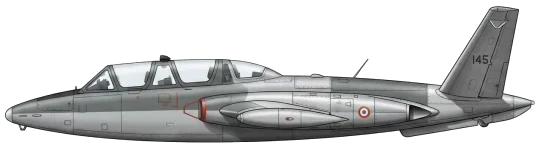
The Fouga CM.170 Magister is a two-seat jet trainer designed and built by Établissements Fouga & Cie of France. Identifiable by its butterfly (V) tail and wingtip tanks, it first flew in 1952 and served with the French Air Force and more than 20 other air arms as a basic and intermediate trainer, and in several countries as a light attack aircraft. Roughly 1,000 were built in France and under licence in West Germany, Finland and Israel.
Development
Design work began in 1948 under Pierre Mauboussin, Robert Castello and Jacques Henrat as the CM.130, a replacement for the piston-engined Morane-Saulnier MS.475. The Armée de l'Air judged the two Turbomeca Palas engines insufficient, so Fouga enlarged the airframe around two Turbomeca Marboré turbojets while retaining the butterfly tail of the CM.8 glider. Three prototypes were ordered in December 1950 and the first flew on 23 July 1952, followed by ten pre-production aircraft in June 1953 and an initial production order for 95 on 13 January 1954. Components were built by Morane-Saulnier at Ossun, Fouga at Aire-sur-l'Adour and Latécoère at Toulouse, with final assembly at Toulouse-Blagnac. West Germany was the first export customer with 62 aircraft bought direct and 188 built by Flugzeug Union Süd; Valmet and Israel Aircraft Industries also held licences, for 286 licence-built aircraft in total. French production ended in 1962; Finnish production continued to 1967.
Design
The Magister is a compact tandem-seat aircraft with a butterfly tail adopted after a conventional tail proved aerodynamically inferior at higher speeds; a ventral keel offsets the negative dihedral effect during rudder input. Two Turbomeca Marboré IIA turbojets of 3.9 kN (880 lbf) each sit close to the centreline, minimising asymmetric thrust; the CM.170-2 used the uprated Marboré VI. The engines share a common fuel system but have separate oil systems, and both can be replaced in 45 minutes. Wingtip tanks raise fuel capacity from 730 to 980 litres, giving 1,200 km range and 2 hr 40 min endurance. Maximum speed is 715 km/h at 9,100 m, service ceiling 11,000 m. Equipment included VHF radio, a Lear radio compass and intercom to NATO accessibility standards; the cockpit was pressurised and ejection seats were optional rather than standard. A binocular periscope and bulged windscreen compensated for the rear instructor's forward view.
Armament
Two 7.5 mm or 7.62 mm machine guns could be fitted in the nose with 200 rounds per gun. Two underwing hardpoints carried up to 140 kg of stores, including 50 kg bombs, T 10, T 900 or SNEB rocket pods, and Nord Aviation SS.11 anti-tank missiles.
Operational History
Israel received its first aircraft in 1957 and built the type as the IAI Tzukit. In the 1967 Six-Day War, 147 Squadron flew 44 Magisters against Egyptian and Jordanian forces, claiming over 50 tanks and 70 other armoured vehicles for the loss of seven aircraft and six pilots. Katanga received three of nine ordered aircraft in February 1961; one attacked UN forces at Jadotville, destroying two DC-4s and a DC-3 on the ground. El Salvador operated twelve ex-Israeli and French aircraft in the civil war, losing none to enemy fire. Morocco flew Magisters against the Polisario until losses led to withdrawal from combat in the 1980s. Finland operated the type from 1958 to 1988, losing 21 in accidents. Ireland's Air Corps flew six from 1975 to 1999; Belgium retired the last in September 2007. Display users included the Patrouille de France (1964–1980), the Red Devils, the Silver Swallows and Brazil's Esquadrilha da Fumaça (1968–1975).
Variants
- CM.170-1 Magister: First production version with Marboré II engines; 761 built, including 188 in West Germany, 62 in Finland and 50 in Israel.
- CM.170-2 Magister: Version with 4.7 kN Marboré VI engines; 137 built.
- CM.175 Zéphyr: Carrier-capable trainer for the Aéronavale with strengthened undercarriage, catapult attachments and arrestor hook; 30 built.
- CM.171 Makalu: Enlarged airframe with 10.8 kN Turbomeca Gabizo engines; sole prototype lost on 20 March 1957.
- IAI Tzukit: Israeli rebuild with new cockpit, new engines and composite materials, incorporating over 250 modifications.
Frequently Asked Questions
What type of aircraft is the CM 170 Magister?
What is the maximum speed of the CM 170 Magister?
What is the range of the CM 170 Magister?
When did the CM 170 Magister first fly?
How many CM 170 Magister have been built?
Which countries operate the CM 170 Magister?
How much does a CM 170 Magister cost?
What is the service ceiling of the CM 170 Magister?
- AUG 302026 Updated Description updated
- AUG 52026 Updated Climb rate added
- JUL 232026 Updated Sources and cross-references refreshed
- APR 72026 Updated Sources and cross-references refreshed
- JAN 242026 Updated Top speed updated