Shahed 129
Iranian single-engine medium-altitude long-endurance unmanned combat aerial vehicle, introduced in 2013, utilized for intelligence, surveillance, reconnaissance, and precision airstrikes. Key figures: top speed 175 km/h, range 1,700 km, service ceiling 7,300 m, unit price $2M, built 42. In service with 1 air force as of 2026 — Iran (23).
| Length | 8 m (26.2 ft) |
| Wingspan | 16 m (52.5 ft) |
| Height | 3.1 m (10.2 ft) |
| Powerplant | 1 × Rotax 914 75 kW each |
| Maximum speed | 175 km/h (109 mph) |
| Operational range | 1,700 km (1,056 mi) |
| Endurance | 24 hours |
| Service ceiling | 7,300 m (23,950 ft) |
- Anti-Tank Sadid-1
- Anti-Tank Sadid-361
- Anti-Tank Fat'h 362
- Guided Bomb Sadid-345
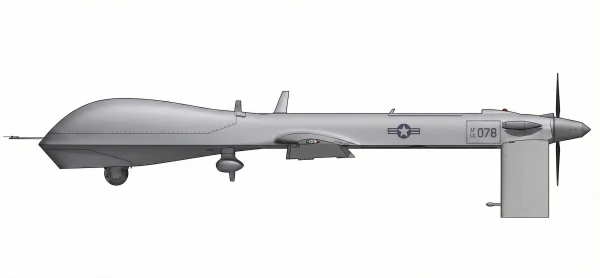

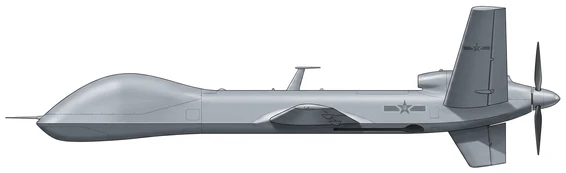
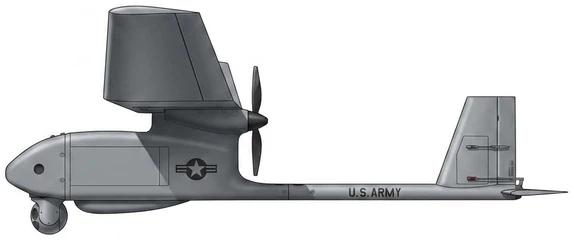
Description
The Shahed 129 is a single-engine medium-altitude long-endurance (MALE) unmanned combat aerial vehicle (UCAV) designed by Shahed Aviation Industries and manufactured by Iran Aircraft Manufacturing Industries Corporation (HESA). Development originated in 2005 with the HESA-100, which evolved into the Shahed 123 and eventually the Shahed 129. Some reports indicate the design was reverse-engineered from an Israeli Hermes 450. The first prototype (model 129-001) conducted its first flight in spring 2012, and serial production commenced in September 2013. Iran has ordered 40 units for delivery through 2024, with a reported production rate of approximately three aircraft per year.
Design
The aircraft utilizes a pusher configuration powered by a 75 kW Rotax 914 engine. The 8-meter fuselage is constructed from composite panels with an aluminum alloy superstructure, featuring high-mounted straight wings and a V-tail vertical stabilizer. Avionics include an Oghab-6 electro-optical/infrared gimbal, a laser range finder, and a real-time video data link. While the airframe has a 1,700 km combat range and 24-hour endurance, its operational radius is limited by a ground control station datalink estimated between 200 and 400 km. An autopilot system allows the aircraft to follow waypoints beyond the range of the control station.
Armament
Armament consists of up to four munitions carried on two twin hardpoints. Initial designs utilized the Sadid-1 TV-guided anti-tank missile, but this was not operationally deployed due to launcher and guidance issues. The platform was subsequently integrated with the Sadid-345 precision-guided munition. The aircraft has a total payload capacity of 400 kg.
Operational History
The Islamic Revolutionary Guard Corps (IRGC) deployed the Shahed 129 to Syria in May 2014. It conducted its first wartime strike in February 2016 and has performed hundreds of sorties in the Syrian conflict. In June 2017, U.S. F-15E Strike Eagles shot down two Shahed 129s near al-Tanf, Syria, following an attempted strike on coalition forces. A third unit was shot down by a Pakistani JF-17 in June 2017 after entering Pakistani airspace. The UAV is also used for border patrol on Iran’s eastern border and was utilized for damage assessment during the 2017 Deir ez-Zor missile strike. In 2022, reports indicated Russia acquired 46 Iranian drones, including Shahed 129 models, for use in Ukraine.
Variants
- Second Generation: Features a redesigned bulging nose for possible satellite navigation or synthetic aperture radar and an increased claimed range of 3,000 km.
- Simorgh: A naval version of the aircraft introduced in December 2019.
- SAR Variant: A 2023 version equipped with an external synthetic aperture radar sensor attached to the fuselage.
Frequently Asked Questions
What type of aircraft is the Shahed 129?
What is the maximum speed of the Shahed 129?
What is the range of the Shahed 129?
When did the Shahed 129 first fly?
How many Shahed 129 have been built?
Which countries operate the Shahed 129?
How much does a Shahed 129 cost?
What is the service ceiling of the Shahed 129?
- AUG 202026 Updated Unit price filled (2.0 $M) for the UAV inventory weighting. Basis: estimate.
- APR 72026 Updated Sources and cross-references refreshed
- JAN 242026 Updated Top speed updated
- JAN 172026 Updated First flight, bombs and 3 more fields updated
- JAN 162026 Created Page created: Shahed 129