Yak-9 Frank
Soviet single-engine multipurpose fighter aircraft, introduced during World War II and operated through the early Cold War for air defense, attack, and escort roles. Key figures: top speed 690 km/h, range 675 km, service ceiling 10,850 m, max takeoff weight 3,204 kg, built 16,769.
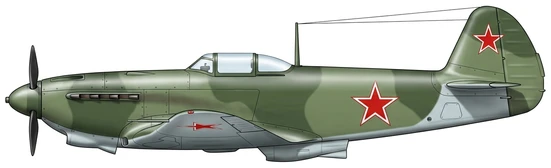
| Crew | 1 |
| Length | 8.6 m (28.1 ft) |
| Wingspan | 9.7 m (32.0 ft) |
| Height | 3 m (9.8 ft) |
| Wing area | 17.2 m² (184.6 sqft) |
| Empty weight | 2,512 kg (5,538 lbs) |
| Max. takeoff weight | 3,204 kg (7,064 lbs) |
| Powerplant | 1 × V12 piston engine Klimov VK-107A 1,230 kW each |
| Maximum speed | 690 km/h (429 mph) |
| Operational range | 675 km (419 mi) |
| Service ceiling | 10,850 m (35,597 ft) |
| Climb rate | 18.9 m/s (62.0 ft/s) |
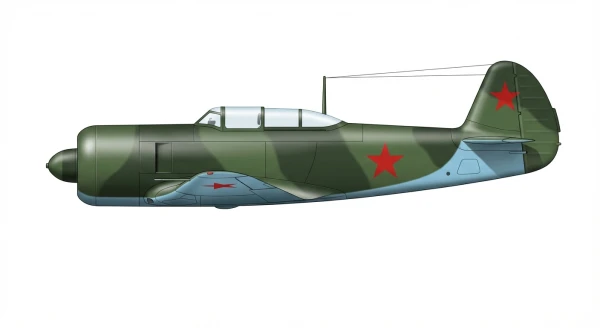
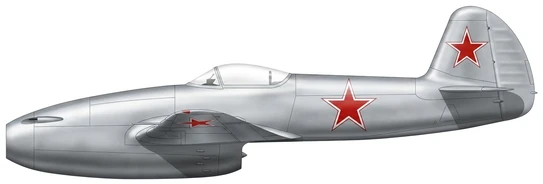
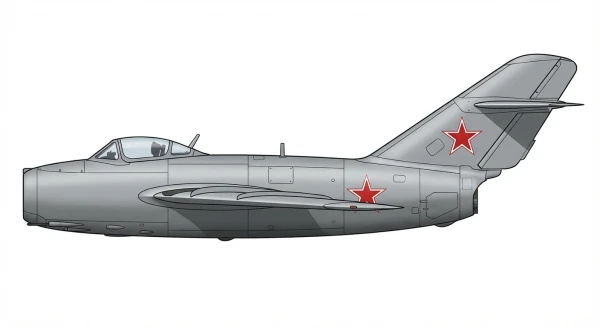
Description
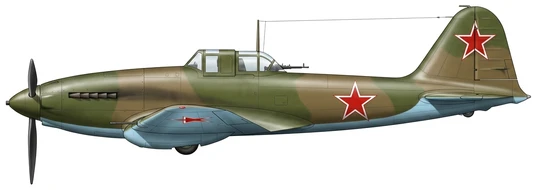
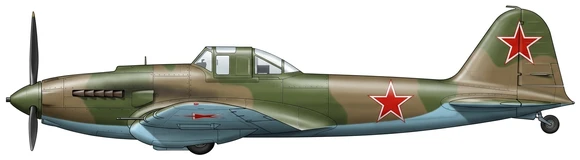
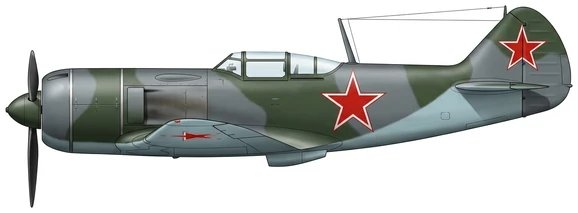
The Yakovlev Yak-9 (NATO reporting name: Frank) was a single-engine, single-seat multipurpose fighter aircraft designed by the Yakovlev Design Bureau and produced in the Soviet Union. Entering service in October 1942, the aircraft was operated by the Soviet Air Force and allied nations during World War II and the early Cold War. It gained recognition during the Battle of Kursk in 1943 for countering Luftwaffe Focke-Wulf Fw 190 and Messerschmitt Bf 109 fighters, becoming one of the most produced Soviet fighter aircraft in history.
Development
The Yak-9 was developed from the Yak-7B fighter, which originated from the lightened Yak-7DI prototype and the Yak-7UTI trainer. Increased availability of duralumin enabled engineers to replace wooden structural components with lighter metal, accommodating larger fuel capacities and heavier armaments. Production began in 1942 and continued until 1948, yielding 16,769 aircraft, 14,579 of which were constructed during World War II.
Design
The Yak-9 featured a cut-down rear fuselage fitted with a clear, unobscured canopy to improve rearward visibility. Construction transitioned from composite wood and Bakelite skinning on variants like the Yak-9U to all-metal wing structures on late-model Yak-9P variants. Powerplants varied across production runs, ranging from the early 930 kW Klimov M-105PF engine to the 1,230 kW Klimov VK-107A V-12 liquid-cooled engine.
Armament
Standard armament on early models consisted of a single 20 mm ShVAK cannon firing through the hollow propeller shaft and one 12.7 mm Berezin UBS machine gun. Specialized variants incorporated heavier nose cannon installations, including 37 mm NS-37 cannons and 45 mm NS-45 cannons fitted with muzzle brakes. The Yak-9B fighter-bomber variant integrated four vertical tube bomb bays behind the cockpit to carry up to 400 kg of FAB-100 bombs or PTAB bomblet cassettes.
Operational History
The Yak-9 saw combat on the Eastern Front, flying low-altitude escort, anti-tank, and air-superiority missions. It was operated by Soviet units, the Free French Normandie-Niémen squadron, and deployed from Bari, Italy, to support Yugoslav partisans. Post-WWII operators included North Korea, Albania, Bulgaria, China, Hungary, Mongolia, Poland, and Yugoslavia; North Korean Yak-9s were used during the Korean War, while Soviet units buzzed Allied transports during the Berlin Blockade.
Variants
- Yak-9T: Equipped with a 37 mm NS-37 cannon firing through the propeller hub, this variant was built for anti-tank and anti-aircraft duties.
- Yak-9K: Designed as a heavy fighter, this model carried a 45 mm NS-45 cannon fitted with a muzzle brake to absorb recoil.
- Yak-9D: Developed for long-range operations, this variant incorporated larger wing fuel tanks extending maximum fuel capacity to 650 liters.
- Yak-9B: Configured as a fighter-bomber, this variant contained four internal vertical tube bomb bays behind the pilot's seat.
- Yak-9U: Powered by a 1,230 kW Klimov VK-107A engine, this variant featured refined aerodynamics and metal wing construction.
Frequently Asked Questions
What type of aircraft is the Yak-9 Frank?
What is the maximum speed of the Yak-9 Frank?
What is the range of the Yak-9 Frank?
When did the Yak-9 Frank first fly?
How many Yak-9 Frank have been built?
What is the service ceiling of the Yak-9 Frank?
- AUG 62026 Created Page created: Yak-9 Frank