La-7 Fin
Soviet piston-engined single-seat fighter aircraft developed during World War II, introduced in 1944 and operated through the late 1940s. Key figures: top speed 661 km/h, range 665 km, service ceiling 10,450 m, max takeoff weight 3,315 kg, built 5,753.
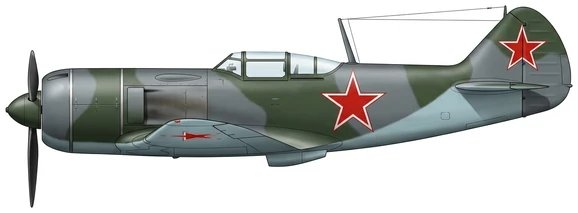
| Crew | 1 |
| Length | 8.6 m (28.2 ft) |
| Wingspan | 9.8 m (32.2 ft) |
| Height | 2.5 m (8.3 ft) |
| Wing area | 17.6 m² (189.3 sqft) |
| Empty weight | 2,638 kg (5,816 lbs) |
| Max. takeoff weight | 3,315 kg (7,308 lbs) |
| Powerplant | 1 × radial piston engine Shvetsov ASh-82FN 1,380 kW each |
| Maximum speed | 661 km/h (411 mph) |
| Operational range | 665 km (413 mi) |
| Service ceiling | 10,450 m (34,285 ft) |
| Climb rate | 15.7 m/s (51.5 ft/s) |
- Unguided Bomb 200 kg of bombs
Description
The Lavochkin La-7 (NATO reporting name: Fin) is a single-seat, piston-engined Soviet fighter aircraft developed during World War II by the Lavochkin Design Bureau. It was a refinement of the La-5 and the final production model of an aircraft family that began with the LaGG-1 in 1938. The aircraft first flew in early 1944 and entered service with the Soviet Air Forces later that year. Outside the Soviet Union, the La-7 served exclusively with the Czechoslovak Air Force.
Development
In 1943, Semyon Lavochkin and the Central Aerohydrodynamics Institute (TsAGI) initiated improvements to the La-5 airframe. TsAGI modified an La-5FN airframe to evaluate aerodynamic changes between December 1943 and February 1944. Lavochkin constructed an improved prototype designated the etalon in January 1944, incorporating metal wing spars to reduce weight. Following flight testing in early 1944, the design was ordered into production as the La-7. Initial deliveries began in March 1944 from Factory Nr. 381 in Moscow, with additional production handled by Zavod Nr. 21 in Gorky and Nr. 99 in Ulan-Ude. A total of 5,753 La-7 fighters and 584 La-7UTI trainers were built before production ended in early 1946.
Design
The La-7 uses a mixed wood and alloy construction, replacing wooden wing spars with metal components. The aircraft is powered by a Shvetsov ASh-82FN 14-cylinder radial engine rated at 1,380 kW (1,850 hp), driving a three-bladed VISh-105V-4 propeller. Aerodynamic modifications over the La-5 included engine air intakes relocated to the wing roots, a fully sealed engine cowling, individual exhaust pipes per cylinder, and streamlined wing-to-fuselage fillets. Cockpit equipment includes a PB-1B(V) gunsight and a protective rollbar.
Armament
Standard La-7 aircraft are armed with two cowl-mounted 20 mm ShVAK autocannons firing through the propeller arc. Beginning in January 1945, a variant was produced carrying three cowl-mounted 20 mm Berezin B-20 cannons. For ground attack roles, the aircraft carries up to 200 kg (440 lb) of bombs on external hardpoints.
Operational History
The 63rd GIAP conducted combat trials with 30 La-7s starting in mid-September 1944 on the 1st Baltic Front. Initial deployments revealed reliability problems with the engine, caused partly by dust ingestion through the lower wing-root intakes, as well as structural wing spar defects in early batches. By May 9, 1945, front-line Soviet strength reached 967 La-7 aircraft. Soviet ace Ivan Kozhedub flew the La-7 for his final 17 aerial victories, including an Me 262 jet fighter. The Czechoslovak Air Force received 56 aircraft in 1945, operating them postwar under the designation S-97 until 1950. The Soviet Air Force retired the type in 1947.
Variants
- La-7TK: High-altitude testbed equipped with a TK-3 turbosupercharger evaluated in July 1944.
- La-7R: Testbed fitted with a tail-mounted RD-1KhZ liquid-fuelled rocket engine to provide temporary speed boosts.
- La-7PVRD: Experimental testbed fitted with two underwing ramjet engines.
- La-7/M-71: Prototype fitted with a Shvetsov M-71 radial engine for trial evaluations in 1944.
- La-7UTI: Two-seat trainer variant featuring reduced armament, a relocated oil cooler, and a radio compass.
Frequently Asked Questions
What type of aircraft is the La-7 Fin?
What is the maximum speed of the La-7 Fin?
What is the range of the La-7 Fin?
When did the La-7 Fin first fly?
How many La-7 Fin have been built?
What is the service ceiling of the La-7 Fin?
- AUG 62026 Created Page created: La-7 Fin