Yak-152
Russian primary trainer aircraft developed in the 2010s, designed to replace older training aircraft for military and civil pilot instruction. Key figures: top speed 500 km/h, range 1,500 km, service ceiling 4,000 m, max takeoff weight 1,490 kg, built 4.
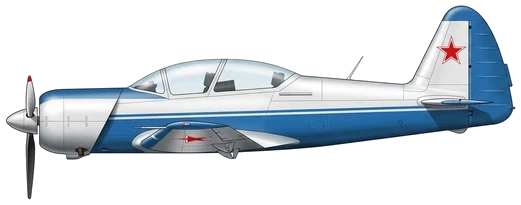
| Crew | 1 |
| Length | 7.7 m (25.3 ft) |
| Wingspan | 8.8 m (28.9 ft) |
| Height | 2.5 m (8.1 ft) |
| Max. takeoff weight | 1,490 kg (3,285 lbs) |
| Powerplant | 1 × V12 piston engine RED Aircraft A03 370 kW each |
| Maximum speed | 500 km/h (311 mph) |
| Operational range | 1,500 km (932 mi) |
| Service ceiling | 4,000 m (13,123 ft) |
| Climb rate | 10.0 m/s (32.8 ft/s) |
Description
The Yakovlev Yak-152 is a Russian primary trainer aircraft designed by the Yakovlev Design Bureau, a subsidiary of the Irkut Corporation, and manufactured in Irkutsk. Intended for military and general aviation pilot training, the type was selected to replace the aging Yakovlev Yak-52 in the Russian Aerospace Forces. The prototype aircraft conducted its maiden flight on 29 September 2016.
Development
Development of the Yak-152 began in the 1990s based on the Yakovlev Yak-54 design, progressing in parallel with the Yak-130 turbofan trainer. Both aircraft were designed with matching cockpit layouts to simplify student transition from the lighter trainer to the Yak-130. Selected in 2001 as the future primary trainer for the Russian Air Force, the project experienced delays during the early 2000s due to limited funding. Investment from Chinese backers in 2006 supported further project work, leading to the creation of the Hongdu Yakovlev CJ-7 variant equipped with a Vedeneyev M14X radial piston engine. The initial Yak-152 prototype was fitted with a German-built RED A03 diesel engine. Following international sanctions that halted engine imports, Yakovlev shifted focus toward integrating domestic powerplants, such as the VMZ M-9F piston engine and Klimov VK-800 turboshaft. Military flight testing was completed in January 2024.
Design
The Yak-152 features a single-engine configuration measuring 7.72 m in length, 2.47 m in height, and spanning 8.82 m across the wings. The aircraft accommodates a crew of one alongside one passenger, featuring a gross weight of 1,320 kg, a maximum takeoff weight of 1,490 kg, and an internal fuel capacity of 200 kg. Power is supplied by a 370 kW (500 hp) RED Aircraft A03 V-12 four-stroke diesel engine driving the prototype. Flight envelope characteristics include structural g-limits of +9/-7, a rate of climb of 10 m/s, a service ceiling of 4,000 m, and a maximum range of 1,500 km. Maximum speed is 500 km/h, with a stall speed of 100 km/h.
Operational History
In 2016, the Russian Ministry of Defence announced plans to procure 150 Yak-152 trainers for the Russian Aerospace Forces following the start of mass production. Outside the military, the Russian civil training organization DOSAAF planned an order of 105 units for pilot instruction. The Belarusian DOSAAF has also stated interest in acquiring the aircraft.
Frequently Asked Questions
What type of aircraft is the Yak-152?
What is the maximum speed of the Yak-152?
What is the range of the Yak-152?
When did the Yak-152 first fly?
How many Yak-152 have been built?
Which countries operate the Yak-152?
What is the service ceiling of the Yak-152?
- AUG 62026 Created Page created: Yak-152