Yak-24 Horse
Soviet twin-engine, tandem rotor transport helicopter developed in the 1950s, used for troop and cargo transport by the Soviet Air Force. Key figures: top speed 175 km/h, range 380 km, service ceiling 4,000 m, max takeoff weight 15,830 kg, built 35.
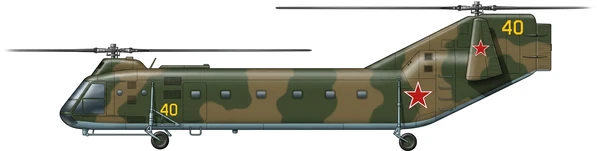
| Crew | 3 (2 pilots, radio operator) |
| Length | 22.4 m (73.5 ft) |
| Wingspan | 20 m (65.6 ft) |
| Height | 6.5 m (21.3 ft) |
| Wing area | 693 m² (7459.4 sqft) |
| Empty weight | 11,000 kg (24,251 lbs) |
| Max. takeoff weight | 15,830 kg (34,899 lbs) |
| Powerplant | 2 × radial piston engines Shvetsov ASh-82V 1,300 kW each |
| Maximum speed | 175 km/h (109 mph) |
| Operational range | 380 km (236 mi) |
| Service ceiling | 4,000 m (13,123 ft) |
| Climb rate | 3.15 m/s (10.3 ft/s) |
Description
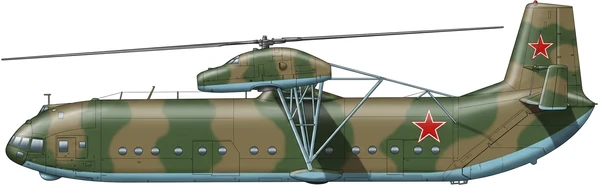
The Yakovlev Yak-24 (NATO reporting name "Horse") was a Soviet twin-engine, tandem-rotor transport helicopter developed by the Yakovlev Design Bureau in the 1950s. Entering production in 1955, it served in limited numbers with the Soviet Air Force as a troop and cargo transport. The aircraft is known for its tandem rotor layout, which earned it the nickname "Flying Railroad Car," and for setting world payload records in 1955.
Development
In September 1951, Joseph Stalin met with senior aircraft designers, leading to an official requirement for a heavy transport helicopter capable of carrying 24 people. The Yakovlev Design Bureau was assigned the development under Alexander Yakovlev, building two flight test prototypes and one static ground test frame with support from national research institutes. The first prototype flew on 3 July 1952. Production was ordered for the Soviet Air Force in 1955 and took place at Factory No. 272 in Leningrad. Total production numbers are uncertain, with estimates ranging from 40 to 100 units, though newer Russian sources state that 35 production models were built between 1956 and 1958 alongside two prototypes and three pre-series units. Manufacturing was curtailed due to persistent technical problems, and the heavy transport role was subsequently assumed by the Mil Mi-6.
Design
The Yak-24 utilized a tandem rotor configuration powered by two 1,268 kW (1,700 hp) Shvetsov ASh-82V 14-cylinder radial engines. Its engines and transmission systems were identical to those on the single-engine Mil Mi-4, with both engines linked so that either could drive one or both rotors. This mechanical arrangement produced severe airframe vibrations that were only partially resolved during development. The helicopter had a fuselage length of 22.40 m, a main rotor diameter of 20.00 m, and a maximum takeoff weight of 15,830 kg.
Armament
The Yak-24 was fitted with a 12.7 mm A-12,7 machine gun in the nose, operated by the radio operator. The cabin could accommodate 2,000 kg of internal cargo, including field guns or a GAZ-69 utility vehicle, and the aircraft could lift up to 4,000 kg as an external sling load.
Operational History
The Yak-24 was operated exclusively by the Soviet Air Force. The helicopter was first displayed publicly at Tushino in July 1955. On 17 December 1955, the type set two world payload records by lifting a 2,000 kg load to 5,082 m and a 4,000 kg load to 2,902 m. Due to data inconsistencies, the exact service record and decommissioning date of the Yak-24 remain unknown.
Variants
-
Yak-24: Initial military production transport variant capable of carrying 19 troops, 12 stretchers, or 2,000 kg of cargo.
-
Yak-24U: Improved 1957 variant featuring a wider all-metal fuselage and larger 21 m all-metal rotors that completed testing in 1958 but was not produced.
-
Yak-24A: Unbuilt 1960 civilian airliner variant planned for Aeroflot with seating for 30 passengers.
-
Yak-24K: Unbuilt nine-seat VIP salon variant designed with a shortened fuselage.
-
Yak-24P: Unbuilt 39-passenger civilian variant designed to be powered by two 2,013 kW (2,700 hp) turboshaft engines.
Frequently Asked Questions
What type of aircraft is the Yak-24 Horse?
What is the maximum speed of the Yak-24 Horse?
What is the range of the Yak-24 Horse?
When did the Yak-24 Horse first fly?
How many Yak-24 Horse have been built?
What is the service ceiling of the Yak-24 Horse?
- AUG 62026 Created Page created: Yak-24 Horse