Mi-4 Hound
Soviet transport helicopter, developed in the early 1950s, used extensively for military and civil roles across numerous global operators. Key figures: top speed 185 km/h, range 500 km, service ceiling 5,500 m, max takeoff weight 7,550 kg, built 3,500.
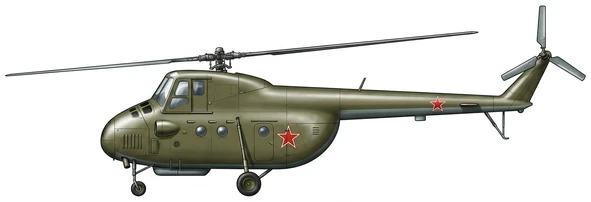
| Crew | 1–2 |
| Length | 16.8 m (55.1 ft) |
| Wingspan | 21 m (68.9 ft) |
| Height | 4.4 m (14.4 ft) |
| Wing area | 346.4 m² (3728.6 sqft) |
| Empty weight | 5,100 kg (11,244 lbs) |
| Max. takeoff weight | 7,550 kg (16,645 lbs) |
| Powerplant | 1 × Shvetsov ASh-82V 14-cylinder air-cooled radial piston engine 1,250 kW each |
| Maximum speed | 185 km/h (115 mph) |
| Operational range | 500 km (311 mi) |
| Service ceiling | 5,500 m (18,045 ft) |
- Anti-Tank 9M17M Phalanga
- Rocket Pod UB-16-57U
- Unguided Bomb 100-kg bomb
- Unguided Bomb 250-kg bomb
Description
The Mil Mi-4 (NATO reporting name "Hound") is a Soviet transport helicopter developed in response to the American H-19 Chickasaw and the use of rotary-wing aircraft during the Korean War. While it resembles the H-19’s configuration with the engine located in front of the cockpit, the Mi-4 is a larger airframe with greater lift capacity. The aircraft was first displayed publicly at Tushino Airfield in 1952 and entered service in 1953.
Design
The helicopter is powered by a single Shvetsov ASh-82V 14-cylinder air-cooled radial piston engine generating 1,250 kW. The Mi-4A variant has a maximum takeoff weight of 7,550 kg and a 21-meter main rotor. It accommodates a crew of one or two and can transport 16 troops or 1,600 kg of cargo. Specialized variants utilized various sensors and avionics, including the SPRS-1 "Kurs-M" or "Rubin-V" searching radar stations, "Baku" hydroacoustic stations, and "Soora" infrared sensors.
Armament
Armament was integrated into the Mi-4AV variant via the K-4V weapons complex. This configuration included four 9M17M "Phalanga" anti-tank guided missiles and 96 57-mm S-5M rockets housed in six UB-16-57U blocks. The variant could alternatively be configured to carry six 100-kg bombs, four 250-kg bombs, or incendiary tanks. A under-fuselage gun turret was also featured on specific versions like the Mi-4M.
Operational History
The Mi-4 provided the foundation for Soviet Army Aviation and served as the main helicopter for the Soviet Armed Forces until the introduction of the Mi-8. During the 1971 Bangladesh liberation war, the Indian Air Force used Mi-4s to conduct the Meghna Heli Bridge operation, transporting the 57 Mountain Division across the Meghna River. It was also used in the Indian Army's first heli-borne operation to deploy a battalion near Sylhet. Beyond military transport, the aircraft performed search and rescue, firefighting, and polar expedition support. Export customers included Albania, Cuba, Egypt, Iraq, and Vietnam. Production also occurred in China as the Harbin Z-5. While the aircraft was retired from Russian service, the North Korean Air Force maintained limited operations as of 2014.
Variants
- Mi-4A: The standard assault transport helicopter version for military use.
- Mi-4AV: An armed variant equipped with the K-4V weapons complex, including ATGMs, rockets, or bombs.
- Mi-4M: An anti-submarine warfare version fitted with a searching radar station and hydroacoustic equipment.
- Mi-4P: A civil transport model designed for 8 to 11 passengers, distinguishable by square cabin windows.
- Harbin Z-5: The Chinese-manufactured version of the military transport helicopter.
Frequently Asked Questions
What type of aircraft is the Mi-4 Hound?
What is the maximum speed of the Mi-4 Hound?
What is the range of the Mi-4 Hound?
When did the Mi-4 Hound first fly?
How many Mi-4 Hound have been built?
What is the service ceiling of the Mi-4 Hound?
- MAY 102026 Created Page created: Mi-4 Hound