Ka-22 Hoop
Soviet experimental rotorcraft combining helicopter and fixed-wing aircraft capabilities, tested during the late 1950s and early 1960s for heavy transport roles. Key figures: top speed 375 km/h, range 450 km, service ceiling 5,500 m, max takeoff weight 42,500 kg, built 4.
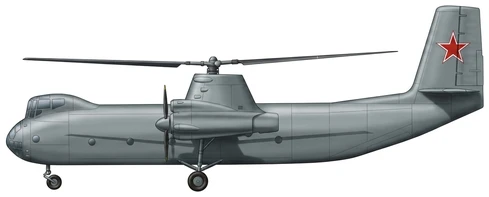
| Crew | 3 |
| Length | 27 m (88.6 ft) |
| Wingspan | 22.5 m (73.8 ft) |
| Wing area | 105 m² (1130.2 sqft) |
| Empty weight | 28,200 kg (62,170 lbs) |
| Max. takeoff weight | 42,500 kg (93,696 lbs) |
| Powerplant | 2 × turboshafts Soloviev D-25VK 4,045 kW each |
| Maximum speed | 375 km/h (233 mph) |
| Operational range | 450 km (280 mi) |
| Service ceiling | 5,500 m (18,045 ft) |
Description
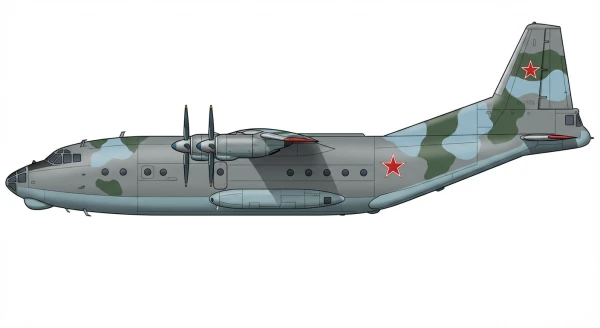
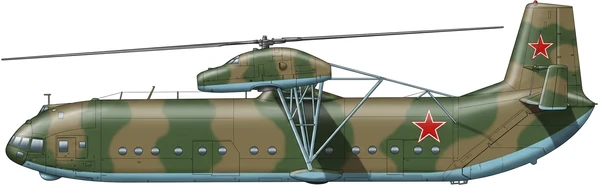
The Kamov Ka-22 Vintokryl (NATO reporting name: Hoop) was an experimental transport rotorcraft developed by Kamov for the Soviet Air Force. Designed to combine vertical take-off and landing capabilities with fixed-wing cruise flight, the aircraft featured a cargo hold comparable in capacity to the Antonov An-12. The Ka-22 set eight world altitude and speed records in its class, though the development program was cancelled before the aircraft entered operational service.
Development
To extend the range of conventional helicopters, Kamov designer Vladimir Barshevsky drafted a design combining wings and an aeroplane propulsion system. Authorization to build three Ka-22 aircraft was granted in 1954, though program delays resulted in the cancellation of the second and third prototypes on 28 March 1956. The initial prototype executed its first tethered lift on 17 June 1959, followed by its first untethered flight on 15 August 1959. Flight testing revealed control difficulties that delayed production, but a follow-on order for three additional aircraft was placed in July 1960.
Design
The Ka-22 featured a fixed-wing configuration with main rotors mounted above each wingtip. Each wingtip housed an engine driving both a four-bladed tractor propeller and a four-bladed main rotor. The initial prototype was powered by two 5,900 shp Kuznetsov TV-2VK engines, which were later replaced by 5,500 shp Soloviev D-25VK turboshaft engines.
The fuselage incorporated a three-seat cockpit positioned above a glazed nose, which hinged to open to starboard for cargo loading. The main cargo area accommodated up to 80 seats or 16.5 tonnes of payload. In helicopter mode, the propeller drives were disconnected and the wing flaps were lowered to 90 degrees. In fixed-wing cruise mode, the main rotors uncoupled to windmill while flight control transferred to conventional ailerons and tail surfaces. The aircraft utilized fixed twin-wheel main landing gear.
Operational History
During testing, pilots D.K. Yefremov and V.V. Gromov established eight world class records with the Ka-22. On 7 October 1961, fitted with wheel spats and a cockpit fairing, the aircraft set a class speed record of 356.3 km/h. After removing the spats and fairing, the aircraft lifted a payload of 16,485 kg to an altitude of 2,557 m on 24 November 1961. The Ka-22 made its sole public and Western appearance during the Soviet Aviation Day display in Moscow on 9 July 1961.
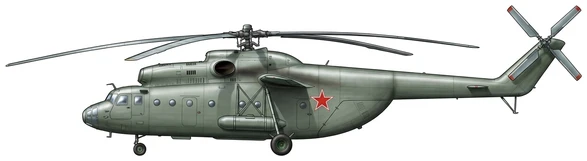
The program was disrupted by two fatal crashes during testing. On 28 August 1962, airframe 01-01 rolled inverted and crashed during a ferry flight to Moscow for acceptance testing, killing the entire crew due to a failure in the starboard rotor collective pitch control linkage. Following control system modifications, including the installation of a differential autopilot to sense attitude and angular accelerations, airframe 01-03 pitched into a steep dive during Soviet Air Force testing on 12 August 1964, killing pilot Col S.G. Brovtsev and technician A.F. Rogov. The Soviet Air Force subsequently terminated the program in favor of the Mil Mi-6, and the remaining airframes (01-02 and 01-04) were scrapped.
Frequently Asked Questions
What type of aircraft is the Ka-22 Hoop?
What is the maximum speed of the Ka-22 Hoop?
What is the range of the Ka-22 Hoop?
When did the Ka-22 Hoop first fly?
How many Ka-22 Hoop have been built?
What is the service ceiling of the Ka-22 Hoop?
- AUG 62026 Created Page created: Ka-22 Hoop