An-124 Condor
Soviet heavy transport aircraft, employed globally in strategic airlift operations during the Cold War era. Key figures: top speed 865 km/h, range 3,700 km, service ceiling 9,000 m, max takeoff weight 405,000 kg, unit price $100M, built 55. In service with 1 air force as of 2026 — Russia (5).
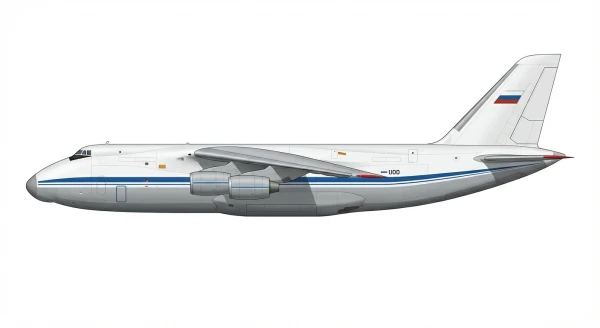
| Crew | 7 |
| Length | 69.0 m (226.2 ft) |
| Wingspan | 73.3 m (240.5 ft) |
| Height | 20.8 m (68.2 ft) |
| Wing area | 628 m² (6759.7 sqft) |
| Empty weight | 175,000 kg (385,808 lbs) |
| Max. takeoff weight | 405,000 kg (892,871 lbs) |
| Powerplant | 4 × turbofans Ivchenko-Progress D-18T 23,400 kgf each |
| Maximum speed | 865 km/h (537 mph) |
| Operational range | 3,700 km (2,299 mi) |
| Service ceiling | 9,000 m (29,528 ft) |
| Takeoff distance | 2,800 m (9,186 ft) |

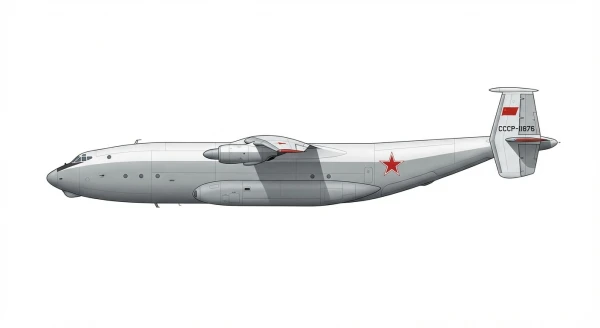
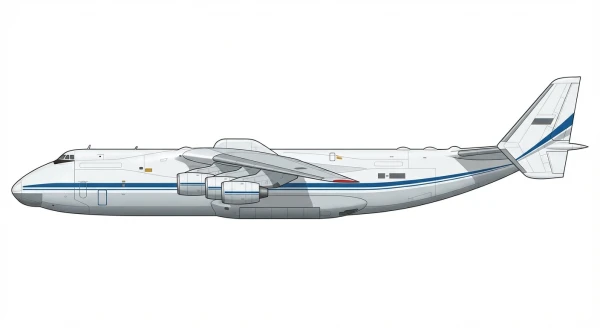
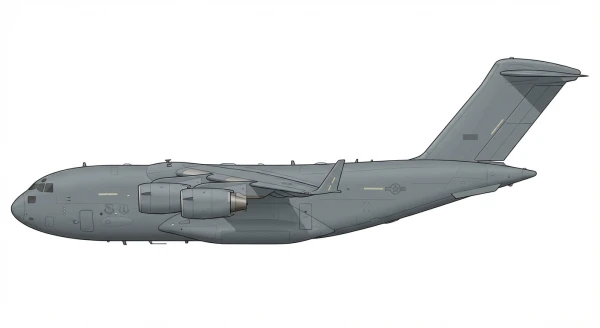
Description
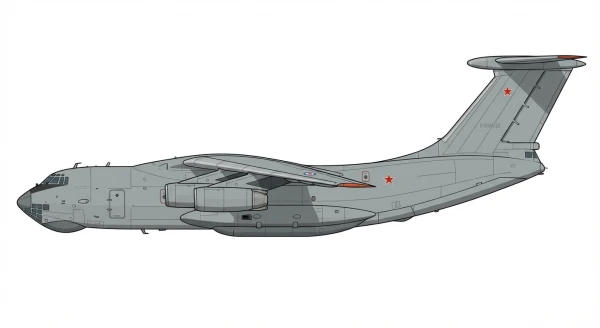
The Antonov An-124 Ruslan (NATO reporting name: Condor) is a four-engined strategic airlift aircraft designed by the Antonov Design Bureau in the Ukrainian SSR. It first flew on 24 December 1982 and remains the largest military transport aircraft in service, and the heaviest cargo aircraft in operation following the destruction of the one-off An-225 Mriya. It carries up to 150 tonnes internally and has been used extensively for outsize commercial and NATO charter cargo.
Development
Design work began in 1971 as Izdeliye 400, in response to a shortfall in Soviet Military Transport Aviation (VTA) heavy airlift capacity, which then rested on roughly 50 An-22 turboprops. A 1975 CIA analysis concluded the USSR did not match US long-range heavy lift capability. Viktor Tolmachev was lead designer. Construction of production facilities began in 1973 at Aviastar-SP in Ulyanovsk, Russia, and the Kyiv Aviation Plant AVIANT in Ukraine, drawing components from over 100 factories. Assembly of the first airframe started in 1979, with first flight on 24 December 1982 and a Western debut at the 1985 Paris Air Show. Civil certification followed on 30 December 1992. Many commercial deliveries were refurbished ex-military airframes or stored fuselages. Russia and Ukraine agreed in April 2008 to resume production, and the An-124-150 with 150-tonne capacity was announced a month later, but United Aircraft Corporation ruled out production for 2009–2012 and Russia halted the programme in August 2014. TsAGI announced the An-124-102 Slon replacement design at MAKS 2017, completing a first cycle of wind tunnel testing in March 2020. By 2019, 26 An-124s were in commercial service.
Design
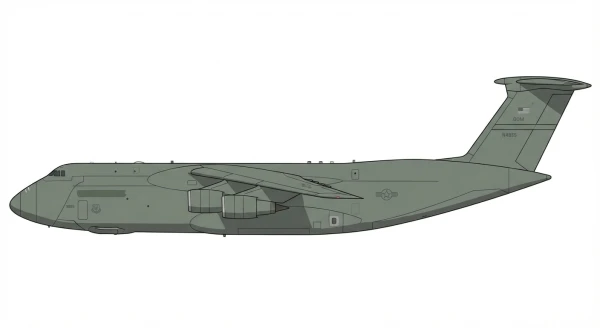
The layout resembles the Lockheed C-5 Galaxy, with a double fuselage permitting a rear cargo door that opens in flight, and similar slat, flap and spoiler arrangements, but uses a conventional empennage akin to the Boeing 747. The cargo hold measures 36 × 6.4 × 4.4 m, about 20% larger than the C-5's, with a titanium floor. Carbon-fibre composites account for around 5% of airframe weight; aluminium alloys predominate, with limited steel and titanium. Controls are hybrid fly-by-wire with mechanical backup arranged for hydraulic redundancy. Power comes from four Progress D-18T turbofans of 226.8 kN each, fitted with thrust reversers. The 24-wheel landing gear uses oleo strut suspension calibrated for rough fields and can kneel for loading. Two TA18-200-124 APUs are housed in the main gear fairings. Loading aids include a 30-tonne overhead crane and winches for loads to 120 tonnes. Two radars are fitted, one for ground mapping and navigation, one for weather. The upper deck seats 88 and is fully pressurised; the main hold is only partially pressurised at 24.6 kPa. There is no inflight refuelling capability.
Operational History
Under the NATO SALIS programme, NAMSA chartered six An-124-100s from Antonov Airlines and Volga-Dnepr on behalf of 18 nations, with two aircraft based full-time at Leipzig/Halle and further aircraft available at six and nine days' notice, supporting operations in Iraq and Afghanistan. United Launch Alliance uses the type to move Atlas V boosters and Centaur upper stages to Cape Canaveral and Vandenberg; SpaceX and Space Systems Loral also charter it. In May 1987 an An-124 flew 20,151 km unrefuelled in 25 hours 30 minutes at a takeoff weight of 455,000 kg. In July 1985 it lifted 171,219 kg to 2,000 m. Other cargoes included the Obelisk of Axum in April 2005, Putzmeister concrete pumps to Fukushima in April 2011, and Bundeswehr equipment from Mazar-i-Sharif in 2021. By 2013 the type had visited 768 airports in over 100 countries. UR-82009 was destroyed by Russian artillery at Antonov Airport on 24 February 2022. Five An-124 hull losses had occurred as of November 2020, with 97 fatalities.
Variants
- An-124 Ruslan: Baseline strategic heavy airlift transport.
- An-124-100: Commercial transport version.
- An-124-100M-150: Single conversion with 150-tonne payload, 420-tonne MTOW and uprated D-18T series 4 engines.
- An-124-210: Air Foyle joint proposal for the UK STSA requirement with RB211-524H-T engines and Honeywell avionics.
- An-124-300: Planned higher-thrust variant ordered by the Russian Aerospace Forces in 2020.
Frequently Asked Questions
What type of aircraft is the An-124 Condor?
What is the maximum speed of the An-124 Condor?
What is the range of the An-124 Condor?
When did the An-124 Condor first fly?
How many An-124 Condor have been built?
Which countries operate the An-124 Condor?
How much does a An-124 Condor cost?
What is the service ceiling of the An-124 Condor?
- AUG 302026 Updated Description updated
- AUG 52026 Updated Powerplant updated in a site-wide editorial pass
- APR 72026 Updated Sources and cross-references refreshed
- JAN 122026 Updated Range updated in a site-wide editorial pass