ATR-42
French-Italian regional airliner, noteworthy for operations throughout 1980s-2000s with more than 100 operators worldwide. Key figures: top speed 556 km/h, range 1,326 km, service ceiling 7,620 m, max takeoff weight 18,600 kg, unit price $20M, built 497. In service with 3 air forces as of 2026 — Myanmar (6), Nigeria (4), Colombia (1).
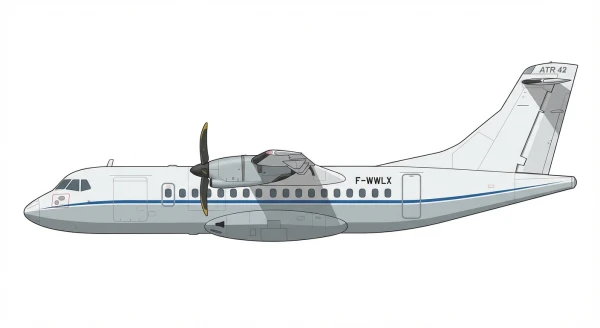
| Length | 22.7 m (74.4 ft) |
| Wingspan | 24.6 m (80.6 ft) |
| Height | 7.6 m (24.9 ft) |
| Wing area | 54.5 m² (586.6 sqft) |
| Empty weight | 11,250 kg (24,802 lbs) |
| Max. takeoff weight | 18,600 kg (41,006 lbs) |
| Powerplant | 2 × turboprops Pratt & Whitney Canada PW127E 1,790 kW each |
| Maximum speed | 556 km/h (345 mph) |
| Operational range | 1,326 km (824 mi) |
| Service ceiling | 7,620 m (25,000 ft) |
| Takeoff distance | 1,165 m (3,822 ft) |


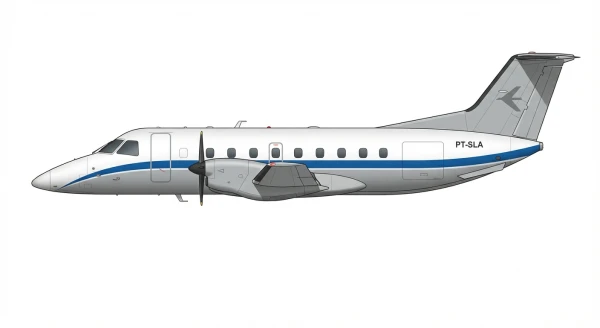
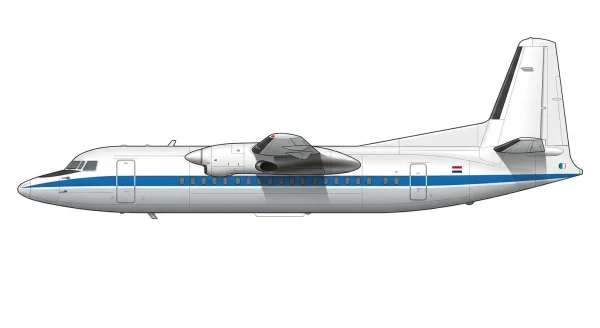
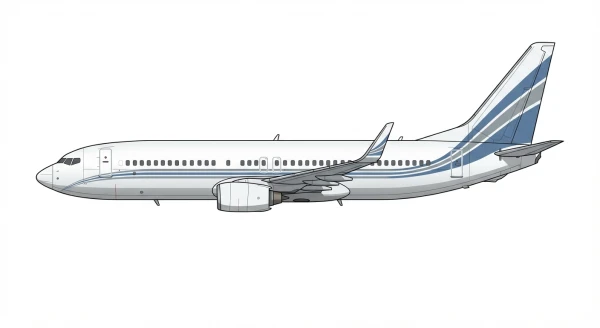
Description
The ATR 42 is a twin-turboprop regional airliner produced by the Franco-Italian consortium ATR, with final assembly at Toulouse, France. Launched on 4 November 1981 as a joint venture between Aérospatiale and Aeritalia, it first flew on 16 August 1984 and entered service with Air Littoral in December 1985. The designation refers to its original 42-seat capacity. It formed the basis for the stretched ATR 72, introduced in 1989, and by 2015 was the only 50-seat regional aircraft still in production.
Development
Aérospatiale and Aeritalia had independently studied regional airliner concepts from 1978 — the AS 35 and AIT 230 respectively — before signing a co-operation agreement in Paris on 4 November 1981. The consortium targeted 430 kg of fuel over a 200 nmi sector, against 790 kg for the British Aerospace HS.748 and Fokker F.27. Type certification was granted by the French DGCA and the Italian civil aviation authority in September 1985, and the first ATR 42-300 was delivered to Air Littoral on 3 December 1985, flying its first revenue service between Béziers and Paris Orly on 23 December. Texas Air Corporation ordered 50 aircraft in August 1988, and the 100th airframe went to Trans World Express the same year. ATR announced 400 sales in September 1989. The -300 and -320 remained in production until 1996. The -500 first flew on 16 September 1994, was certified in July 1995, and was delivered to Air Dolomiti on 31 October 1995; 120-minute ETOPS approval followed on 19 November 2000. The -600 was launched on 2 October 2007, flew on 4 March 2010 as F-WWLY, and was delivered to Precision Air in November 2012. The STOL 42-600S, launched on 9 October 2019 with 20 commitments, flew on 11 May 2022; development was terminated in November 2024.
Design
The ATR 42 is a straight high-wing aircraft with a T-tail and retractable landing gear housed in fuselage fairings. Wing area is 54.5 m² with a span of 24.57 m and an aspect ratio of 11.1; MTOW is 18,600 kg for a wing loading of 341 kg/m². The pressurised circular-section cabin is 2.57 m wide, seating four abreast, with 48 seats at 30 in pitch. There is no APU; a propeller brake on the starboard engine allows it to run for ground power. Deicing boots permit flight in icing conditions. Cruise speed is 300 kn TAS at a fuel flow of 811 kg/h. The -600 introduced a Thales glass cockpit with five LCD displays and CAT III capability.
Operational History
American Eagle ordered 41 ATR 42s and 59 ATR 72s on 21 August 1990 and took the 500th ATR on 5 September 1997. Tarom received its first two -500s on 5 June 1998, and Cubana ordered the type on 28 June 1998. China Xinjiang Airlines placed the first Chinese order in May 1997. Japan Air Commuter took its first -600 in January 2017; Silver Airways introduced the -600 in the United States on 22 April 2019. Bulk and ULD freighter conversions had covered over one-fifth of first-generation ATR 42s and 72s by October 2012. As of August 2022, six were in military service with Colombia, Nigeria, Myanmar and Senegal; Italy operates the -400 Surveyor maritime patrol variant with the Guardia di Finanza and Coast Guard. The type has been involved in 47 accidents with 34 hull losses and 276 fatalities.
Variants
- ATR 42-200: Prototype version powered by PW120 engines rated at 1,800 shp, built in small numbers for testing.
- ATR 42-300: Standard production model with 2,000 shp PW120s, built until 1996, including the -300QC quick-change freight/passenger conversion.
- ATR 42-320: Improved -300 with 2,100 shp PW121 engines for better hot-and-high performance.
- ATR 42-400: Six-bladed propellers and mini winglets on PW121 engines; three delivered to Italy as the Surveyor maritime patrol version and two to CSA Czech Airlines.
- ATR 42-500: PW127E engines of 2,400 shp flat-rated to 45 °C, six-bladed composite propellers, redesigned cabin, higher MTOW and dual Honeywell HT1000 FMS.
Frequently Asked Questions
What type of aircraft is the ATR-42?
What is the maximum speed of the ATR-42?
What is the range of the ATR-42?
When did the ATR-42 first fly?
How many ATR-42 have been built?
Which countries operate the ATR-42?
How much does a ATR-42 cost?
What is the service ceiling of the ATR-42?
- AUG 302026 Updated Description updated
- APR 72026 Updated Picture credits updated in a site-wide editorial pass
- FEB 72026 Updated Top speed added; range added