EMB 110
Brazilian regional airliner, developed in the late 1960s, widely used for regional air service and military transport worldwide. Key figures: top speed 459 km/h, range 1,964 km, service ceiling 6,550 m, max takeoff weight 5,900 kg, unit price $2M, built 503. In service with 3 air forces as of 2026 — Brazil (43), Chile (4), Colombia (2).
| Crew | 2 |
| Length | 15.1 m (49.5 ft) |
| Wingspan | 15.3 m (50.3 ft) |
| Height | 4.9 m (16.1 ft) |
| Wing area | 29.1 m² (313.2 sqft) |
| Empty weight | 3,590 kg (7,915 lbs) |
| Max. takeoff weight | 5,900 kg (13,007 lbs) |
| Powerplant | 2 × Pratt & Whitney Canada PT6A-34 turboprop engines |
| Maximum speed | 459 km/h (285 mph) |
| Operational range | 1,964 km (1,220 mi) |
| Service ceiling | 6,550 m (21,490 ft) |
| Climb rate | 8.3 m/s (27.2 ft/s) |



Description
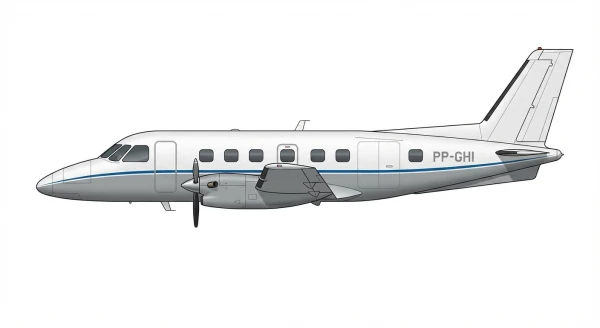
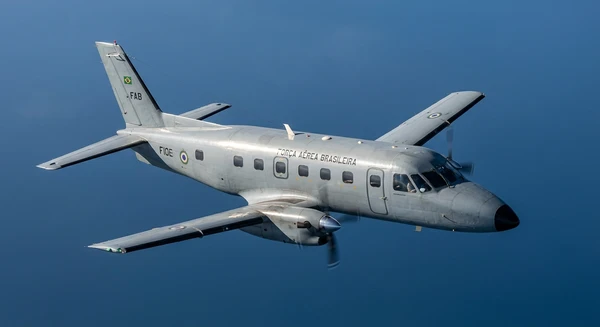
The Embraer EMB 110 Bandeirante is a Brazilian twin-turboprop light transport aircraft, designed by Embraer for military and civil use. It entered commercial service on 16 April 1973 with the Brazilian airline Transbrasil, after a first delivery to the Brazilian Air Force (FAB) on 9 February 1973. It is known for its versatility, having been developed into transport, radio calibration, maritime patrol, aerial survey and search and rescue versions.
Development
The programme originated in a 1965 directive from the Brazilian Ministry of Aeronautics, calling for a reliable, low-cost-to-operate turboprop aircraft with a low wing and seating for eight people. The specification, drawn up under the IPD-6504 programme, stemmed from a study of Brazilian commercial air traffic and existing airport infrastructure. The French engineer Max Holste led the design, with construction of the prototype supervised by Ozires Silva. The first prototype, designated YC-95, made its maiden flight on 26 October 1968 from São José dos Campos airport, piloted by José Mariotto Ferreira, for a flight of about 50 minutes. Two further prototypes, designated EMB 100, flew on 19 October 1969 and 29 June 1970. Embraer was founded in August 1969 and took over responsibility for the programme on 2 January 1970. Market developments led to the EMB 100 being redesigned as the larger-capacity EMB 110. In May 1970, the FAB ordered 80 production aircraft. Brazilian airworthiness certification was obtained at the end of 1972. Between 1968 and 1990, 494 aircraft were built; production ended in 1990 in favour of the EMB 120 Brasilia, an enlarged, faster and pressurised derivative.
Design
The EMB 110 is a low-wing monoplane, with a modified NACA 23016 aerofoil at the root and a NACA 23012 at the tip, for a wing area of 29.1 m². The EMB 110P1A/41 version is 15.1 m long, with a wingspan of 15.33 m and a height of 4.92 m, for a maximum take-off weight of 5,900 kg. Power comes from two Pratt & Whitney Canada PT6A-34 engines of 560 kW (750 hp) driving 2.36 m three-blade Hartzell reversible-pitch, feathering propellers. Fuel capacity is 1,720 L in four integral wing tanks. Maximum cruise speed is 411 km/h at 2,440 m, economical cruise 341 km/h for a range of 1,964 km with 45 minutes of reserves, and service ceiling 6,550 m. The crew consists of two pilots, with typical seating for 15 to 21 passengers.
Operational History
Deliveries to the FAB began in February 1973; more than a hundred examples served with it. Two EMB 111A Patrulha maritime patrol aircraft were leased to the Argentine Navy during the Falklands War, as an interim solution between the withdrawal of the Lockheed SP-2H Neptune and the arrival of modified Lockheed L-188 Electras. The Chilean Navy acquired three navalised EMB 110Cs and six EMB 111ANs. Ryanair put a 15-seat EMB 110 into service on 8 July 1985, operating it until 1989. On 15 December 2010, the FAB flew its first modernised aircraft under the C/P-95 designation, equipped by Aeroeletronica, the Brazilian subsidiary of Elbit Systems; its fleet then numbered 96 EMB 110s, and 48 in 2017. In October 2018, some 150 examples remained in service worldwide; in 2020, 39 were still flying with 15 operators, including Wiggins Airways (7), Royal Air Freight (5) and Transportes Aereos Guatemaltecos (4).
Variants
- EMB 110 (C-95): Initial production version with 680 hp PT6A-27 engines, twelve-seat military transport for the FAB, 60 built.
- EMB 110B (R-95): Aerial survey and photography version, seven built, six of them for the FAB.
- EMB 110K1 (C-95A): Cargo transport version for the FAB with a rear-fuselage cargo door, 20 built.
- EMB 111A Patrulha (P-95 Bandeirulha): Maritime patrol version, developed into the P-95B with improved avionics and strengthened structure, ten built.
- EMB 110P2/41: Pressurised 21-seat regional airliner.
Frequently Asked Questions
What type of aircraft is the EMB 110?
What is the maximum speed of the EMB 110?
What is the range of the EMB 110?
When did the EMB 110 first fly?
How many EMB 110 have been built?
Which countries operate the EMB 110?
How much does a EMB 110 cost?
What is the service ceiling of the EMB 110?
- AUG 302026 Updated Description updated
- AUG 52026 Updated Powerplant updated in a site-wide editorial pass
- APR 72026 Updated Picture credits updated in a site-wide editorial pass
- JAN 242026 Updated Top speed updated
- JAN 122026 Updated Range, wingspan and 11 more fields added; first flight and version updated