F28 Fellowship
Dutch regional jet, operational in the late 20th century, notable for short take-off and landing capabilities. Key figures: top speed 848 km/h, range 1,700 km, service ceiling 8,839 m, max takeoff weight 33,000 kg, unit price $4M, built 241. In service with 1 air force as of 2026 — Philippines (1).
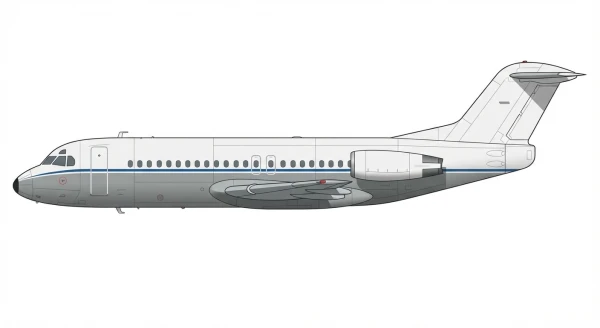
| Length | 29.6 m (97.2 ft) |
| Wingspan | 25.1 m (82.3 ft) |
| Height | 8.5 m (27.8 ft) |
| Wing area | 79.0 m² (850.0 sqft) |
| Empty weight | 16,144 kg (35,591 lbs) |
| Max. takeoff weight | 33,000 kg (72,752 lbs) |
| Powerplant | 2 × turbofans Rolls-Royce RB183-2 Spey Junior Mk 155-15P 4,491 kgf each |
| Maximum speed | 848 km/h (527 mph) |
| Operational range | 1,700 km (1,056 mi) |
| Service ceiling | 8,839 m (28,999 ft) |

Description
The Fokker F28 Fellowship is a twin-engined short-range jet airliner designed and built by the Dutch manufacturer Fokker. Launched in April 1962 as a turbofan-powered complement to the F27 Friendship turboprop, it first flew on 9 May 1967 and entered revenue service with Braathens on 28 March 1969. It competed with the Douglas DC-9 and the BAC One-Eleven, and served widely on short sectors and unpaved strips before being replaced in production by the Fokker 70 and Fokker 100.
Development
Fokker began studying a turbofan short-haul airliner around 1960, prompted in part by a British European Airways specification for a high-speed turbofan regional aircraft. Initial work centred on a 50-seat design with a range of 1,650 km; market research led to enlargement to 65 seats in five-abreast configuration. The programme was shared between Fokker, MBB and VFW-Fokker of West Germany, and Short Brothers of Northern Ireland, with the Dutch government funding 50% of Fokker's stake and the West German government 60% of the 35% German stake. Fokker built the nose, centre fuselage and inner wing; MBB/VFW-Fokker the forward and rear fuselage and tail; Shorts the outer wings. Final assembly was at Schiphol. Bristol Siddeley BS.75 turbofans were initially selected but withdrawn, and the Rolls-Royce Spey Junior was adopted instead. The prototype PH-JHG flew on 9 May 1967 with Jas Moll as pilot in command; West German type certification followed on 24 February 1969. Fairchild proposed a locally built derivative, the Fairchild 228, but acted only as a distributor. Production ended in 1987 after 241 airframes.
Design
The F28 has a low-mounted wing of slight crescent sweep, a T-tail and two rear-fuselage-mounted Rolls-Royce Spey turbofans of up to 9,850 lbf (43.9 kN). The wing uses conventional box construction in two pieces spliced to the fuselage, with fail-safe structure and bonding techniques carried over from the F27. Flight controls are cable-actuated in duplicate and aerodynamically balanced except for the rudder. Thrust reversers were omitted in favour of a five-section lift dumper, reducing weight, maintenance and debris ingestion on unpaved strips. A hydraulically actuated split tail cone acts as a variable airbrake, permitting rapid descent and higher engine settings on approach. Fuel is carried in the outer wings and fuselage, with optional pylon tanks. The tricycle landing gear uses large low-pressure tyres and antiskid brakes.
Operational History
Garuda Indonesia operated the largest fleet at 62 aircraft. Other operators included Time Air/Canadian Regional (35), Ansett Group Australia, Aerolíneas Argentinas, Merpati Nusantara, Biman Bangladesh and Satena, with some 22 further airlines flying smaller numbers. MacRobertson Miller Airlines flew the longest nonstop F28 route, Perth–Kununurra, about 2,240 km, then the world's longest twin-jet route. Fly-SAX was the last airline operator, storing its final aircraft in September 2019. Argentina's LADE, part of the Argentine Air Force, retained two aircraft as of August 2024, being replaced by the Embraer ERJ 140. The type has a hull loss rate of 4.62 per million flights, against 1.78 for the Boeing 737-100/200 and 1.45 for the DC-9.
Variants
- F.28 Mk 1000: Initial production model seating up to 70 passengers, approved 24 February 1969, with a 1000C freight-door subvariant.
- F.28 Mk 2000: Stretched by 1.4 m ahead of and 0.76 m behind the wing for 79 passengers, approved 30 August 1972; 10 built.
- F.28 Mk 3000: Mk 1000 with a 1.5 m wingspan extension, greater structural strength and increased fuel, approved 19 July 1978.
- F.28 Mk 4000: Mk 2000 airframe with extended wingspan, two overwing exits per side and 85 seats, in service with Linjeflyg from late 1976.
- F.28 Mk 6000: Long-fuselage model with increased span and leading-edge slats, first flown 27 September 1973; two built and later converted to Mk 2000 standard.
Frequently Asked Questions
What type of aircraft is the F28 Fellowship?
What is the maximum speed of the F28 Fellowship?
What is the range of the F28 Fellowship?
When did the F28 Fellowship first fly?
How many F28 Fellowship have been built?
Which countries operate the F28 Fellowship?
How much does a F28 Fellowship cost?
What is the service ceiling of the F28 Fellowship?
- AUG 302026 Updated Description updated
- JUL 232026 Updated Sources and cross-references refreshed
- APR 82026 Updated Empty weight added
- APR 72026 Updated Sources and cross-references refreshed
- FEB 72026 Updated Top speed added
- JAN 202026 Updated Range added