A-4 Skyhawk vs F-8 Crusader
A-4 Skyhawk vs F-8 Crusader at a glance — top speed 1,077 vs 1,971 km/h, range 4,063 vs 2,791 km, max takeoff weight 11,136 vs 13,000 kg, built 2,960 vs 1,219 units.
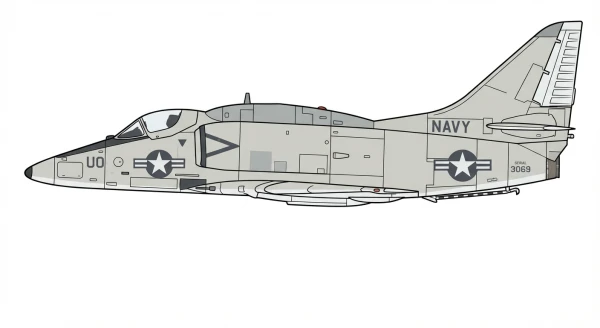
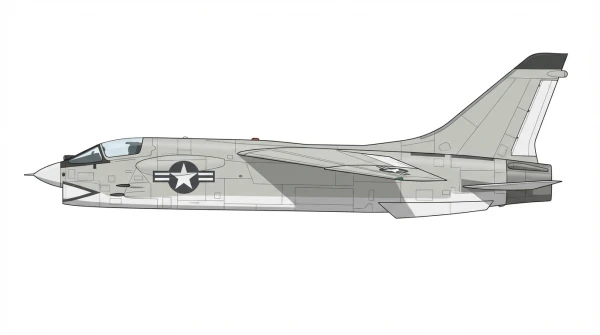
| A-4 Skyhawk | F-8 Crusader | |
|---|---|---|
| Origin country | 🇺🇸 United States | 🇺🇸 United States |
| Category | Combat Aircraft | Combat Aircraft |
| Manufacturer | McDonnell Douglas | Vought |
| First flight | 22 June 1954 | 25 March 1955 |
| Year introduced | 1956 | 1957 |
| Number produced | 2960 units | 1219 units |
| Average unit price | $2 million | $2.5 million |
| Wing area | 24.2 m² | 34.8 m² |
| Wingspan | 8.4 m | 10.9 m |
| Height | 4.6 m | 4.8 m |
| Length | 12.2 m | 16.5 m |
| Maximum speed | 1077 km/h | 1971 km/h |
| Operational range | 4,063 km | 2,791 km |
| Service ceiling | 12,880 m | 17,678 m |
| Max. takeoff weight | 11,136 kg | 13,000 kg |
| Empty weight | 4,750 kg | 7,956 kg |
| Total thrust | 1 x 4,100 kgf | 1 x 8,165 kgf |
Detailed Comparison
The A-4 Skyhawk and F-8 Crusader were both single-engine, carrier-capable jets developed for the U.S. Navy in the 1950s, yet they were conceived for fundamentally different missions. The Skyhawk was a pure light attack aircraft, while the Crusader was designed as a supersonic air superiority fighter with a secondary ground-attack capability. This divergence in purpose is evident in their design, performance, and operational history.
Development and Design
The A-4 Skyhawk was the product of Ed Heinemann's philosophy of radical simplicity. Designed to be small, lightweight, and inexpensive, it was half the Navy's specified weight. Its compact delta wing was so short it did not require a folding mechanism for carrier stowage, saving weight and complexity. Other innovations, like gravity-deployed leading-edge slats, further reduced weight by omitting motors. In contrast, the F-8 Crusader was a complex, high-performance design built for speed. Its most notable feature was a variable-incidence wing, which pivoted upwards 7° for takeoff and landing to improve low-speed handling and pilot visibility without a nose-high attitude. The Crusader also incorporated an area-ruled fuselage and an afterburning engine to become the first U.S. jet to exceed 1,000 mph.
Specifications and Performances
Performance metrics starkly reflect their different roles. The Crusader was built for speed and altitude. Powered by an afterburning Pratt & Whitney J57, it could reach 1971 km/h with a service ceiling of 17,678 m. The Skyhawk, with its non-afterburning J52 turbojet, was a subsonic aircraft with a maximum speed of 1077 km/h and a ceiling of 12,880 m. The trade-off was in payload and range. The A-4 could carry a significantly larger weapons load of 8,500 lb (3,900 kg) and had a ferry range of 3,300 km. The F-8's payload was limited to 5,000 lb (2,270 kg) and its combat range was far shorter at 730 km, prioritizing intercept performance over loiter time or strike capability.
Deployment and usage
The Skyhawk became a ubiquitous ground-attack workhorse. It served extensively in Vietnam for the U.S. Navy and saw combat with the Israeli, Argentine, and Kuwaiti air forces, proving its value as a rugged and effective bomber. Its simple design contributed to its longevity and widespread export success, with over 2,960 units built. The F-8 was primarily an air-to-air fighter, earning the nickname "the last gunfighter" for being the final U.S. fighter designed with cannons as its primary weapon, although its AIM-9 Sidewinder missiles proved more effective in combat over Vietnam. The RF-8 reconnaissance variant was critical during the Cuban Missile Crisis. While effective, the Crusader was known as a difficult aircraft to fly, suffering a high mishap rate, and had a more limited production run of 1,219 aircraft.
Conclusion
Both aircraft successfully fulfilled their design objectives. The F-8 Crusader was a technologically advanced interceptor that met the specific performance demands of its time, but its complexity and specialized role limited its service life and adaptability. The A-4 Skyhawk's focus on low cost, simplicity, and payload resulted in a remarkably versatile and enduring light attack platform. Its design proved more adaptable and cost-effective over the long term, leading to a much larger production run and a service history that spanned numerous conflicts and decades, outlasting its more complex contemporary.