A400M Atlas vs An-22 Cock
A400M Atlas vs An-22 Cock at a glance — top speed 780 vs 740 km/h, range 3,300 vs 10,950 km, max takeoff weight 141,000 vs 250,000 kg, built 174 vs 68 units.
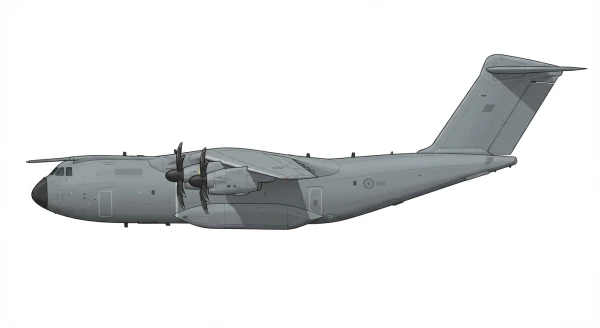
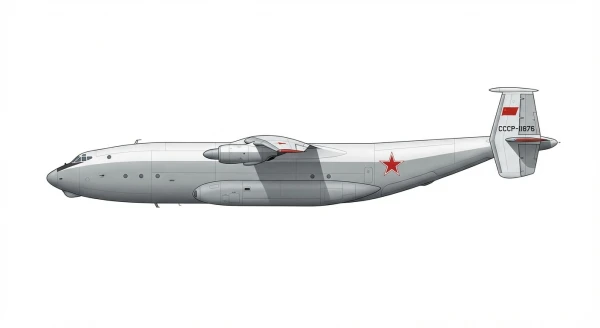
| A400M Atlas | An-22 Cock | |
|---|---|---|
| Origin country | 🇪🇺 Europe | 🇺🇦 Ukraine |
| Category | Military Transport Aircraft | Military Transport Aircraft |
| Manufacturer | Airbus | Antonov |
| First flight | 11 December 2009 | 27 February 1965 |
| Year introduced | 2013 | 1967 |
| Number produced | 174 units | 68 units |
| Average unit price | $152 million | -- |
| Wing area | 221.5 m² | 345.0 m² |
| Wingspan | 42.4 m | 64.4 m |
| Height | 14.7 m | 12.5 m |
| Length | 45.1 m | 57.9 m |
| Maximum speed | 780 km/h | 740 km/h |
| Operational range | 3,300 km | 10,950 km |
| Service ceiling | 12,500 m | 8,000 m |
| Max. takeoff weight | 141,000 kg | 250,000 kg |
| Empty weight | 66,500 kg | 114,000 kg |
| Total thrust | 4 x 8,203 kW | 4 x 11,186 kW |
Detailed Comparison
Separated by four decades of aerospace development, the Airbus A400M Atlas and Antonov An-22 Cock represent the persistent requirement to bridge the gap between tactical theater transport and strategic heavy lift. While the An-22 was the Soviet Union's brute-force answer to moving heavy armor before the Il-76 and An-124 arrived, the A400M represents a complex European compromise designed to replace the C-130/C-160 mix while avoiding the acquisition costs of the C-17.
Development and Design
The An-22 was an engineering exercise in scaling. Antonov enlarged the An-12 concept, utilizing a high-wing configuration and the massive Kuznetsov NK-12MA turboprops—the same engines powering the Tu-95 strategic bomber. Its design prioritized raw volume and rough-field access via adjustable tire pressure and high-lift devices, accepting the noise and vibration penalties of the 15,000 hp engines.
Conversely, the A400M suffered from "design by committee" via the OCCAR framework. The requirement to develop the Europrop TP400-D6—the most powerful Western turboprop—rather than buying off-the-shelf engines caused years of delays and gearbox reliability issues. The A400M integrates 30% composite materials and a fly-by-wire system derived from the A380, contrasting sharply with the An-22’s analog, hydraulic-heavy architecture.
Specifications and Performance
The An-22 remains the superior pure freighter. Its 80,000 kg payload dwarfs the A400M's 37,000 kg capacity. The Soviet aircraft offers a 639 m³ cargo volume against the Airbus's roughly 340 m³, allowing the An-22 to transport four BMD-1 armored vehicles simultaneously.
However, the A400M offers superior tactical agility. While the An-22 claims a 10,950 km range (unladen/ferry), the A400M's 3,300 km range at max payload reflects modern theater requirements rather than intercontinental projection. The A400M cruises at 780 km/h, edging out the An-22's 740 km/h, but more importantly, operates with a two-pilot crew compared to the An-22's five-to-eight man complement. The An-22 requires 1,460 m for takeoff; the A400M requires only 1,150 m, despite the lower thrust output (8,203 kW vs 11,186 kW), validating its modern high-lift wing design.
Deployment and Usage
The An-22 served as the backbone of Soviet projection during the Cold War. It facilitated the initial insertion of VDV (Airborne) forces during the 1979 invasion of Afghanistan and delivered heavy equipment during the Yom Kippur War. Its utility was defined by volume—moving helicopters and tanks that smaller transports could not.
The A400M’s operational history is defined by multi-role integration. In Operation Barkhane (Sahel) and the 2021 Kabul evacuation, it functioned not just as a hauler but as a tactical asset capable of steep tactical approaches and, crucially, aerial refueling. The recent 2024 "mixed airdrop" certification allows simultaneous paratroop and cargo deployment, a flexibility the rigid An-22 doctrine lacked.
Conclusion
For pure strategic logistics—moving main battle tanks or heavy infrastructure—the Antonov An-22 retains the advantage purely on physics. It moves double the weight over triple the distance. However, in a contested, modern battlespace, the A400M is the decisive platform. The An-22 is a vulnerable, loud, labor-intensive logistical pipe; the A400M is a survivable tactical asset that integrates into digitized command structures. The An-22 wins on the tarmac; the A400M wins in the theater of operations.