A-6 Intruder vs F-111 Aardvark
A-6 Intruder vs F-111 Aardvark at a glance — top speed 1,040 vs 2,655 km/h, range 5,219 vs 5,940 km, max takeoff weight 27,500 vs 45,359 kg, built 693 vs 563 units.
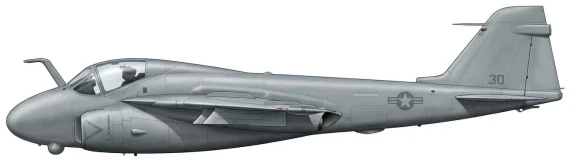
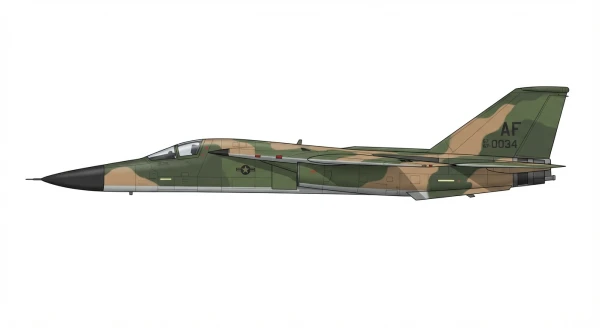
| A-6 Intruder | F-111 Aardvark | |
|---|---|---|
| Origin country | 🇺🇸 United States | 🇺🇸 United States |
| Category | Combat Aircraft | Combat Aircraft |
| Manufacturer | Grumman | General Dynamics |
| First flight | 19 April 1960 | 21 December 1964 |
| Year introduced | 1963 | 1967 |
| Number produced | 693 units | 563 units |
| Average unit price | $25 million | $15 million |
| Wing area | 49.1 m² | 61.1 m² |
| Wingspan | 16.2 m | 19.2 m |
| Height | 4.8 m | 5.0 m |
| Length | 16.6 m | 22.4 m |
| Maximum speed | 1040 km/h | 2655 km/h |
| Operational range | 5,219 km | 5,940 km |
| Service ceiling | 12,400 m | 20,117 m |
| Max. takeoff weight | 27,500 kg | 45,359 kg |
| Empty weight | 11,630 kg | 21,400 kg |
| Total thrust | 2 x 8,436 kgf | 2 x 11,385 kgf |
Detailed Comparison
The Grumman A-6 Intruder and the General Dynamics F-111 Aardvark were both developed in the 1960s as twin-engine, two-seat, all-weather attack platforms, but they represent divergent operational philosophies. The A-6 was a dedicated carrier-based, subsonic aircraft optimized for heavy ordnance delivery, relying on its integrated avionics for mission effectiveness. In contrast, the land-based F-111 was a larger, more complex supersonic interdictor that utilized a variable-geometry wing and terrain-following radar for high-speed, low-level penetration of enemy airspace.
Development and Design
The A-6's design stemmed from a specific U.S. Navy and Marine Corps requirement for a carrier-capable, all-weather replacement for the piston-engined A-1 Skyraider. Its core innovation was the Digital Integrated Attack/Navigation Equipment (DIANE) system. This advanced avionics suite, combined with a side-by-side cockpit for the pilot and bombardier/navigator, enabled precision strikes at low altitude in any weather, a significant leap in capability.
The F-111 was born from the far more ambitious TFX program, which sought to create a single aircraft for both U.S. Air Force deep-strike and U.S. Navy fleet-interceptor roles. This joint requirement drove its key design features:
- A variable-sweep wing that could be adjusted from 16° for takeoff to 72.5° for supersonic flight, optimizing performance across a wide speed range.
- A pioneering Terrain Following Radar (TFR) system that allowed for automated, high-speed flight at extremely low altitudes.
- A unique crew escape module that ejected the entire cockpit as a single unit.
While the USAF's F-111A proved successful, the naval F-111B variant was cancelled due to excessive weight and performance issues, highlighting the difficulties of the joint-service concept.
Specifications and Performances
A comparison of performance metrics underscores their different mission profiles. The F-111's afterburning TF30 engines delivered over twice the thrust of the A-6's J52 turbojets, enabling a maximum speed of 2655 km/h (Mach 2.5) compared to the A-6's subsonic 1040 km/h. The F-111 was also significantly larger and heavier, with a maximum takeoff weight of 45,359 kg versus the A-6's 27,500 kg. This size was a critical factor in its unsuitability for carrier operations. The F-111 carried a larger offensive load (11,000 kg) and featured an internal weapons bay that improved its aerodynamic performance. The A-6 carried a still-formidable 8,165 kg payload but did so entirely on external hardpoints.
Deployment and usage
The A-6 served as a workhorse for the U.S. Navy and Marine Corps from Vietnam to the Gulf War. Its ability to deliver heavy bomb loads accurately in all weather conditions was highly valued, though its low-altitude attack profile resulted in significant combat losses to ground fire. The versatile airframe was also adapted into tanker (KA-6D) and electronic warfare variants. The F-111 had a troubled combat introduction in Vietnam but evolved into a premier deep-strike asset. It became renowned for long-range missions, such as the 1986 raid on Libya, which showcased its unique combination of speed, range, and low-level penetration capabilities. During the Gulf War, the F-111F was particularly effective in destroying Iraqi armor with laser-guided bombs.
Conclusion
The A-6 Intruder and F-111 Aardvark were both landmark all-weather strike aircraft. The A-6 was an evolutionary design that perfected the carrier-based subsonic attack role, its success defined by its ruggedness and revolutionary integrated avionics. The F-111 was a more ambitious, technologically revolutionary aircraft. Despite its troubled development and the failure of the joint-service concept, it became a uniquely capable land-based strategic interdictor whose performance was unmatched in its niche. The A-6's focused design ensured its long and successful service life, while the F-111's technological leap created a powerful, but ultimately more specialized, weapon system.