AH-6 Little Bird vs MD-500
AH-6 Little Bird vs MD-500 at a glance — top speed 282 vs 282 km/h, range 430 vs 430 km, max takeoff weight 1,610 vs 1,361 kg, built 1,420 vs 4,700 units.
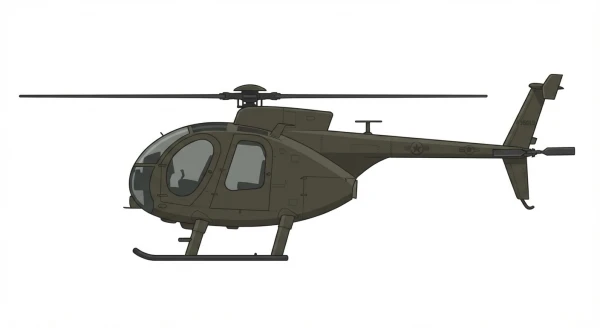
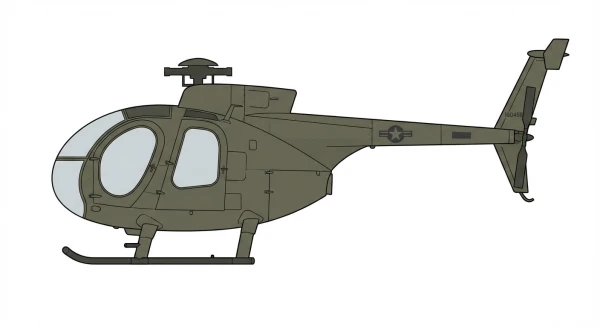
| AH-6 Little Bird | MD-500 | |
|---|---|---|
| Origin country | 🇺🇸 United States | 🇺🇸 United States |
| Category | Military Helicopters | Military Helicopters |
| Manufacturer | Boeing | Hughes |
| First flight | 27 February 1963 | 28 January 1982 |
| Year introduced | 1980 | 1967 |
| Number produced | 1420 units | 4700 units |
| Average unit price | $7.5 million | $4 million |
| Wingspan | 8.4 m | 8.3 m |
| Height | 2.6 m | 2.6 m |
| Length | 9.2 m | 9.4 m |
| Maximum speed | 282 km/h | 282 km/h |
| Operational range | 430 km | 430 km |
| Service ceiling | 4,877 m | 4,877 m |
| Max. takeoff weight | 1,610 kg | 1,361 kg |
| Empty weight | 896 kg | 672 kg |
| Total thrust | 1 x 239 kW | 1 x 313 kW |
Detailed Comparison
The Boeing AH-6 Little Bird and the MD-500 series share an airframe lineage tracing back to the Hughes OH-6 Cayuse of the 1960s, but their modern iterations occupy distinct operational tiers. The MD-500 remains a dual-use light utility helicopter adapted for basic counter-insurgency, while the AH-6 is a specialized, heavily modified platform optimized for special operations and precision light attack.
Development and Design
Hughes developed the original Model 369 for the U.S. Army’s Light Observation Helicopter program. The civilian MD-500 series maintained the egg-shaped fuselage, five-blade main rotor, and short tail, prioritizing low production costs. MD Helicopters iterated on the baseline with the 530F for hot-and-high conditions and the MD 520N, incorporating the NOTAR system to eliminate the tail rotor and reduce acoustic signature.
Boeing’s AH-6 series diverges by integrating advanced combat architecture directly into the airframe. The export-focused AH-6i and proposed AH-6S variants incorporate AH-64D Apache Block III composite rotor blades, a stretched cabin for troop recovery, and a digital glass cockpit. Boeing also utilized the AH-6 airframe for the Unmanned Little Bird (ULB) program, developing an optionally manned platform capable of autonomous flight and remote weapons deployment controlled by Apache crews.
Specifications and Performances
Both airframes share a maximum speed of 282 km/h and a 430 km range, but their weight margins dictate their combat utility. The MD-500’s lighter empty weight (672 kg) provides raw kinetic agility in an unburdened state. The AH-6 requires a higher Maximum Takeoff Weight (1610 kg versus the MD-500’s 1361 kg) to support its military equipment.
To manage this mass, the AH-6 utilizes an uprated Rolls-Royce 250-CE30 engine to maintain a 10.5 m/s climb rate while carrying military payloads:
- 2× AGM-114 Hellfire missiles for anti-armor roles
- 2× GAU-19 .50 caliber rotary cannons or M134 Miniguns
- FLIR sensor turrets and tactical data link nodes
The standard MD-500, relying on the 313 kW Allison 250-C20B, achieves a lower 9.0 m/s climb rate and possesses tighter payload margins when fitted with ad-hoc external weapons.
Deployment and usage
The MD-500 operates globally as a low-cost, low-intensity conflict asset. El Salvador used 500D and E models armed with 7.62mm miniguns and unguided 70mm rockets during its civil war. North Korea illicitly acquired civilian MD-500s in the 1980s, modifying a portion to carry Soviet AT-3 Sagger wire-guided missiles.
The AH-6 operates within elite units and state militaries. Flown extensively by the U.S. Army's 160th Special Operations Aviation Regiment (SOAR), the AH-6 provides close air support in dense urban environments. It relies on integrated targeting systems to execute night and low-visibility operations, a technical requirement absent in standard MD-500 Defenders.
Conclusion
The AH-6 holds the definitive edge in precision strike and special operations. Its integrated avionics, Hellfire integration, and 1610 kg MTOW make it a lethal close air support asset for tier-one units and militaries like Saudi Arabia. The MD-500 is relevant solely in acquisition economics. At $4.0 million, the MD-500 provides baseline reconnaissance and unguided fire support for developing nations, but lacks the sensor fusion, armored redundancy, and guided munitions capability required to survive in contested environments.