AS332 Super Puma vs H225M / EC725 Caracal
AS332 Super Puma vs H225M / EC725 Caracal at a glance — top speed 327 vs 324 km/h, range 851 vs 1,253 km, max takeoff weight 9,150 vs 11,200 kg, built 890 vs 90 units.
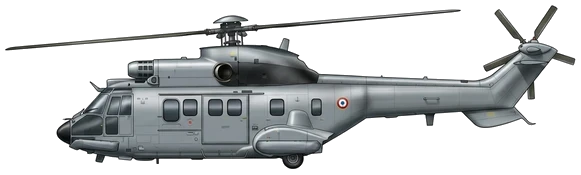
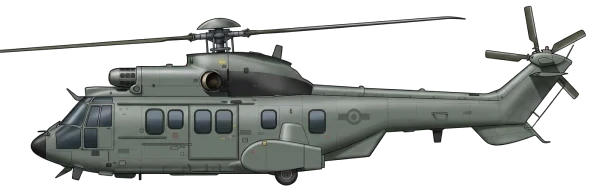
| AS332 Super Puma | H225M / EC725 Caracal | |
|---|---|---|
| Origin country | 🇫🇷 France | 🇩🇪 Germany🇫🇷 France |
| Category | Military Helicopters | Military Helicopters |
| Manufacturer | Aérospatiale | Airbus Helicopters |
| First flight | 13 September 1978 | 27 November 2000 |
| Year introduced | 1981 | 2005 |
| Number produced | 890 units | 90 units |
| Average unit price | -- | $70 million |
| Wing area | 206.1 m² | -- m² |
| Wingspan | 16.2 m | 16.2 m |
| Height | 5.0 m | 4.6 m |
| Length | 16.8 m | 19.5 m |
| Maximum speed | 327 km/h | 324 km/h |
| Operational range | 851 km | 1,253 km |
| Service ceiling | 5,180 m | 6,100 m |
| Max. takeoff weight | 9,150 kg | 11,200 kg |
| Empty weight | 4,660 kg | 5,330 kg |
| Total thrust | 2 x 1,376 kW | 2 x 1,776 kW |
Detailed Comparison
The Airbus H225M Caracal is a direct, heavy-duty evolution of the Aérospatiale AS332 Super Puma airframe, engineered to solve the survivability and payload deficits identified by French forces operating older Puma variants in hostile environments. While the AS332 established the European medium-lift utility baseline in the 1980s, producing 890 units, the H225M was procured specifically for dedicated Combat Search and Rescue (CSAR) and special operations.
Development and Design
The AS332 emerged in the 1970s as a utility transport, prioritizing crashworthiness, a monocoque tail boom, and a widened fuselage over the legacy SA 330. It relies on a four-blade rotor and Turbomeca Makila 1A2 turboshafts.
The H225M was developed in the late 1990s after the French Air Force demanded a more survivable CSAR platform. Eurocopter upgraded the dynamic system with a five-blade composite main rotor utilizing a new airfoil to reduce vibration during high-speed, low-altitude ingress. The airframe integrates modular armor plating, dual-channel Full Authority Digital Engine Control (FADEC), and an all-glass cockpit. The H225M also natively integrates the HForce Generic Weapon System, coupling a Thales Scorpion helmet-mounted sight with Wescam electro-optics to guide Hellfire missiles, a capability absent from base AS332 variants.
Specifications and Performances
The transition from utility to dedicated combat platform required structural and propulsion overhauls.
- Weight and Payload: The H225M operates with a Max Takeoff Weight of 11,200 kg, a 2,050 kg increase over the AS332's 9,150 kg MTOW, to accommodate armor, sensors, and weaponry.
- Power: To prevent this weight from degrading flight characteristics, Airbus integrated Makila 2A1 engines. These produce 1,776 kW each, a 29% thrust increase over the AS332’s 1,376 kW output.
- Altitude: The H225M extends the service ceiling from 5,180 m to 6,100 m, an aerodynamic modification driven by high-altitude extraction requirements.
Deployment and usage
The AS332 operates globally in utility, MEDEVAC, and maritime patrol roles. The French Army deployed it during the 1994 Rwanda intervention, and the Swedish and Spanish air forces utilized it for MEDEVAC in Afghanistan. It remains heavily utilized in civilian offshore oil transport.
The H225M is deployed into higher-threat environments. The French Air Force inserted Caracals into Lebanon for Opération Baliste in 2006 and later into Kabul. Combat feedback from Afghanistan forced a 2013 upgrade cycle, adding SAGEM FLIR, Nexter door guns, and low-temperature FADEC modifications. Export usage reflects its combat designation: Mexico utilizes armed EC725s for counter-cartel operations, losing one airframe to hostile fire during Operation Jalisco in 2015.
Conclusion
The AS332 retains the edge in mass-procurement utility transport and uncontested maritime patrol. It delivers standard medium-lift capabilities at a volume and operating cost the Caracal is not designed to match. However, for contested airspace, the H225M is the definitive choice. Air forces executing CSAR or special operations infiltration require the H225M; its $70 million acquisition cost buys the Makila 2A1 engines, structural armor, and integrated HForce targeting required to survive and operate in deep-penetration missions where an AS332 would be compromised.