H215M / AS532 Cougar vs H225M / EC725 Caracal
H215M / AS532 Cougar vs H225M / EC725 Caracal at a glance — top speed 250 vs 324 km/h, range 573 vs 1,253 km, max takeoff weight 9,000 vs 11,200 kg, built 408 vs 90 units.
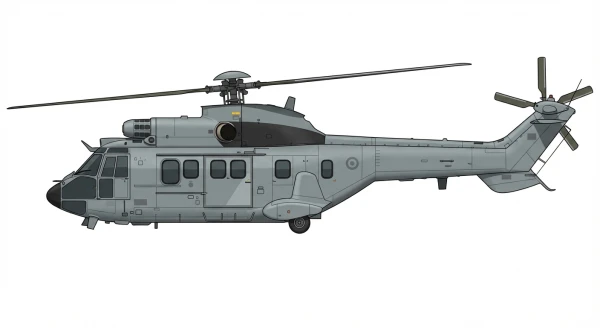
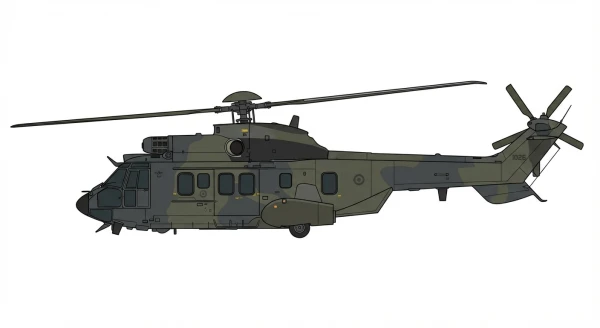
| H215M / AS532 Cougar | H225M / EC725 Caracal | |
|---|---|---|
| Origin country | 🇩🇪 Germany🇫🇷 France | 🇩🇪 Germany🇫🇷 France |
| Category | Military Helicopters | Military Helicopters |
| Manufacturer | Airbus Helicopters | Airbus Helicopters |
| First flight | 1 September 1978 | 27 November 2000 |
| Year introduced | 1978 | 2005 |
| Number produced | 408 units | 90 units |
| Average unit price | $18 million | $70 million |
| Wingspan | 15.6 m | 16.2 m |
| Height | 4.8 m | 4.6 m |
| Length | 18.7 m | 19.5 m |
| Maximum speed | 250 km/h | 324 km/h |
| Operational range | 573 km | 1,253 km |
| Service ceiling | 4,100 m | 6,100 m |
| Max. takeoff weight | 9,000 kg | 11,200 kg |
| Empty weight | 4,330 kg | 5,330 kg |
| Total thrust | 2 x 1,185 kW | 2 x 1,776 kW |
Detailed Comparison
The Airbus H225M Caracal is a direct and more capable evolution of the H215M Cougar, developed from a French Air Force requirement for a dedicated Combat Search and Rescue (CSAR) platform. This lineage defines their relationship: the Cougar is a versatile, multi-purpose utility helicopter, while the Caracal is a specialized, higher-performance machine built for more demanding mission sets. The significant price differential, with the Caracal costing nearly four times the Cougar ($70M vs $18M), reflects this leap in capability.
Development and Design
The Cougar's design originates as a militarized version of the successful SA 332 Super Puma, itself an upgrade of the SA 330 Puma from the 1970s. It is a proven, robust utility airframe. The Caracal, while using the Cougar's basic architecture, was a purpose-built development to overcome the Cougar's limitations in power, endurance, and combat survivability. Key design enhancements in the Caracal include a five-blade composite main rotor that reduces vibration, and more powerful Turboméca Makila 2A1 engines (1,776 kW each) managed by a FADEC system. This contrasts with the Cougar's older Makila 1A2 engines (1,185 kW each). The Caracal also incorporates an all-glass cockpit and integrated avionics from the outset, providing superior situational awareness and mission management compared to the Cougar's original configuration.
Specifications and Performances
The performance metrics clearly illustrate the Caracal's superiority. Its Maximum Takeoff Weight (MTOW) is 11,200 kg, a substantial increase over the Cougar's 9,000 kg, enabling it to carry more fuel, troops, or equipment. This translates directly to enhanced operational reach. The Caracal's range of 930 km far exceeds the Cougar's 573 km, and its maximum speed of 324 km/h is significantly faster than the Cougar's 250 km/h. Furthermore, a higher service ceiling (6,100 m vs. 4,100 m) allows the Caracal to operate more effectively in mountainous terrain, a critical factor in theaters like Afghanistan. These improvements are direct results of its more powerful engines and aerodynamic refinements.
Deployment and usage
Both helicopters have seen extensive global service. The Cougar is a workhorse for troop transport, logistical support, and maritime roles (AS532SC variant). Its large operator base speaks to its reliability and utility. The Caracal, however, is consistently tasked with more specialized and high-risk missions. Its first deployment was for a civilian evacuation from Lebanon, and it has been a key asset for French SOF and CSAR units in Afghanistan and the Sahel. The Caracal's advanced HForce weapon system allows for the integration of precision-guided munitions like Hellfire missiles, and its countermeasures suite is more advanced, reflecting its intended role in contested environments.
Conclusion
The H215M Cougar remains a highly effective and cost-efficient medium-lift utility helicopter, suitable for a wide range of standard military transport and support tasks. The H225M Caracal, by contrast, is a specialized, high-performance combat helicopter. Its superior range, speed, payload, and integrated systems justify its higher acquisition and operational costs for nations requiring a dedicated platform for Combat Search and Rescue, special operations, and other demanding missions where the performance envelope of a standard utility helicopter is insufficient. The choice between the two is a clear distinction between broad utility and specialized, high-end capability.