Douglas DC-3 vs DHC-5 Buffalo
Douglas DC-3 vs DHC-5 Buffalo at a glance — top speed 413 vs 467 km/h, range 2,540 vs 1,100 km, max takeoff weight 13,154 vs 22,317 kg, built 10,174 vs 122 units.
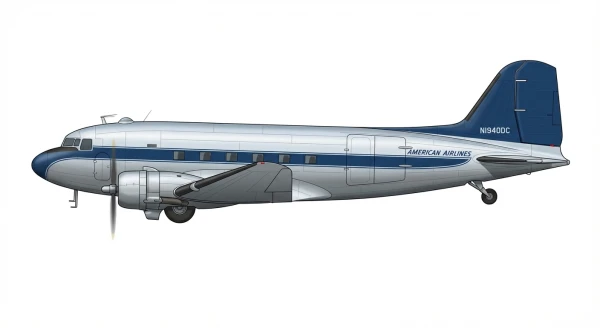
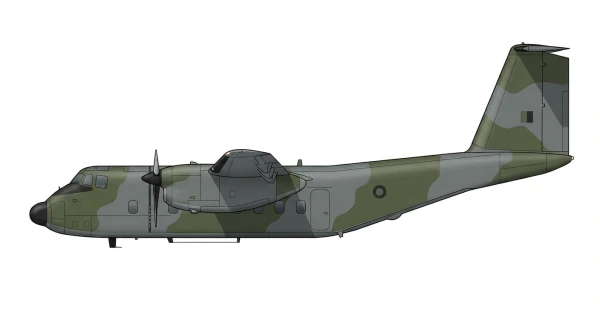
| Douglas DC-3 | DHC-5 Buffalo | |
|---|---|---|
| Origin country | 🇺🇸 United States | 🇨🇦 Canada |
| Category | Military Transport Aircraft | Military Transport Aircraft |
| Manufacturer | Douglas | De Havilland Canada |
| First flight | 23 December 1941 | 9 April 1964 |
| Year introduced | 1936 | 1965 |
| Number produced | 10174 units | 122 units |
| Average unit price | $80K | $25 million |
| Wing area | 91.7 m² | 88.0 m² |
| Wingspan | 29.0 m | 29.0 m |
| Height | 5.6 m | 8.8 m |
| Length | 22.7 m | 24.0 m |
| Maximum speed | 413 km/h | 467 km/h |
| Operational range | 2,540 km | 1,100 km |
| Service ceiling | 7,071 m | 9,449 m |
| Max. takeoff weight | 13,154 kg | 22,317 kg |
| Empty weight | 6,450 kg | 11,412 kg |
| Total thrust | 3 x 875 kW | 2 x 2,336 kW |
Detailed Comparison
The Douglas DC-3 serves as a foundational piston-engine transport from the 1930s that revolutionized air logistics through range and reliability, while the De Havilland Canada DHC-5 Buffalo represents a Cold War-era evolution focused on specialized turboprop STOL (Short Takeoff and Landing) capabilities. While the DC-3 prioritized commercial viability which translated into general military utility, the Buffalo was purpose-built to deliver heavy payloads into unprepared tactical environments.
Development and Design
The DC-3 emerged from commercial competition in the 1930s, engineered by Douglas to meet American Airlines' sleeper requirements. Its design features a low-wing all-metal structure with conventional landing gear, originally powered by two Wright R-1820 or Pratt & Whitney R-1830 radial engines. It was not originally designed with offensive armament or tactical drops in mind, but rather for efficient passenger transit.
In contrast, the DHC-5 Buffalo was developed specifically for a 1962 U.S. Army requirement for a STOL tactical transport. De Havilland Canada evolved the design from the DHC-4 Caribou, utilizing a high-wing configuration with full-span leading-edge slats and double-slotted flaps. Crucially, the Buffalo replaced piston power with General Electric T64 turboprops driving reversible-pitch propellers to maximize short-field performance.
Specifications and Performance
Performance metrics highlight the shift from range-focused logistics to tactical agility.
- Range: The DC-3 offers a superior range of 2,540 km compared to the Buffalo's 1,100 km, reflecting the Douglas design's origin as a coast-to-coast airliner.
- Payload: The Buffalo dominates in lift capacity. With a Maximum Takeoff Weight (MTOW) of 22,317 kg, the DHC-5 is significantly heavier than the DC-3's 13,154 kg, allowing it to carry up to 8,200 kg of cargo—nearly triple the DC-3's 2,700 kg capacity.
- Power and Speed: The Buffalo's turboprops provide 2,336 kW per engine, vastly outclassing the DC-3's radial output of roughly 890 kW. This power enables the Buffalo's defining STOL capability, with takeoff distances over a 50 ft obstacle as short as 369 m, a feat the DC-3 cannot match with similar loads.
Deployment and Usage
The DC-3, designated C-47 Skytrain in U.S. service, became the logistical backbone of Allied forces during World War II, with over 10,000 military units produced. Its usage was ubiquitous: troop transport, paratroop deployment, and medical evacuation. Post-war, it saturated the civilian market and foreign air forces due to immense surplus availability.
The Buffalo saw a more specialized service history. Though evaluated in Vietnam by the U.S. Army, inter-service politics limiting fixed-wing army assets curtailed U.S. adoption. However, its ruggedness made it ideal for the Royal Canadian Air Force in tactical and Search and Rescue (SAR) roles, as well as UN missions in the Middle East. It found a niche with 122 units built, serving in environments requiring extreme access, such as the jungles of South America and deserts of Africa.
Conclusion
The Douglas DC-3 stands as the archetype of strategic air mobility, achieving historical significance through mass production, simplicity, and range. The DHC-5 Buffalo represents the technological refinement of that concept into a high-performance tactical instrument. While the DC-3 relied on quantity and operational flexibility to define an era, the Buffalo demonstrated that specific engineering for short-field performance allows for heavy lift operations in austere environments where standard transports cannot operate.