F-104 Starfighter vs F-4 Phantom II
F-104 Starfighter vs F-4 Phantom II at a glance — top speed 2,500 vs 2,370 km/h, range 2,623 vs 2,699 km, max takeoff weight 13,170 vs 28,030 kg, built 2,578 vs 5,195 units.
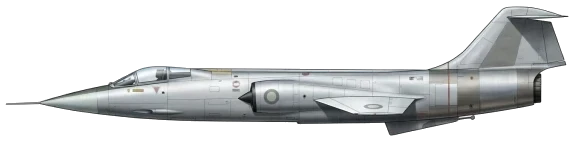
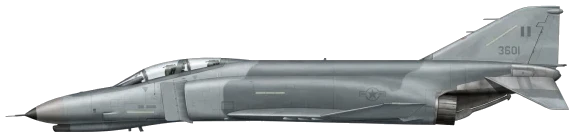
| F-104 Starfighter | F-4 Phantom II | |
|---|---|---|
| Origin country | 🇺🇸 United States | 🇺🇸 United States |
| Category | Combat Aircraft | Combat Aircraft |
| Manufacturer | Lockheed | McDonnell |
| First flight | 4 March 1954 | 27 May 1958 |
| Year introduced | 1958 | 1962 |
| Number produced | 2578 units | 5195 units |
| Average unit price | $1.4 million | $2.4 million |
| Wing area | 18.2 m² | 49.2 m² |
| Wingspan | 6.4 m | 11.7 m |
| Height | 4.1 m | 5.0 m |
| Length | 16.7 m | 19.0 m |
| Maximum speed | 2500 km/h | 2370 km/h |
| Operational range | 2,623 km | 2,699 km |
| Service ceiling | 15,240 m | 18,288 m |
| Max. takeoff weight | 13,170 kg | 28,030 kg |
| Empty weight | 6,350 kg | 13,757 kg |
| Total thrust | 1 x 7,076 kgf | 2 x 8,094 kgf |
Detailed Comparison
Lockheed’s F-104 Starfighter and McDonnell’s F-4 Phantom II materialized from opposing mid-1950s requirements: one a minimalist daytime interceptor built around a single J79 engine, the other a heavy, twin-engine fleet defense fighter reliant on radar-guided missiles. Both aircraft populated NATO flight lines throughout the Cold War, but their trajectories diverged. The F-104 forced air forces into rigid adherence to its narrow flight envelope, while the F-4 absorbed continuous payload and avionics expansions, dictating Western air combat doctrine through the Vietnam War.
Development and Design
Lockheed designer Kelly Johnson drafted the F-104 in 1952 in direct response to Korean War pilot feedback, discarding heavy airframes for a 6,350 kg empty weight interceptor optimized for maximum climb. The design utilized extremely thin, straight wings with a 3.36% thickness-to-chord ratio. This reduced drag but forced the implementation of a boundary layer control system to lower landing speeds. McDonnell approached the F-4 from a naval requirement, evolving the F3H Demon into a 13,757 kg twin-engine interceptor demanding a second crewman to operate the Westinghouse radar. McDonnell engineers countered the resulting lateral instability by angling the outer wing sections upward by 12 degrees, avoiding a complete redesign of the titanium central section.
Specifications and Performances
The F-104 and F-4 both utilized the General Electric J79 turbojet, yielding differing flight profiles based on mass. A single J79-GE-11A pushed the 13,170 kg (max takeoff) F-104 to 2,500 km/h and an initial climb rate of 244 m/s. The aircraft acted as a manned missile, trading maneuverability for intercept speed. The F-4, carrying two J79-GE-17A engines, matched the Starfighter’s Mach 2.2 class speed despite a maximum takeoff weight of 28,030 kg. This mass penalty reduced its initial climb rate to 210 m/s but enabled an 8,480 kg payload capacity across nine hardpoints. The Phantom carried AIM-7 Sparrows and heavy ground-attack munitions, whereas early Starfighters were restricted to wingtip Sidewinders and an M61 Vulcan cannon.
Deployment and usage
The USAF deployed F-104Cs to Vietnam for deterrence and EC-121 escort, but the airframe saw higher utilization in Europe. West Germany procured the F-104G as a nuclear strike and low-level attack aircraft. Operating a high-speed, thin-winged interceptor in Northern European weather resulted in 292 Luftwaffe airframe losses between 1961 and 1989. The F-4 directed the air war over Vietnam, scoring the majority of US air-to-air kills and producing all five American ace crews of the conflict. Its combat record expanded globally:
- US forces employed it through the 1991 Gulf War for Wild Weasel missions.
- Israeli Phantoms executed deep strike missions during the 1973 Yom Kippur War.
- Iranian squadrons operated the F-4 against Iraqi targets throughout the 1980s.
Combat feedback regarding early AIM-7 missile failure rates led to the F-4E, which integrated an internal 20 mm cannon.
Conclusion
The F-4 Phantom II holds the edge in multi-role combat, strike, and beyond-visual-range engagements. Its twin-engine thrust, two-man crew, and payload capacity allowed it to adapt to evolving combat requirements, keeping it in active service with nations like Greece and Turkey into the 2020s. The F-104 Starfighter wins only in point-defense interception scenarios where raw climb rate and time-to-target are the sole metrics. Once engaged in maneuvering combat or tasked with low-level ground attack, the F-104's high wing loading became a liability, whereas the F-4's radar architecture established the baseline for fourth-generation fighter development.


