F-4 Phantom II vs F/A-18 Hornet
F-4 Phantom II vs F/A-18 Hornet at a glance — top speed 2,370 vs 1,915 km/h, range 2,699 vs 2,017 km, max takeoff weight 28,030 vs 23,541 kg, built 5,195 vs 1,480 units.
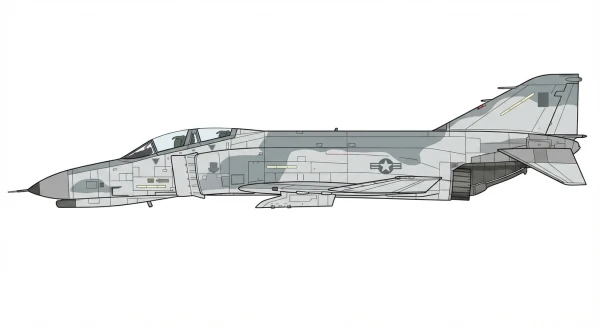
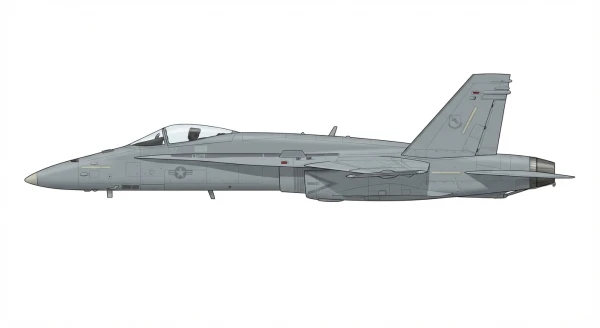
| F-4 Phantom II | F/A-18 Hornet | |
|---|---|---|
| Origin country | 🇺🇸 United States | 🇺🇸 United States |
| Category | Combat Aircraft | Combat Aircraft |
| Manufacturer | McDonnell | McDonnell Douglas |
| First flight | 27 May 1958 | 18 November 1978 |
| Year introduced | 1962 | 1983 |
| Number produced | 5195 units | 1480 units |
| Average unit price | $2.4 million | $29 million |
| Wing area | 49.2 m² | 38.0 m² |
| Wingspan | 11.7 m | 12.3 m |
| Height | 5.0 m | 4.7 m |
| Length | 19.0 m | 17.1 m |
| Maximum speed | 2370 km/h | 1915 km/h |
| Operational range | 2,699 km | 2,017 km |
| Service ceiling | 18,288 m | 15,000 m |
| Max. takeoff weight | 28,030 kg | 23,541 kg |
| Empty weight | 13,757 kg | 10,433 kg |
| Total thrust | 2 x 8,094 kgf | 2 x 8,051 kgf |
Detailed Comparison
The F-4 Phantom II and F/A-18 Hornet represent two distinct generations of carrier-capable, multi-role combat aircraft. The F-4, with its 1958 first flight, was a second-generation design focused on raw power, speed, and missile-based interception, later adapted for ground attack. In contrast, the F/A-18, first flown two decades later in 1978, was a third-generation aircraft designed from the outset for multi-role versatility, emphasizing agility, advanced avionics, and simplified carrier operations. This fundamental difference in design philosophy is evident in their respective capabilities and operational histories.
Development and Design
The F-4 Phantom II originated as a fleet defense interceptor for the U.S. Navy, built around two powerful General Electric J79 turbojets and the most advanced radar of its day. Its design prioritized speed and altitude, resulting in a large, heavy airframe capable of Mach 2.23. Key features include a two-person crew (pilot and Weapon Systems Officer), a distinctive wing with 12° of dihedral on the outer sections for lateral stability, and a massive payload capacity of over 8,400 kg. Early models lacked an internal cannon, reflecting the era's doctrine that air combat would be dominated by missiles.
The F/A-18 Hornet was born from the YF-17 prototype, a loser in the USAF's Lightweight Fighter competition. The U.S. Navy selected the design for its multi-role needs, seeking to replace several older aircraft types with a single, flexible platform. Its design emphasizes maneuverability over raw speed.
- Aerodynamics: Features large leading-edge extensions (LEX) and a digital fly-by-wire control system for exceptional high angle-of-attack performance and agility.
- Propulsion: The data provided points to the F/A-18E/F Super Hornet, which uses two General Electric F414 turbofans, offering greater fuel efficiency and reliability than the F-4's J79s.
- Operations: Designed for ease of maintenance and a reduced operational footprint, critical for sustained carrier deployments.
Specifications and Performances
While both are twin-engine fighters, their performance envelopes reflect their design priorities. The F-4 is significantly faster, with a maximum speed of 2,370 km/h compared to the F/A-18E/F's 1,915 km/h, and possesses a higher service ceiling (18,288 m vs. 15,240 m). This highlights the Phantom's interceptor heritage. However, the Hornet family possesses superior low-speed handling and agility, crucial for dogfighting and carrier landings. The Phantom’s initial climb rate of 210 m/s was exceptional for its time. The Super Hornet has a greater maximum takeoff weight (29,937 kg vs. 28,030 kg), allowing it to carry more fuel and advanced ordnance like the AGM-154 JSOW, though the Phantom’s overall weapons load was also formidable.
Deployment and usage
The F-4 Phantom II was the workhorse of Western air forces throughout the Cold War, particularly during the Vietnam War. It served as the primary air superiority fighter, ground-attack aircraft, and reconnaissance platform for the U.S. Air Force, Navy, and Marine Corps. It was widely exported and saw extensive combat with nations like Israel and Iran.
The F/A-18 Hornet became the U.S. Navy and Marine Corps' premier multi-role fighter from the 1980s onward. It saw its combat debut in 1986 over Libya and was a key asset in the 1991 Gulf War, Operation Allied Force, and post-9/11 conflicts in Afghanistan and Iraq. Its ability to self-designate targets and seamlessly switch between fighter and attack roles in a single sortie defined its operational value. The later Super Hornet and EA-18G Growler variants continue to form the backbone of U.S. naval aviation.
Conclusion
The F-4 Phantom II was a triumph of its era: a powerful, high-performance platform that defined a generation of air combat through sheer speed and payload. It was a successful interceptor that proved adaptable enough to become a potent fighter-bomber. The F/A-18 Hornet, and particularly its Super Hornet evolution, represents a more refined approach. It traded the Phantom's top-end speed for superior agility, advanced avionics, and true multi-role capability from its inception. The transition from the F-4 to the F/A-18 marks a clear doctrinal shift from specialized, high-performance interceptors to versatile, efficient platforms optimized for the complex demands of modern network-centric warfare.