J-15 Flying Shark vs Shenyang J-35
J-15 Flying Shark vs Shenyang J-35 at a glance — top speed 2,300 vs 1,905 km/h, range 3,500 vs 3,500 km, max takeoff weight 33,000 vs 28,000 kg, built 76 vs 57 units.
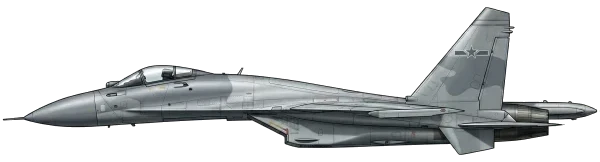
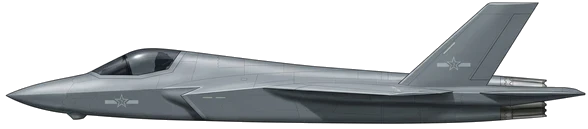
| J-15 Flying Shark | Shenyang J-35 | |
|---|---|---|
| Origin country | 🇨🇳 China | 🇨🇳 China |
| Category | Combat Aircraft | Combat Aircraft |
| Manufacturer | Shenyang | Shenyang |
| First flight | 1 August 2009 | 29 October 2021 |
| Year introduced | 2013 | 2025 |
| Number produced | 76 units | 57 units |
| Average unit price | -- | $60 million |
| Wing area | 67.8 m² | -- m² |
| Wingspan | 14.7 m | 11.5 m |
| Height | 5.9 m | 4.8 m |
| Length | 22.3 m | 17.3 m |
| Maximum speed | 2300 km/h | 1905 km/h |
| Operational range | 3,500 km | 3,500 km |
| Service ceiling | 18,000 m | 16,000 m |
| Max. takeoff weight | 33,000 kg | 28,000 kg |
| Empty weight | 17,500 kg | -- kg |
| Total thrust | 2 x 12,502 kgf | 2 x 8,892 kgf |
Detailed Comparison
China’s naval aviation transition rests on replacing the reverse-engineered, heavyweight J-15 with the clean-sheet, medium-weight stealth J-35. The People's Liberation Army Navy (PLAN) is pivoting from localized fleet air defense using ski-jump carriers to expeditionary power projection utilizing electromagnetic catapults, requiring airframes aligned with this doctrine.
Development and Design
The J-15 emerged from the 2001 acquisition of an unfinished Ukrainian Su-33 prototype, the T-10K-3. Shenyang Aircraft Corporation mated this airframe with J-11B avionics and a glass cockpit. The resulting 33,000 kg maximum takeoff weight (MTOW) fighter utilizes a conventional swept-wing heavy airframe optimized for long-range interception but penalized by a high radar cross-section. The J-35 originated as the privately funded FC-31 demonstrator in 2012. Shenyang later redesigned the airframe specifically for carrier operations, reducing its MTOW to 28,000 kg while integrating low-observable geometry, serpentine S-ducts to obscure engine fan blades, and a distributed aperture system. The J-15 stores all munitions externally, while the J-35 manages drag and radar signature via a centerline internal weapons bay.
Specifications and Performances
The J-15 outpaces the J-35 in raw kinetic metrics. Capable of 2,300 km/h with an 18,000 m service ceiling, it exceeds the J-35’s 1,905 km/h top speed and 16,000 m ceiling. However, STOBAR (Short Take-Off But Arrested Recovery) launch from the Liaoning and Shandong restricts the J-15’s operational payload. It cannot launch with both a full internal fuel load and its maximum 6,500 kg external payload.
The J-35 bypasses this penalty through CATOBAR (Catapult Assisted Take-Off But Arrested Recovery) optimization. Despite weighing 5,000 kg less at MTOW, the J-35 carries a higher total payload of 8,000 kg distributed between internal bays and external hardpoints. Engine maturation dictates the timeline of both programs. The J-15 transitioned from imported Saturn AL-31s to domestic WS-10s. The J-35 currently relies on 93.2 kN WS-21 interim engines, awaiting the 116 kN WS-19 required to achieve supercruise.
Deployment and usage
Entering service in 2013, the 76-unit J-15 fleet formed the initial backbone of PLAN carrier aviation. Flight operations revealed control system vulnerabilities, resulting in groundings and fatal crashes. Furthermore, its reliance on ski-jumps restricted its combat radius and limited its use of heavy standoff weapons like the YJ-12 anti-ship missile. To address this, Shenyang introduced the CATOBAR-capable J-15T in 2024. The J-35 entered service in 2025 alongside the electromagnetic catapult-equipped carrier Fujian. Pakistan ordered the land-based J-35AE export variant in June 2025 to counter Indian fighter acquisitions.
Conclusion
The J-35 renders the baseline J-15 obsolete for offensive operations in contested airspace. Against modernized air defense networks, the J-15’s high radar cross-section and STOBAR-induced payload limitations degrade its utility as a frontline strike fighter.
The PLAN will divide future operational roles:
- The J-35 holds the absolute edge in penetrating A2/AD envelopes, utilizing its low-observability and electromagnetic catapult launches to deliver internal munitions deep into contested airspace.
- The J-15T will serve strictly as a standoff missile truck, remaining outside contested zones to launch heavy anti-ship and land-attack cruise missiles cued by J-35 targeting data.
The J-35 dictates the engagement terms in direct combat, answering the PLAN's requirement for a survivable first-day strike asset.
