F/A-18 E/F Super Hornet vs J-15 Flying Shark
F/A-18 E/F Super Hornet vs J-15 Flying Shark at a glance — top speed 1,915 vs 2,300 km/h, range 2,346 vs 3,500 km, max takeoff weight 29,900 vs 33,000 kg, built 632 vs 76 units.
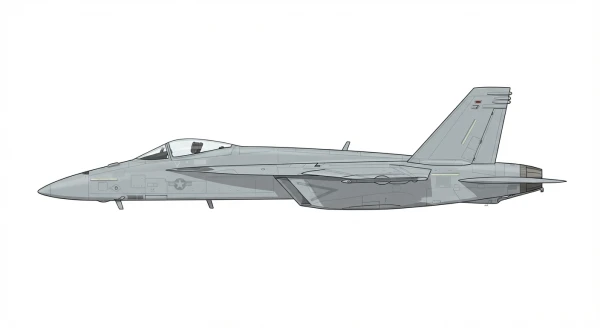
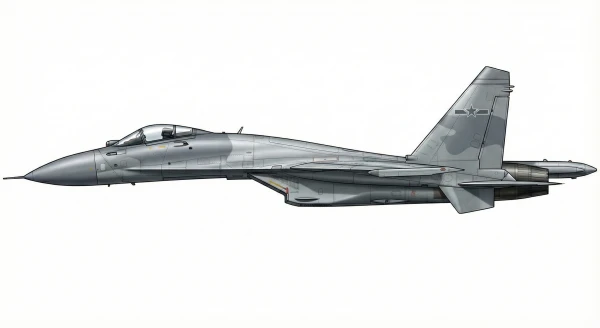
| F/A-18 E/F Super Hornet | J-15 Flying Shark | |
|---|---|---|
| Origin country | 🇺🇸 United States | 🇨🇳 China |
| Category | Combat Aircraft | Combat Aircraft |
| Manufacturer | Boeing | Shenyang |
| First flight | 29 November 1995 | 1 August 2009 |
| Year introduced | 2001 | 2013 |
| Number produced | 632 units | 76 units |
| Average unit price | $70 million | -- |
| Wing area | 46.5 m² | 67.8 m² |
| Wingspan | 13.6 m | 14.7 m |
| Height | 4.9 m | 5.9 m |
| Length | 18.3 m | 22.3 m |
| Maximum speed | 1915 km/h | 2300 km/h |
| Operational range | 2,346 km | 3,500 km |
| Service ceiling | 15,940 m | 18,000 m |
| Max. takeoff weight | 29,900 kg | 33,000 kg |
| Empty weight | 14,550 kg | 17,500 kg |
| Total thrust | 2 x 9,979 kgf | 2 x 12,502 kgf |
Detailed Comparison
Boeing’s F/A-18E/F Super Hornet and Shenyang’s J-15 Flying Shark occupy the central strike fighter roles for the world’s two largest navies, yet they operate under completely different launch paradigms. The Super Hornet relies on Catapult Assisted Take-Off But Arrested Recovery (CATOBAR) infrastructure, maximizing payload and range, while the baseline J-15 is constrained by Short Take-Off But Arrested Recovery (STOBAR) physics on the Liaoning and Shandong carriers.
Development and Design
The Super Hornet was a pragmatic 1990s derivation to replace the A-12 and A-6, avoiding the cost of a clean-sheet design. Boeing enlarged the legacy Hornet by 20%, altered the intakes for F414 engines, and integrated radar cross-section reduction. Successive Block II and III iterations evolved its avionics, standardizing the AN/APG-79 AESA radar and conformal fuel tanks. Shenyang’s J-15 emerged via reverse engineering after China acquired an unfinished Su-33 prototype (T-10K-3) from Ukraine. Built on the J-11B airframe, the J-15 is heavy and originally suffered from reliance on imported Russian Saturn AL-31 engines. China has since transitioned the fleet to indigenous WS-10 engines and developed the J-15T variant to interface with the electromagnetic catapults on the new Fujian carrier, bridging the launch infrastructure gap.
Specifications and Performances
On paper, the J-15 outclasses the Super Hornet kinematically. The Chinese airframe maxes out at 2,300 km/h and lists a 3,500 km range, exceeding the Super Hornet’s 1,915 km/h and 2,346 km limits. However, operational realities reverse this advantage:
- The J-15's STOBAR launch imposes strict weight penalties, forcing operators to trade fuel for payload and restricting its 33,000 kg maximum takeoff weight limit.
- The F/A-18's CATOBAR launch allows it to take off at its maximum 29,900 kg MTOW, permitting full weapon loads combined with external drop tanks.
The Super Hornet’s F414-GE-400 turbofans provide 19,958 kgf combined thrust. While lower than the J-15’s 25,000 kgf output, the American engines push a lighter, structurally efficient airframe that does not require a ski-jump compromise.
Deployment and usage
The U.S. Navy has operated the Super Hornet in continuous combat since 2002. It executed strikes over Iraq and Afghanistan, scored an air-to-air kill against a Syrian Su-22 in 2017, and intercepted Houthi anti-ship cruise missiles and drones in the Red Sea. This two-decade combat record generated refined software, mature tactics, and high sortie-generation rates. The J-15 entered service in 2013 and has zero combat experience. Its operational history consists of regional patrols and carrier qualification cycles in the South China Sea. The fleet suffered several early mechanical failures and crashes attributed to flight control system software and weight issues, indicating a steep learning curve for PLAN naval aviation.
Conclusion
The Super Hornet possesses a definitive edge in any current tactical scenario. Its CATOBAR integration, proven APG-79 radar, mature munitions suite, and battle-tested reliability make it a superior strike asset. The baseline J-15 is a heavy, aerodynamically capable airframe restricted by its carriers' ski-jumps, forced to act as a point-defense interceptor rather than a deep-strike platform. While the catapult-capable J-15T paired with the Fujian carrier will eventually close this operational gap and leverage the Flanker design's natural range, the Super Hornet remains the apex naval strike fighter today through integration, ordnance capacity, and mechanical maturity.