Su-27 Flanker Family, Variants and Successors
How to read a Flanker designation: Sukhoi's T-10 codes, the Su-27 suffixes, the renumbered Su-33, Su-34 and Su-35, NATO's reporting names, China's J-11 line and who flies which type in 2026.
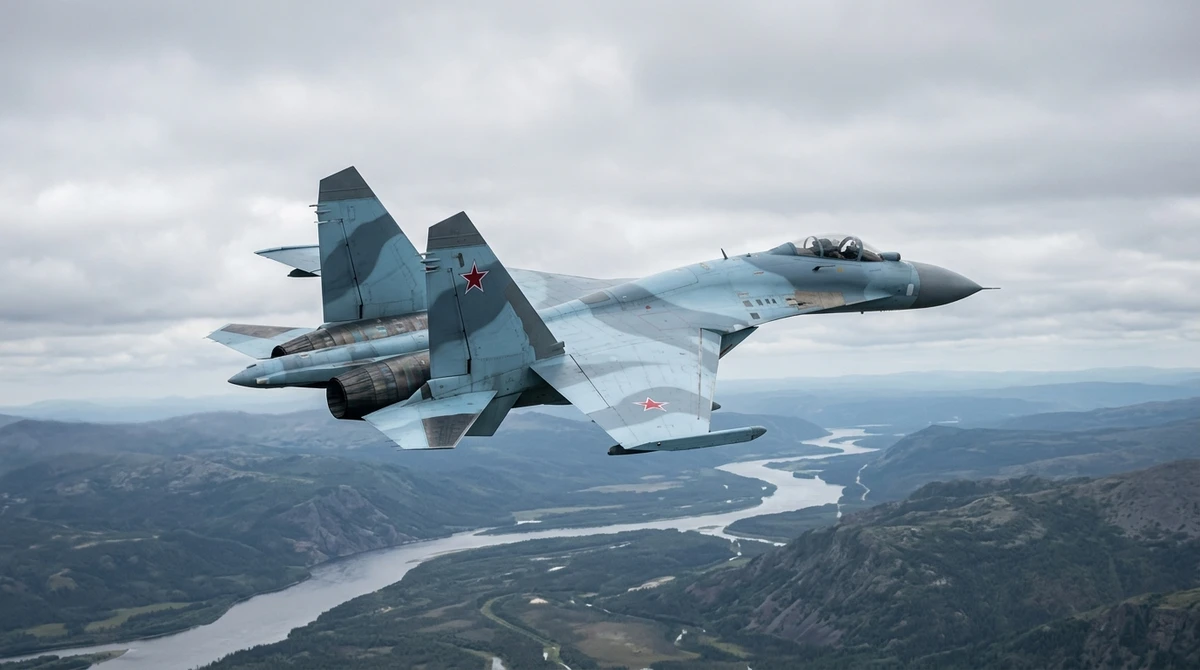
Russia's United Aircraft Corporation handed over batches of Su-35S fighters on 17 April, 26 May and 27 August 2026; China's new carrier Fujian entered service on 5 November 2025 with J-15T and J-15DT jets in its air wing; Algeria took its first Su-57 deliveries over the winter of 2025-26 as the type's first export customer. All of them belong to the family of the Su-27 or succeed it.
Every airframe in the family carries up to four labels at once: Sukhoi's factory code, a service designation whose suffix is a Russian initial, in several cases a later renumbering as a new Su- type, and a NATO reporting name that is firm for the early variants and inconsistent after them. This guide decodes them branch by branch, as of October 2026.
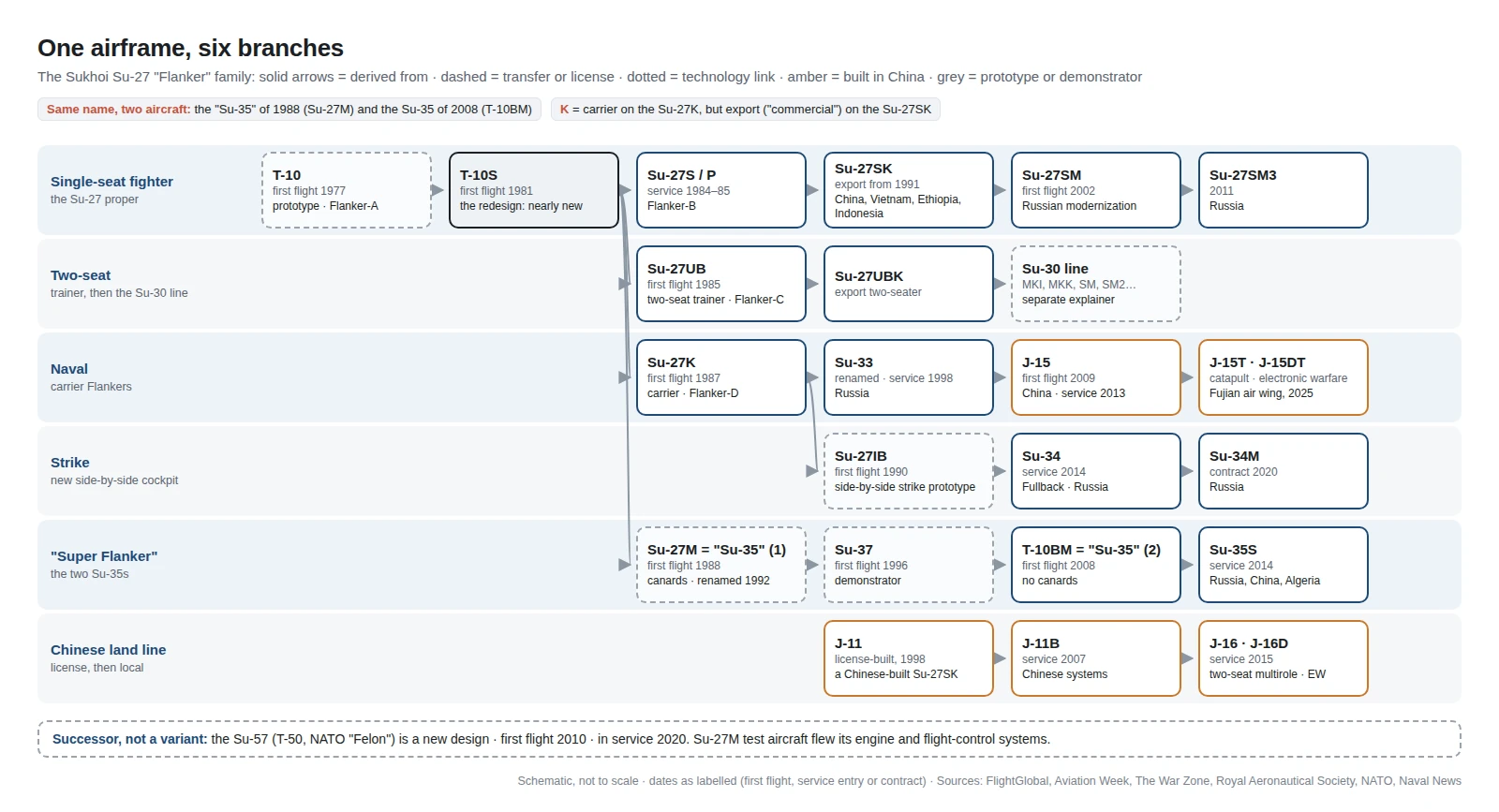
- One ancestor: the production Su-27 descends from the T-10S redesign first flown in 1981, reworked so thoroughly from the T-10 of 1977 that it was close to a new aircraft.
- Suffixes are Russian initials: UB is a combat trainer, P an air-defense version, IB a fighter-bomber, SM a mid-life upgrade of existing jets, M a new-build advanced airframe.
- K has two meanings: shipborne on the Su-27K, the future Su-33, but commercial on the export Su-27SK and Su-27UBK, which have nothing naval about them.
- "Su-35" names two aircraft: the canard-equipped Su-27M of 1988, renamed for the 1992 Farnborough show, and the canard-less T-10BM of 2008 that serves today as the Su-35S.
- NATO letters stop being official at D: Flanker-A to -D, Fullback for the Su-34 and Felon for the Su-57 are sourced; later letters circulate without a primary source.
How to read a Flanker designation
The factory code is Sukhoi's own: T-10 was the bureau's tenth design, and the letter that follows names a configuration, T-10S for the redesigned fighter, T-10K for the carrier version, T-10V for the strike aircraft, T-10M and T-10BM for the two "Su-35" generations. The service designation is assigned by the Soviet and then Russian defense ministry, with export suffixes added by industry. A variant that diverged far enough was eventually renumbered as a new Su- type, often years after its first flight: the Su-27K became the Su-33, the Su-27IB the Su-34, the Su-27M the first "Su-35", the Su-27PU the Su-30. The NATO reporting name, "Flanker" plus a letter, was assigned as each variant was identified, with separate names for the strike derivative and the successor.
| Russian reading | What it means | Example | |
|---|---|---|---|
| S | Not firmly attested on the Su-27S | Series-production fighter | Su-27S, Su-35S |
| P | PVO | Version for the air-defense forces, without the air-to-ground weapons wiring | Su-27P |
| UB | Uchebno-boyevoy | Combat trainer, tandem two-seat | Su-27UB |
| K | Korabelny or kommercheskiy | Shipborne on the Su-27K; commercial (export) on the Su-27SK and UBK | Su-27K, Su-27SK |
| IB | Istrebitel-bombardirovshchik | Fighter-bomber | Su-27IB, later Su-34 |
| M | Modernizirovanny | On the Su-27M, a new-build advanced airframe, later called Su-35 | Su-27M |
| SM, SM3 | Seriyny modernizirovanny | Mid-life upgrade of existing airframes; SM2 and SM3 are later Russian standards | Su-27SM, Su-27SM3 |
| BM | Bolshaya modernizatsiya | "Major modernization": the 2008 Su-35 redesign | T-10BM, "Su-35BM" |
The T-10S redesign
The first prototype, T-10-1, flew on 20 May 1977 with AL-21 turbojets and an ogival wing. Flight testing sent the design back to the drawing board: Aerospaceweb lists excessive drag, a weak structure, excessive weight and flutter, and the second prototype was lost in July 1978. Sukhoi completed the redesign in 1980. The T-10S kept the general layout and little else: a straight-tapered wing with squared tips carrying missile rails, fins moved outboard, a reshaped nose for a larger radar, the airbrake moved to the spine, flaperons, and a redesigned undercarriage and structure. The first T-10S flew on 20 April 1981; T-10-17, the first airframe to full production standard, followed on 26 May 1982.
Seen first by satellite at the Ramenskoye test center, the prototypes carried the provisional Western label "Ram-K" before the reporting name Flanker-A was assigned. The production fighter entered Soviet service in the mid-1980s: Aerospaceweb dates service entry to December 1984; other accounts give 22 June 1985.
The design branches
From the T-10S the family forks into six branches: four Russian, the Su-30 line, and a Chinese line grown from the export Su-27SK and a Su-33 prototype.
Single-seat fighters, Su-27S to Su-27SM3
The Su-27 as built from the mid-1980s came in two Soviet versions: the Su-27S for Frontal Aviation and the Su-27P for the PVO air-defense forces, without the air-to-ground weapons wiring. Both are Flanker-B to NATO. The export Su-27SK and two-seat Su-27UBK were developed in 1991; China took the first from 1992, and at its request the SK's maximum takeoff weight was raised to 33 tonnes. Vietnam, Ethiopia and Indonesia followed, Indonesia later receiving the updated Su-27SKM in 2010.
Russia's own upgrade path began with the Su-27SM, which first flew in December 2002; a repair-and-modernization contract followed in 2004, and 20 aircraft went to the KnAAPO plant at Komsomolsk-on-Amur that year. The SM gave the 1980s fighter a glass cockpit and a multirole weapons set:
- Air-to-air: the R-77 (RVV-AE) active-radar missile.
- Air-to-surface: the Kh-29 and Kh-31 missiles.
- Guided bombs: the KAB-500Kr and KAB-1500.
A Su-27SM2 step, with the Irbis-E radar and uprated engines from the Su-35 program, was proposed; the Su-27SM3 is the one that reached squadrons, with AL-31F-M1 engines rated at 13,500 kgf, a strengthened airframe, two extra hardpoints and four cockpit displays, on 12 aircraft completed from airframes originally built for an unrealized Chinese order, according to GlobalSecurity; all 12 had reached Krymsk by 2011. In March 2019 the plant announced the last baseline Su-27-family delivery to the Russian defense ministry, reported by AIN as the last classic Flanker.
Two-seaters and the Su-30 line
The Su-27UB (uchebno-boyevoy, combat trainer) first flew on 7 March 1985: a tandem two-seater that kept the full weapons system, hence NATO's separate letter, Flanker-C. Its export form is the Su-27UBK. The two-seat Su-27PU development was renumbered Su-30 and became the family's most widely exported branch: the Su-30MKI for India, the Su-30MKK for China (first delivered in December 2000), the Su-30MK2 ordered by China's navy in January 2003 and flown by Vietnam among others, Algeria's Su-30MKA, and Russia's Su-30SM and Su-30SM2. That line has a grammar of its own, covered in GMN's Su-30 variants explainer.
Naval branch, Su-27K to Su-33
The carrier fighter was developed as the T-10K and designated Su-27K, shipborne: folding wings and tailplanes, canard foreplanes, an arrester hook, a twin-wheel nose gear and a refueling probe. First flight came on 17 August 1987 and the first carrier landing on 1 November 1989, but the type entered service only on 31 August 1998, under the new name Su-33; NATO calls it Flanker-D. About two dozen airframes were built, prototypes included. The Su-33's only ship, Admiral Kuznetsov, has been in repair since 2017, and in July 2025 Izvestia, relayed by Meduza, reported that the work had been halted and decommissioning was being weighed; the same reporting notes that the air wing moved ashore after the loss of one Su-33 and one MiG-29K during the carrier's Syria deployment.
Strike branch, Su-27IB to Su-34
The fighter-bomber (istrebitel-bombardirovshchik) began as the Su-27IB, factory code T-10V, with a new forward fuselage: a side-by-side armored cockpit under the flattened nose that earned it the "platypus" nickname. T-10V-1 flew on 13 April 1990 and the production-standard aircraft on 28 December 1994. The prototypes were first shown as the Su-32 (Su-32FN for export) before the service name Su-34 settled; NATO calls it Fullback. The Russian Air Force formally accepted the type on 20 March 2014. A modernized Su-34M, with updated avionics and electronic warfare equipment, replaced it in production under a 2020 contract; the first 2026 batch was delivered on 9 July 2026. In the Russia-Ukraine war the Su-34 has been the most frequently lost Flanker type, by GMN's event log and by Oryx's photo-documented count alike.
Super Flankers, two Su-35s and the Su-37
Sukhoi's "Super Flanker" began as the Su-27M, factory code T-10M: a new-build advanced fighter with canard foreplanes, the N011 radar, taller fins and a rearward-facing radar, first flown on 28 June 1988. For its Western debut at Farnborough in 1992 Sukhoi rebranded it "Su-35". About a dozen were built, flown by the Russian Air Force for testing only and never mass-produced. The eleventh airframe, T10M-11, received thrust-vectoring nozzles and flew as the Su-37 on 2 April 1996; a one-off demonstrator, it crashed on 19 December 2002 and never entered service.
The aircraft that carries the name today is a different design. The T-10BM, bolshaya modernizatsiya or "major modernization" (hence "Su-35BM" in the press), dropped the canards and introduced the Irbis-E passive electronically scanned radar, AL-41F1S (117S) thrust-vectoring engines and the Khibiny-M electronic warfare suite. The first aircraft, Su-35-1, flew on 18 February 2008 at Zhukovsky by FlightGlobal's contemporary report; Sukhoi-derived sources give 19 February. Russia ordered 48 at the MAKS show in 2009, the production Su-35S entered service in February 2014 and the 100th was delivered in December 2018. China signed for 24 in November 2015, at a reported $2 billion, and received the first four in December 2016. Algeria became the second export operator in March 2025, with airframes originally built for Egypt identified in Algerian markings by satellite imagery, as The War Zone and Aviation Week reported; The War Zone reports that Egypt's reported late-2018 deal was derailed by the threat of US CAATSA sanctions. Iran announced a purchase through state media in March 2023, but no delivery had been independently confirmed as of October 2026; leaked Rostec documents reported by The Defense Post in October 2025, which GMN cannot verify, list 48 aircraft for 2026-28.
| Factory code | Service name | NATO name | Status 2026 | |
|---|---|---|---|---|
| Single-seat fighter | T-10S | Su-27S, P, SKUpgrades: SM, SM3 | Flanker-B | In service, Russia and export operators |
| Two-seat and Su-30 line | From the T-10S | Su-27UB, UBKSu-27PU renumbered Su-30 | Flanker-C | Su-30 in production and widely exported |
| Naval | T-10K | Su-27K, renumbered Su-33 | Flanker-D | Russia; carrier in repair since 2017 |
| Strike | T-10V | Su-27IB, renumbered Su-34Su-34M since 2020 contract | Fullback | In production, Russia |
| Super Flanker | T-10M, then T-10BM | Su-27M ("Su-35", 1992), Su-37, Su-35S | Flanker-E by most outletsContested; Wikipedia gives Flanker-M for the Su-35S | Su-35S in production: Russia, China, Algeria |
| Chinese line | Su-27SK license, Su-33 prototype | J-11, J-16, J-15 families | No official letters | In production, China |
| Successor | T-50 | Su-57 | Felon | New design, not a Flanker; Russia and Algeria |
The Chinese Flanker line
China is the only country to have built Flankers outside Russia; the account below follows the Royal Aeronautical Society's October 2023 survey of the Chinese fleet. A license agreement valued by the RAeS at $1.2 billion covered 200 J-11 fighters assembled at Shenyang from Russian Su-27SK kits; the first flew in December 1998, and the J-11A added new cockpit displays and the R-77E missile. By late 2006, 104 or 105 J-11 and J-11A had been built when, in the RAeS account, China decided to cancel the remainder. The Chinese suffixes form a code of their own:
- A: improved license batch (J-11A).
- B: indigenized, with Chinese radar and avionics and, after a first batch on AL-31F engines, the WS-10A (J-11B).
- S: two-seat, from shuang (J-11BS, J-15S).
- H: naval, from haijun (J-11BH, J-11BSH).
- G: modified, from gai: the AESA retrofit with the gray radome (J-11BG, J-11BHG).
- T and D: on the J-15, catapult-compatible and electronic warfare; J-15DH and J-15DT are the ski-jump and catapult EW versions.
The J-11B first flew in 2004 and entered service in 2007 with the Chinese Type 1493 radar; the J-11BH went to the navy from 2010. The two-seat J-11BS followed about two years later although, as the RAeS notes, China had never received permission to produce twin-seaters. Since about 2019 the J-11BG and J-11BHG retrofit has added an AESA radar and the PL-10 and PL-15 missiles. A J-11D with AESA and WS-10B engines was built in three prototypes in 2015-16 and abandoned; its avionics went to the J-15T. The RAeS put the land-based force in early 2023 at about 100 J-11A, 150 to 160 J-11B and BH, and 90 J-11BS.
The J-16 is the Chinese two-seat multirole Flanker: a J-11BS airframe with Su-30MKK features (refueling probe, landing gear and fuel capacity), an AESA radar and WS-10B engines. It flew in late 2011 and entered service in mid-2015; the J-16D electronic-warfare version, with wingtip electronic support pods and no gun, flew in December 2015 and had been delivered by November 2021. The RAeS counted about 270 J-16 and 30 J-16D in early 2023. The J-16 is sometimes reported as "Flanker-N", a label for which GMN found no primary source.
The naval J-15 has a different root. In the RAeS account, China acquired an unfinished Su-33 prototype via Ukraine in 2001, identified as T-10K-3, which "formed the basis of an indigenous naval Flanker variant": a Su-33-like structure with J-11B avionics and AL-31F engines. The J-15 first flew on 31 August 2009 and its first unit formed in late 2013; the two-seat J-15S has been in service since July 2022. The J-15T carries catapult-compatible nose gear, the AESA radar derived from the J-11D, WS-10 engines and the PL-10 and PL-15; it flew in July 2016 and was publicly unveiled at the Zhuhai air show in November 2024, as The War Zone reported. The J-15D electronic-warfare jet flew in October 2016; The War Zone published the first clear imagery of the catapult-compatible J-15DT in August 2025, three months before Fujian was commissioned on 5 November 2025 with J-15T and J-15DT aircraft in its air wing, according to Naval News. The rest of the PLA inventory is covered in GMN's guide to Chinese fighters.
| Based on | What distinguishes it | Key dates | |
|---|---|---|---|
| J-11 / J-11A | Su-27SK kits | License assembly; A adds new displays and R-77E | First aircraft Dec 1998; about 100 built by late 2006 |
| J-11B / BH | J-11 | Chinese Type 1493 radar and avionics, WS-10A; BH for the navy | First flight 2004; service 2007; BH from 2010 |
| J-11BS / BSH | J-11B | Two-seat | About two years after the J-11B |
| J-11BG / BHG | J-11B / BH | AESA retrofit, PL-10 and PL-15 | Since about 2019 |
| J-16 | J-11BS airframe, Su-30MKK features | Two-seat multirole, AESA, WS-10B | First flight late 2011; service mid-2015 |
| J-16D | J-16 | Electronic warfare, wingtip ESM pods, no gun | First flight Dec 2015; delivered by Nov 2021 |
| J-15 / J-15S | Su-33 prototype, J-11B avionics | Carrier fighter, AL-31F; S two-seat | First flight 31 Aug 2009; unit late 2013; S in service Jul 2022 |
| J-15T | J-15 | Catapult nose gear, AESA, WS-10, PL-10 and PL-15 | First flight Jul 2016; unveiled Nov 2024 |
| J-15D / DH / DT | J-15, two-seat | Electronic warfare; DH ski-jump, DT catapult | First flight Oct 2016; DT imaged Aug 2025; aboard Fujian Nov 2025 |
NATO reporting names, firm and contested
The reporting names are the labels most Western readers meet first, and the least reliable beyond the 1980s. The firm set is short: Flanker-A for the T-10 and T-10S prototypes, Flanker-B for the Su-27S, P and SK, Flanker-C for the two-seat Su-27UB and UBK, Flanker-D for the Su-27K and Su-33. Two members of the family carry names of their own: Fullback for the Su-34, used by NATO itself in an October 2014 release on Russian air activity, and Felon for the Su-57, reported by The Aviationist in November 2019. Flanker-E is where consistency ends: Aerospaceweb applies it to the 1988 Su-27M, most outlets to the Su-35S, and Wikipedia gives the Su-35S "Flanker-M" instead. Letters for the Su-37, the Su-30 variants, the Russian upgrades and the Chinese types circulate in secondary sources and in GMN's own page addresses, but GMN found no primary source for any of them and does not present them as official. The system itself is explained in GMN's guide to NATO reporting names.
Who flies what, and what comes next
The table lists types only; fleet sizes are on each air force page.
| Su-27 variants | Su-30 line | Later types | |
|---|---|---|---|
| Russia | Su-27S, P, UB; Su-27SM, SM3 | Su-30SM, SM2 | Su-33, Su-34 and Su-34M, Su-35S, Su-57 |
| China | Su-27SK, UBK; J-11, A, B, BS, BG, BH20 to 25 Su-27SK left in 2023 per the RAeS | Su-30MKK, MK2 | Su-35, J-16 and J-16D, J-15 family |
| India | None | Su-30MKI | None |
| Kazakhstan | Su-27, UBTen upgraded to BM2/UBM2 standard in Belarus, 2007-10 | Su-30SM | None |
| Belarus | NoneSu-27 fleet retired Dec 2012 | Su-30SM, SM2Two SM2 received 29 Jan 2026 per the defense ministry | None |
| Ukraine | Su-27S, P, UBLocal S1M, P1M and UB1M upgrades | None | None |
| Vietnam | Su-27SK, UBK | Su-30MK2 | None |
| Indonesia | Su-27SK, SKM | Su-30MK, MK2 | None |
| Algeria | None | Su-30MKA | Su-35 (from Mar 2025), Su-57 (from late 2025)Su-34 kits named in leaked files, unverified |
| Ethiopia | Su-27Second-hand from Russia, 1998-2002 | None | None |
| Eritrea, Angola | Residual Su-27 | None | None |
| United States | Two ex-Ukrainian Su-27UB imported in 2009One now at the National Museum of the USAF | None | None |
The Su-57 is the successor, not a variant. Developed as the T-50 under the PAK FA program, it is a new design, first flown on 29 January 2010 and in service since 2020. The two lines are linked: Su-27M airframes served as testbeds for its AL-41F1 engine, flown on 21 January 2010, and for its flight-control system, while the Su-35S borrowed propulsion and avionics technology developed for the T-50. Deliveries continued in February 2026 and on 24 September 2026. Algeria is the first export customer: UAC said in November 2025 that two aircraft had gone to an unnamed customer, and the jets were filmed near Oum El Bouaghi in February 2026, as Defense News and The Aviationist reported; the order is 12 according to leaked documents reported by The Defense Post.
Russian Su-35S production continues batch by batch: seven handovers in 2025, the last on 25 December, which industry estimates put at 14 to 21 aircraft, then the three 2026 batches noted above. In China, the Fujian air wing puts the catapult J-15T and J-15DT at sea for the first time. In GMN's event log the war in Ukraine has made the Su-34 and Su-35S the family's most exposed types; one Su-35 downed near Mostky on 8 July 2026 was later linked, in testimony by the chairman of the US Joint Chiefs of Staff, to the first Ukrainian F-16 air-to-air kill. GMN's event logs for the Su-34 and the Su-35 record each incident with its sources, counting destroyed airframes only, damage excluded, which is why they differ from Oryx's photo-documented tallies.