J-15 Flying Shark
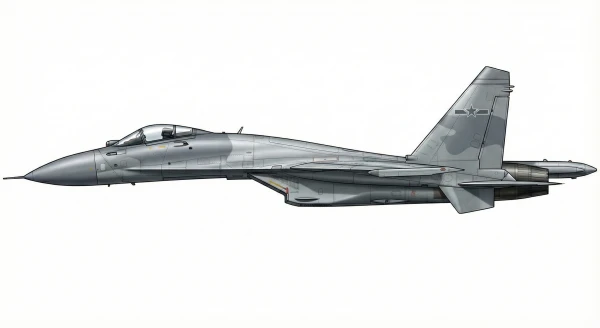
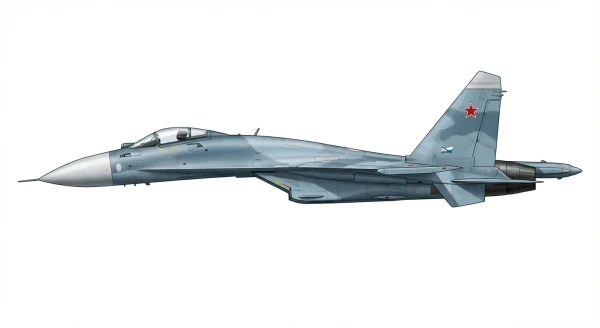
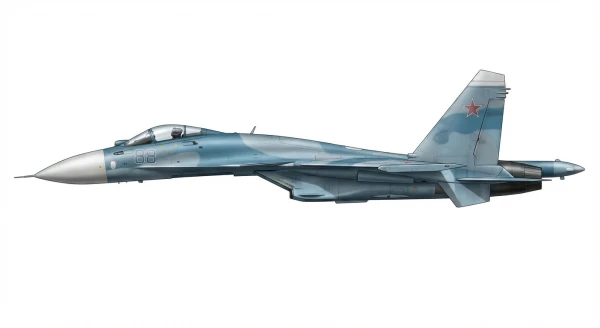
Chinese carrier-based twin-engine multirole fighter, developed from the Su-33, in use by the Chinese Naval Air Force. Key figures: top speed 2,300 km/h, range 3,500 km, service ceiling 18,000 m, max takeoff weight 33,000 kg, built 76. In service with 1 air force as of 2026 — China (75).
| Crew | 1–2 |
| Length | 22.3 m (73.1 ft) |
| Wingspan | 14.7 m (48.2 ft) |
| Height | 5.9 m (19.4 ft) |
| Wing area | 67.8 m² (730.2 sqft) |
| Empty weight | 17,500 kg (38,581 lbs) |
| Max. takeoff weight | 33,000 kg (72,752 lbs) |
| Powerplant | 2 × Saturn AL-31 12,502 kgf each |
| Ejection seat | Zvezda K-36DM |
| Maximum speed | 2300 km/h (Mach 2.3) |
| Operational range | 3,500 km (2,175 mi) |
| Service ceiling | 18,000 m (59,055 ft) |
| Climb rate | 246.0 m/s (807.1 ft/s) |

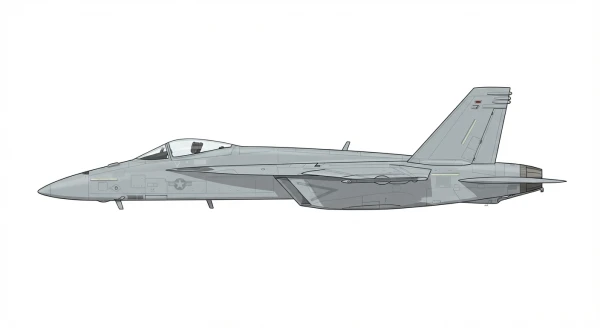
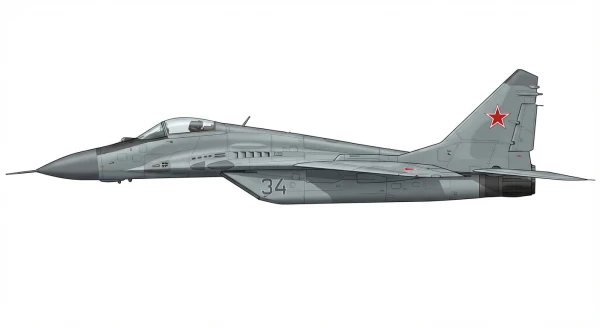
Description
The Shenyang J-15 program, also known as "Flying Shark", and codenamed by NATO "Flanker-K", was officially initiated in 2006 to develop a carrier-based multirole fighter for the People's Liberation Army Navy. Its development followed the acquisition and study of an unfinished Su-33 prototype, the T-10K-3, from Ukraine in 2001. This reverse-engineering effort was spurred by unsuccessful negotiations with Russia to purchase Su-33s, which collapsed after China was found to have developed the J-11B, a modified Su-27SK, in violation of intellectual property agreements. Developed by the Shenyang Aircraft Corporation (SAC) and the 601 Institute, the J-15 is based on the J-11B airframe but incorporates navalized technologies. The first prototype, powered by Russian Saturn AL-31 engines, made its maiden flight on August 31, 2009. Key milestones include its first takeoff from a simulated ski-jump in May 2010 and its first successful landing on the aircraft carrier Liaoning on November 25, 2012. The aircraft officially entered active service in 2013.
Design
The J-15 features significant design modifications for carrier operations, including a structurally reinforced airframe, a tailhook, and strengthened landing gear. To minimize weight and enhance flight characteristics, the design incorporates a higher proportion of composite materials compared to the Su-33, enabling a slower landing speed. The aircraft's avionics, derived from the J-11B program, include a glass cockpit, a MIL-STD-1553B data bus, and a 4-redundant, 3-axis fly-by-wire system. Early models were powered by Russian AL-31 engines, which were considered a performance limitation, but later variants have been fitted with the indigenous WS-10 turbofan. For extended missions, the J-15 is capable of air-to-air refueling via a UPAZ-1 buddy refueling pod carried by another J-15.
Armament
The aircraft is equipped with an internal 30 mm GSh-30-1 cannon with 150 rounds. Its offensive capability is centered around twelve external hardpoints capable of carrying a total payload of 6,500 kg. Munitions include a versatile mix of air-to-air missiles such as the PL-8, PL-10, PL-12, and the long-range PL-15 on newer variants. For anti-surface warfare, it can be armed with YJ-83K and YJ-12 anti-ship missiles, KD-88 and AKF-98 standoff land-attack missiles, and the YJ-91 anti-radiation missile. The aircraft can also carry various unguided bombs and rockets to fulfill multiple mission profiles.
Operational History
The J-15's operational history began with its first arrested landings on the carrier Liaoning in November 2012, with mass production of combat-ready units starting in late 2013. The fleet has since conducted deployment drills aboard both the Liaoning and Shandong carriers, including operations in the South China Sea. The aircraft's service life has revealed certain challenges, including "unpardonable mechanical failures" and payload limitations inherent to its heavy airframe and reliance on STOBAR ski-jump takeoffs. These issues have prompted development of a replacement. The operational capabilities were expanded in October 2024 with the introduction of the CATOBAR-capable J-15T and the electronic warfare J-15D variants. Several accidents have been reported, including crashes attributed to flight control system failures and a bird strike incident that resulted in an engine fire.
Variants
- J-15: Single-seat variant for multirole carrier operations.
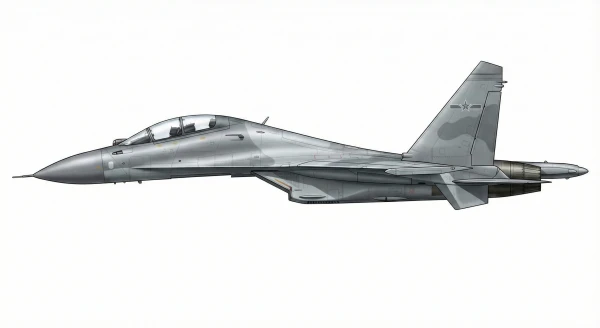
- J-15S: Two-seat trainer variant which first flew in 2012.
- J-15T: An improved variant with CATOBAR launch capability, WS-10 engines, and fifth-generation avionics including AESA radar.
- J-15D: A two-seat electronic warfare (EW) variant featuring wingtip EW pods and specialized electronic systems.
Identified in 19 sorties in the official China-Taiwan Tensions activity reports between 2023 and 2023 — a floor, not a census: only sorties the source identified by type are counted, and how much it disclosed varies by year.
Frequently Asked Questions
What type of aircraft is the J-15 Flying Shark?
What is the maximum speed of the J-15 Flying Shark?
What is the range of the J-15 Flying Shark?
When did the J-15 Flying Shark first fly?
How many J-15 Flying Shark have been built?
Which countries operate the J-15 Flying Shark?
What is the service ceiling of the J-15 Flying Shark?
- AUG 52026 Updated Thrust updated
- APR 72026 Updated Sources and cross-references refreshed
- APR 52026 Updated Ejection seat added
- JAN 242026 Updated Thrust updated
- JUN 162025 Updated Specifications and description reviewed