J-10 Vigorous Dragon vs JAS 39 Gripen
J-10 Vigorous Dragon vs JAS 39 Gripen at a glance — top speed 2,400 vs 2,100 km/h, range 2,950 vs 4,000 km, max takeoff weight 19,278 vs 14,000 kg, built 602 vs 300 units.
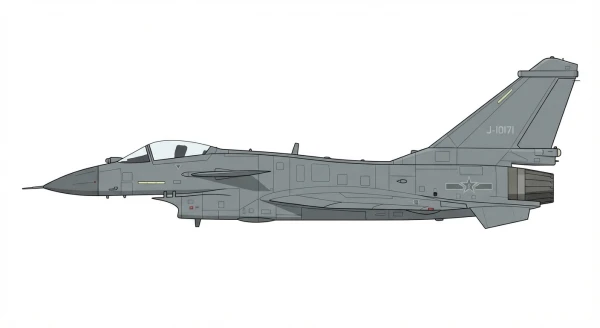
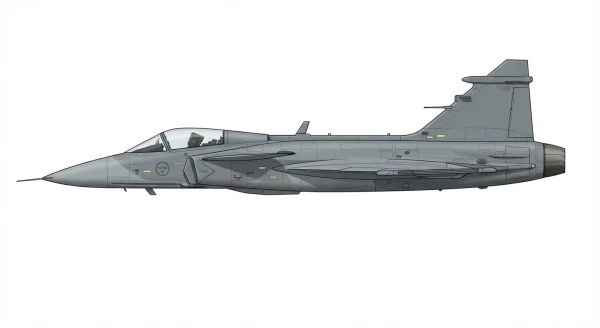
| J-10 Vigorous Dragon | JAS 39 Gripen | |
|---|---|---|
| Origin country | 🇨🇳 China | 🇸🇪 Sweden |
| Category | Combat Aircraft | Combat Aircraft |
| Manufacturer | Chengdu | Saab |
| First flight | 23 March 1998 | 9 December 1988 |
| Year introduced | 2005 | 1996 |
| Number produced | 602 units | 300 units |
| Average unit price | $35 million | $30 million |
| Wing area | 39.0 m² | 30.0 m² |
| Wingspan | 9.7 m | 8.4 m |
| Height | 4.8 m | 4.5 m |
| Length | 15.5 m | 14.9 m |
| Maximum speed | 2400 km/h | 2100 km/h |
| Operational range | 2,950 km | 4,000 km |
| Service ceiling | 18,000 m | 15,240 m |
| Max. takeoff weight | 19,278 kg | 14,000 kg |
| Empty weight | 9,750 kg | 6,800 kg |
| Total thrust | 1 x 12,500 kgf | 1 x 8,209 kgf |
Detailed Comparison
The Chengdu J-10 and Saab JAS 39 Gripen are single-engine, canard-delta fighters built for fundamentally different strategic doctrines. The J-10 provides mass and medium-weight multirole capacity for the People's Liberation Army Air Force (PLAAF), prioritizing domestic supply chains and regional projection. The Gripen is a lightweight platform optimized for dispersed operations, software modularity, and high exportability within Western-aligned markets.
Development and Design
China spent two decades developing the J-10 to close the gap with fourth-generation Western fighters, utilizing aerodynamic data from the canceled Israeli Lavi program. Early production blocks required Russian AL-31FN turbofans, but the program transitioned to the domestic WS-10 engine to sever foreign dependencies. The airframe evolved incrementally, culminating in the J-10C, which incorporates an AESA radar and diverterless supersonic inlets (DSI).
Sweden designed the Gripen around its Cold War Bas 90 doctrine, which required operations from 800-meter road strips by conscript ground crews. This dictated a strict requirement for a 10-minute turnaround time. While the JAS 39A/C relied on the Volvo RM12, Saab redesigned the platform in the 2010s. The resulting Gripen E expands the airframe to house a General Electric F414G engine, 40% more internal fuel, and a Raven ES-05 AESA radar.
Specifications and Performances
The J-10 operates in a heavier weight class. Its 19,278 kg maximum takeoff weight (MTOW) and 7,670 kgf thrust engine exceed the legacy Gripen C’s 14,000 kg MTOW and 5,507 kgf RM12.
- The J-10 dictates an 1,850 km range, aligning with PLAAF requirements to patrol the South China Sea and Taiwan Strait.
- The Gripen C limits range to 805 km, reflecting Sweden's localized defense posture, though the E-model increases this metric.
The Gripen maintains an advantage in operating economics. At $4,700 per flight hour, it operates at lower margins than heavier fighters. Saab also uses open software architecture, allowing client states to integrate third-party weapons without manufacturer intervention.
Deployment and usage
The J-10 forms the numerical backbone of China's fighter fleet with over 600 units built. It executes daily air sovereignty patrols but lacks combat testing. Geopolitics restrict its exports; Pakistan remains the sole foreign operator.
The Gripen possesses an active operational record. Swedish Gripens flew 2,000 hours of reconnaissance over Libya in 2011, and Thai Gripens executed air-to-ground strikes during the 2025 border conflict with Cambodia. Backed by technology transfer policies and NATO-standard weapon compatibility (AMRAAM, Meteor), the Gripen has systematically captured the mid-tier export market, securing contracts in Brazil, Colombia, Peru, and Ukraine.
Conclusion
The Gripen is the superior fighter for air forces operating under tight budgets or relying on austere basing. Its sensor fusion, open-architecture weapons integration, and low operating costs allow smaller nations to sustain high sortie rates without degrading procurement budgets. The J-10 holds the edge in regional high-intensity conflicts where absolute payload, unrefueled range, and mass scale dictate the air campaign. Constrained by its closed architecture, the J-10 functions strictly as a tool of Chinese power projection rather than a globally competitive multirole platform.