J-20 Mighty Dragon vs Shenyang J-35
J-20 Mighty Dragon vs Shenyang J-35 at a glance — top speed 2,130 vs 1,905 km/h, range 5,500 vs 3,500 km, max takeoff weight 37,000 vs 28,000 kg, built 300 vs 57 units.
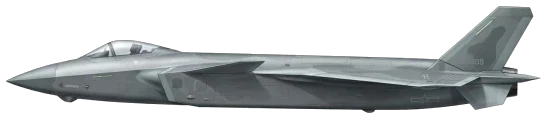
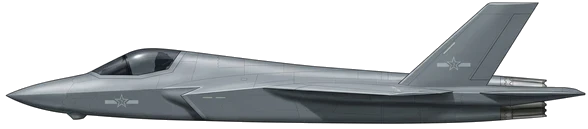
| J-20 Mighty Dragon | Shenyang J-35 | |
|---|---|---|
| Origin country | 🇨🇳 China | 🇨🇳 China |
| Category | Combat Aircraft | Combat Aircraft |
| Manufacturer | Chengdu | Shenyang |
| First flight | 11 January 2011 | 29 October 2021 |
| Year introduced | 2017 | 2025 |
| Number produced | 300 units | 57 units |
| Average unit price | $110 million | $60 million |
| Wing area | 73.0 m² | -- m² |
| Wingspan | 13.0 m | 11.5 m |
| Height | 4.7 m | 4.8 m |
| Length | 21.2 m | 17.3 m |
| Maximum speed | 2130 km/h | 1905 km/h |
| Operational range | 5,500 km | 3,500 km |
| Service ceiling | 20,000 m | 16,000 m |
| Max. takeoff weight | 37,000 kg | 28,000 kg |
| Empty weight | 17,000 kg | -- kg |
| Total thrust | 2 x 14,480 kgf | 2 x 8,892 kgf |
Detailed Comparison
The Chengdu J-20 operates as China's heavy, long-range air superiority platform designed to pierce anti-access/area denial (A2/AD) networks, whereas the Shenyang J-35 functions as a medium-weight, multirole fighter optimized for carrier operations and export. The J-20 is a mass-produced asset (over 300 units) tailored to Pacific distances. The J-35 (57 units built), evolving from the privately funded FC-31 prototype, entered service in 2025 to fill the People's Liberation Army Navy's (PLAN) requirement for a fifth-generation catapult-launched carrier fighter.
Development and Design
Chengdu designed the J-20 with an unstable canard-delta configuration to maintain high-alpha pitch authority and supersonic agility. Early iterations relied on Russian AL-31 and interim WS-10 engines, but current production integrates the domestic WS-15 to enable supercruise. Its large airframe accommodates a massive internal fuel load and deep weapon bays sized for PL-15 and PL-21 very-long-range air-to-air missiles. Shenyang’s J-35 utilizes a conventional blended-wing-body layout. Initially limited by the 93.2 kN WS-21 interim engine, it requires the in-development WS-19 (110–116 kN thrust) to achieve its intended kinematic performance. While the J-20 is strictly land-based, the naval J-35 integrates a catapult launch bar, folding wings, and a recovery tailhook. Shenyang also produces a land-based variant (J-35A) and an export model (J-35AE).
Specifications and Performances
The physical dimensions and kinematics of these aircraft dictate their distinct tactical utility:
- The J-20 achieves speeds of 2,130 km/h and utilizes its 37,000 kg maximum takeoff weight (MTOW) to sustain a 5,500 km range, allowing it to operate far beyond the First Island Chain without tanker support.
- The J-35 is restricted to speeds of 1,905 km/h, a 28,000 kg MTOW, and a 1,250 km combat radius, keeping it tethered closer to carrier strike groups or forward air bases.
The J-20 carries up to 11,000 kg of ordnance, exceeding the J-35's 8,000 kg limit. Both aircraft rely on active electronically scanned array (AESA) radars and electro-optical targeting systems (EOTS). However, the J-20's larger nose cone houses an array estimated at 2,000–2,200 transmit/receive modules, granting it an inherent advantage in radar detection range and electronic warfare output.
Deployment and usage
The PLAAF integrated the J-20 into combat units in 2018. It regularly executes maritime patrols in the East and South China Seas. In 2022, United States Pacific Air Forces confirmed interactions between USAF F-35s and J-20s, citing professional execution and mature command and control integration. The J-35 currently lacks combat operational history. Carrier certification flights occurred in late 2025 aboard the Fujian using electromagnetic catapults. Unlike the closely guarded J-20, the J-35 is actively exported, with Pakistan securing an order in June 2025.
Conclusion
The J-20 definitively outclasses the J-35 in long-range interception and air superiority within the Indo-Pacific. Its 2,000 km range advantage and heavier payload capacity make it the only Chinese stealth fighter capable of independently hunting AWACS and aerial refueling tankers deep over the Pacific. Conversely, the J-35 is the superior asset for naval force projection. Its reinforced landing gear, folding wings, and optimized footprint make it the sole fifth-generation option for PLAN carrier strike groups. For land-based operations, the J-20 will remain the primary heavy penetrating fighter, while the J-35A will serve strictly as a lower-cost, medium-weight complement to build PLAAF inventory mass.
